
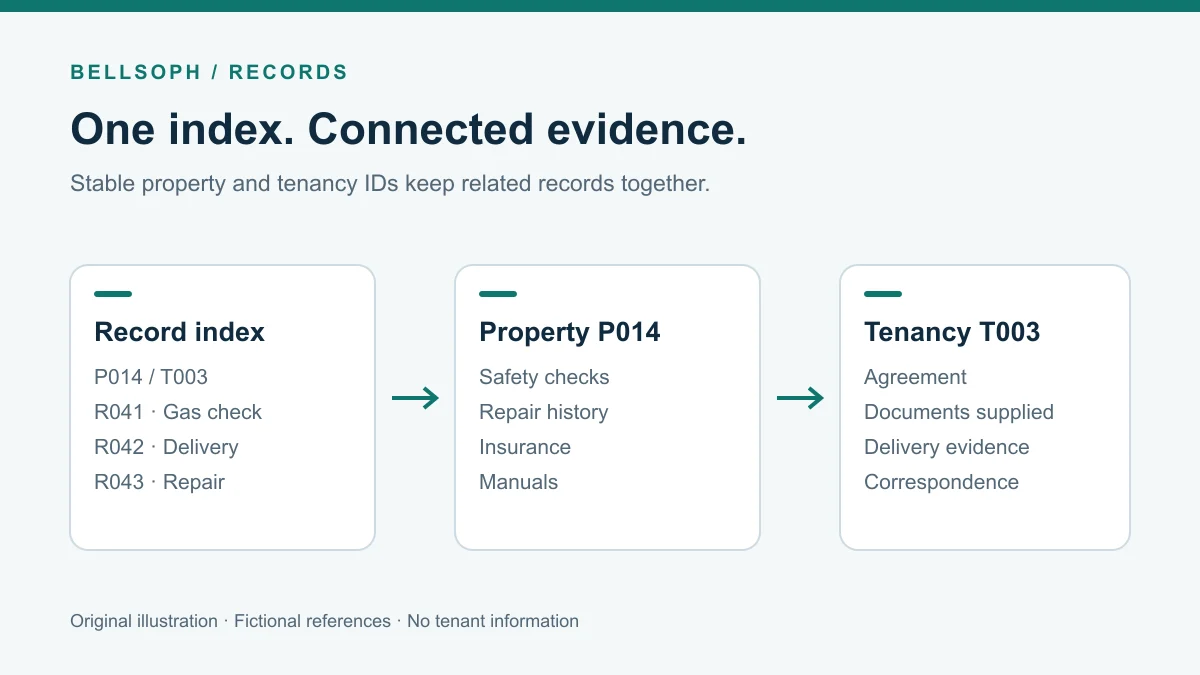
Keep one record index linking each property and tenancy to its documents, versions, delivery evidence and next action. Give every missing file an owner. Set retention reviews by record type and purpose: there is no single period that safely covers every landlord document.
This landlord record keeping checklist is a practical organisation method for UK landlords and property managers. The gas-safety example is for England, and the tax references concern UK Income Tax. Official guidance was checked on 12 September 2026. Requirements differ by nation, tenancy and record; use the relevant authority or qualified adviser for your circumstances. The register helps organise evidence and does not certify compliance.
Copy the property and tenancy record checklist
Start with one property and its current tenancy. Locate the documents you already hold, open them, and record gaps before moving to the next home. A file called “certificate.pdf” is not useful evidence until you have checked what it contains and which property it concerns.
Property-level records
Use a permanent property ID, such as P014, even if an address label changes. Keep the following groups where applicable:
- property identity, ownership or management authority and agent instructions;
- safety check records, inspection reports, related remedial work and the source of each review date;
- insurance, warranties, manuals and contractor details relevant to the property;
- repair reports, photographs, quotations, approvals, invoices and completion notes;
- property-level financial evidence linked to the appropriate accounting entry.
This is an organisational checklist, not a claim that every listed document is legally required for every home. Use the Property Law and Regulations hub to find the relevant specialist guidance. Keep the obligation and its evidence linked, but assess them separately.
Tenancy-level records
Give each tenancy its own reference, for example T003. Group the agreement and later changes, relevant deposit records, check-in or check-out evidence, documents supplied to occupants, and significant correspondence. Keep any identity evidence in a restricted location, with a reference in the index rather than copies scattered through shared folders.
Do not move an outgoing tenancy's documents into the incoming tenancy's folder. A property may be the same while the people, agreement and delivery obligations differ. Mark the earlier tenancy closed and assign its records a retention review.
For England tenancy checks, use the Right to Rent evidence checklist to connect the checking route, actual check date, prescribed result and any follow-up. Keep identity evidence in a restricted file rather than duplicating it across general registers.
Portfolio-level index
The master index should locate the records across properties. It need not contain the documents themselves. The wider portfolio record system can connect it with rent, tasks and expenses.
A simple folder map might look like this:
| Folder | Contents |
|---|---|
| Portfolio / Record index | Links to each property and tenancy |
| Portfolio / Shared supplier invoices | One source for costs affecting several homes |
| P014 / Property records / Safety checks | Issued records and related follow-up |
| P014 / Property records / Repairs | Issue history and completion evidence |
| P014 / Property records / Insurance and manuals | Property-level reference documents |
| P014 / T003 / Agreement and changes | Documents for this tenancy |
| P014 / T003 / Documents supplied | The exact versions supplied |
| P014 / T003 / Delivery evidence | Linked sending records |
| P014 / T003 / Condition and correspondence | Tenancy-specific observations and communications |
Treat folder names as navigation. Access permissions still need to be set in the storage system. A folder labelled “restricted” does not restrict anyone by itself.
Build a register that someone else can use
Copy these fields into your preferred record system. The field list is deliberately fuller than a folder inventory: it records what remains to be done as well as what exists.
| Field group | Columns to keep | Example or instruction |
|---|---|---|
| Identity | Record ID, property ID, tenancy ID where relevant | R041, P014, T003 |
| Document | Record type, document date, version, current or superseded | Gas check, 01/09/2026, v1, current |
| Location | Evidence link or controlled file reference | Link to the actual checked file |
| Delivery | Recipient, sent date, method, delivery reference, acknowledgement if available | Record facts; leave unknowns explicit |
| Retention | Purpose, source of rule, trigger, review date | Record the applicable basis, not a guessed year count |
| Responsibility | Owner, next action, target date | Manager requests missing evidence |
| Verification | Checked by, checked date, unresolved issue | Note unreadable pages or mismatched addresses |
Use one row per identifiable record. Link a delivery receipt to the document version it accompanied. For a document covering several tenancies, keep one controlled source file and a separate delivery entry for each relevant recipient or tenancy.
Here is a completed fictional working example. The dates in the final column are administrative follow-up dates, not legal deadlines or disposal dates.
| Record | Property / tenancy | Document and status | Evidence reference | Owner and next action |
|---|---|---|---|---|
| R041 | P014 / T003 | Gas check, 01/09/2026, v1, current | GAS-2026-09-01-v1.pdf | Manager checks linked delivery record on 14/09/2026 |
| R042 | P014 / T003 | Email delivery entry, 02/09/2026, acknowledgement absent | SEND-R041-2026-09-02.eml | Manager confirms accessible copy and records response on 14/09/2026 |
| R043 | P014 / property | Repair completion note, 03/09/2026, current | REPAIR-M018-COMPLETE.pdf | Manager reconciles with issue M018 on 15/09/2026 |
For R041, the separate retention fields would identify the applicable gas-record rule and its trigger. R042 and R043 need their own purpose and retention assessment. Do not inherit R041's period just because the rows are linked.
Before entering a whole portfolio, ask a colleague to use these three rows to find the files. If they need you to explain a private abbreviation or supply a missing password, improve the system while the sample is still small.
Name files and preserve versions
Use a predictable pattern, for example P014-T003-GAS-2026-09-01-v1.pdf. The date format sorts chronologically, and the identifiers connect the document to the index. Keep tenant names, birth dates and identity-document numbers out of filenames that might appear in broad search results or email subjects.
Separate document dates from upload dates
Record the date shown on the document separately from when you received or uploaded it. Scanning an older certificate today does not create a new check date. If the date is unreadable, mark it unresolved and request a legible copy rather than filling the gap from memory.
Open every page when accepting a file. Check the address, relevant period, page count, legibility and any referenced attachment. An upload succeeding only tells you that a file transferred.
Distinguish current from superseded
If an issuer supplies a correction, retain a clear relationship between v1 and v2. Identify the corrected version as current and record why the earlier version was superseded. Avoid filenames such as “final-final-new”, which tell the next person nothing about the sequence.
Preserving versions does not mean keeping everything forever. Apply the relevant retention decision to older versions too. Do not edit an issued certificate yourself to make its address or date fit; raise the discrepancy with the issuer. For an unsatisfactory EICR, record remedial-work confirmation alongside the original report and document-delivery evidence.
Record delivery and follow-up separately
A document being present does not establish that it was supplied to the right person. Keep the recipient, document version, date, method and evidence of sending together. Distinguish sent, delivery evidence available and acknowledged. These are different facts.
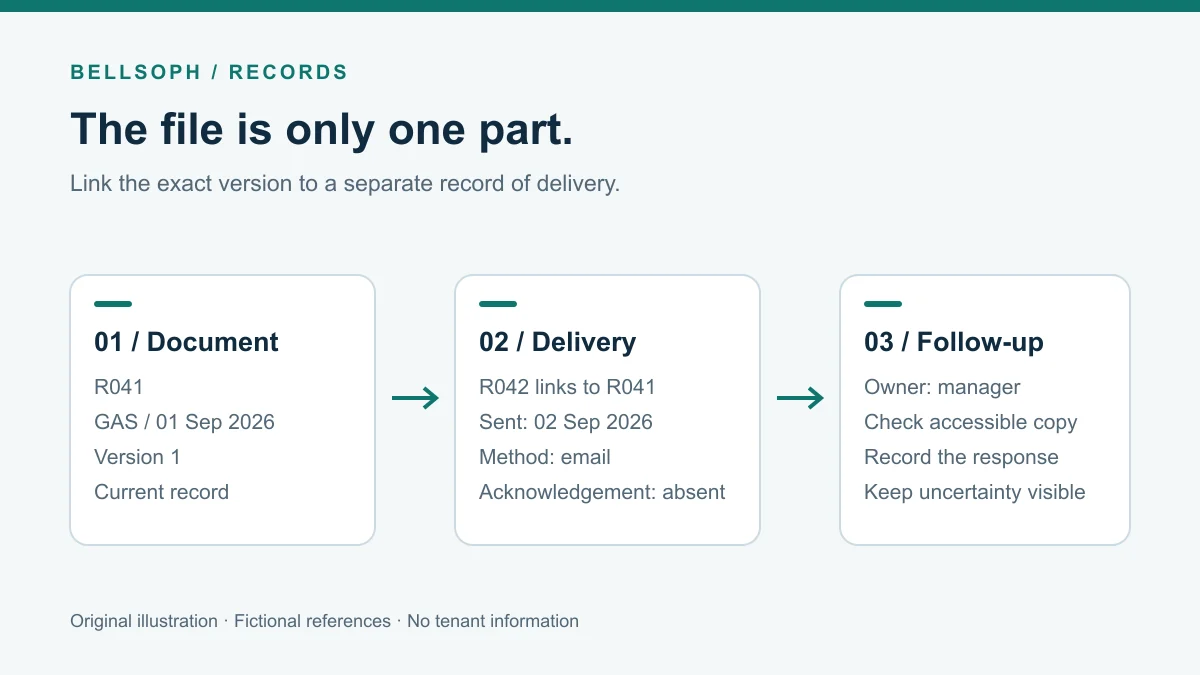
A document and evidence of delivery answer different questions. Fictional record references.
For an England gas-safety example, HSE's landlord guidance says existing tenants must receive a copy within 28 days of the check, and new tenants before moving in. It also sets conditions for electronic records and electronic supply. Check those conditions rather than assuming an email attachment always suffices.
The index is not a substitute for checking the applicable service requirements. An acknowledgement can be useful evidence, but its absence should not be silently converted into “not sent” or “served correctly”. Record what is known and seek advice where the legal position matters.
Keep a missing-evidence queue
When a file is absent, unreadable or inconsistent, create a specific task: “Request complete R041 from issuer”, for example. Add an owner and a follow-up date. Link the task to the record so another manager can see why it remains open.
On receipt, check the replacement and close only the resolved gap. A new file may solve the readability problem while leaving delivery evidence outstanding. Never fabricate a receipt, recreate a signature or backdate a sending entry to make a row look complete.
Decide retention by record type
The ICO's storage-limitation guidance explains that UK GDPR does not prescribe one duration for all personal data. Retention needs a justified purpose, relevant legal requirements and review. The ICO currently marks this guidance as under review following the Data (Use and Access) Act.
Use this decision table when building the retention fields:
| Record type | Basis to check | Review decision |
|---|---|---|
| Landlord gas safety check record, England example | HSE specifies keeping the check record for two years | Record the check date and applicable rule; assess any separate reason for further retention |
| Rental-income and expense evidence | Applicable HMRC record-keeping rules for the taxpayer and return | Confirm the required period and trigger with HMRC or the accountant |
| Tenancy correspondence and delivery evidence | Purpose, relevant obligations and any actual dispute or claim | Set a justified review; keep only what remains necessary |
| Duplicate or superseded personal-data copies | Whether that copy has a continuing purpose | Remove unnecessary copies through the controlled disposal process |
The HMRC rental-income records page identifies receipts, invoices, bank statements and rental records to keep. It does not establish one retention period for every item in this register. Do not borrow an employee's or company's rule without checking that it applies to the rental business concerned.
For the transaction account behind those documents, use the rent reconciliation template to keep charges, receipts and credits traceable to their evidence.
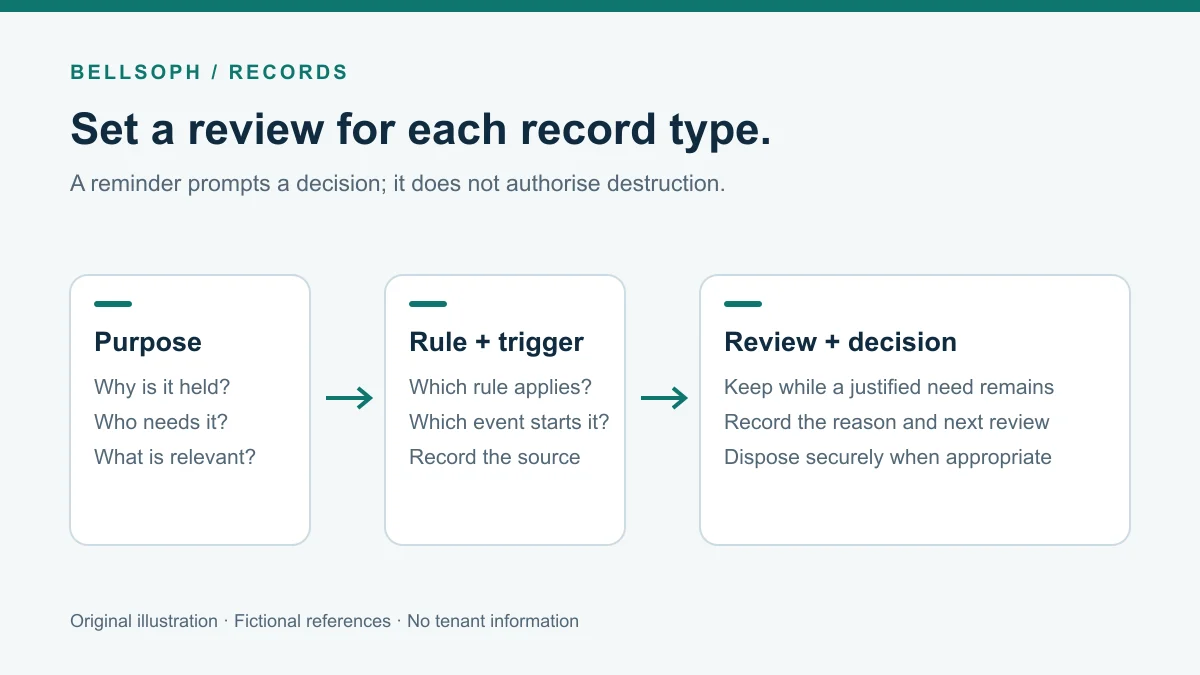
Review each record type on its own basis. A review reminder is not an automatic destruction instruction.
Separate next operational review, retention review and disposal authorised. A September reminder might ask whether evidence arrived, while the retention review happens much later. When a justified retention need ends, follow your disposal process, including relevant backups. Moving personal data offline is still retention.
Keep a concise disposal decision record: category, scope, decision date and responsible person. Avoid retaining the very sensitive contents you intended to dispose of inside that log.
Retrieve a three-document evidence pack
Imagine an authorised manager asks for the current gas check, its delivery evidence and a related repair history for fictional P014/T003. The purpose is to understand the records, not to assert that the pack proves every legal duty was met.
- Filter the index by P014 and confirm T003 is the relevant tenancy.
- Open R041 and check its date, version and property against the request.
- Follow its link to R042. Read the actual sending record and identify what it establishes, including any uncertainty about receipt.
- Open R043 and follow its repair reference M018. Check the completion note against the issue history; use the maintenance checklist and log to organise that separate workflow.
- Prepare a short contents list showing each filename, date and relationship. Note missing or contradictory evidence explicitly.
- Confirm the recipient is authorised, share only the necessary material through an appropriate channel, and record the handoff.
Check exported files before sending them. A working link in your own account may be inaccessible to the recipient, while a public link may expose too much. Keep the original records in their controlled location and clearly label any redacted working copies.
Repeat the exercise with a different property each month. Measure success by whether someone can retrieve and understand the requested evidence without guessing, rather than by the number of uploaded files.
Run a monthly records review
Use a short, repeatable review alongside your normal property-management routine:
- open a sample of evidence links and confirm they still resolve;
- review missing files, unreadable documents and unanswered requests;
- compare current tenancy references with the index;
- check that corrections did not break version or delivery links;
- review who can access shared folders, including former staff or agents;
- test a restore from a dated backup in a controlled location;
- check retention reviews due and record the resulting decisions.
Give each finding an owner and next step. Keep the review note concise enough to use next month. If you change storage providers, test links and exports on a small batch before migrating the rest.
A shared system can help when several people maintain the same index. Explore keeping property records and follow-up tasks together with Bellsoph, and test your actual filing and retrieval needs before moving records. A software reminder does not replace the underlying document or your judgement about it.
Questions about landlord records
Do scanned copies suffice?
It depends on the record and purpose. HSE permits electronic gas-safety records subject to conditions including hard-copy reproduction, protection against loss or interference and identification of the operative. Its electronic-supply conditions also matter. Check requirements for other documents separately; do not destroy originals solely because a scan looks readable.
Does a receipt folder satisfy Making Tax Digital?
A folder alone does not create the required digital bookkeeping. For landlords within MTD for Income Tax, HMRC's digital-record guidance requires appropriate software records and continued supporting evidence. Use the landlord expenses spreadsheet guide for receipt reconciliation and the software boundary. This document index is not a tax-filing product or an eligibility assessment.
Where should a joint-property invoice live?
Keep one controlled invoice and link each relevant property or accounting entry to it. Record the allocation explanation separately so nobody books the full invoice twice. The expense guide covers the financial workflow; this register supplies the evidence location. The landlord costs calculator can support planning, but its estimates should remain separate from actual invoices.
How should I start when the files are scattered?
List the locations first, then organise one property's current records and unresolved gaps. Validate that sample before processing older material. Keep a migration note identifying what moved and what remains to be checked. Use the Property Hub for the linked operational guides as each part of the system becomes usable.
Use the England landlord compliance checklist to identify the applicable duty and next action, then connect that action to the evidence in this record index.
For an occupied-property visit, use the room-by-room inspection record to record observations and access limits, then file the linked repair evidence here.