
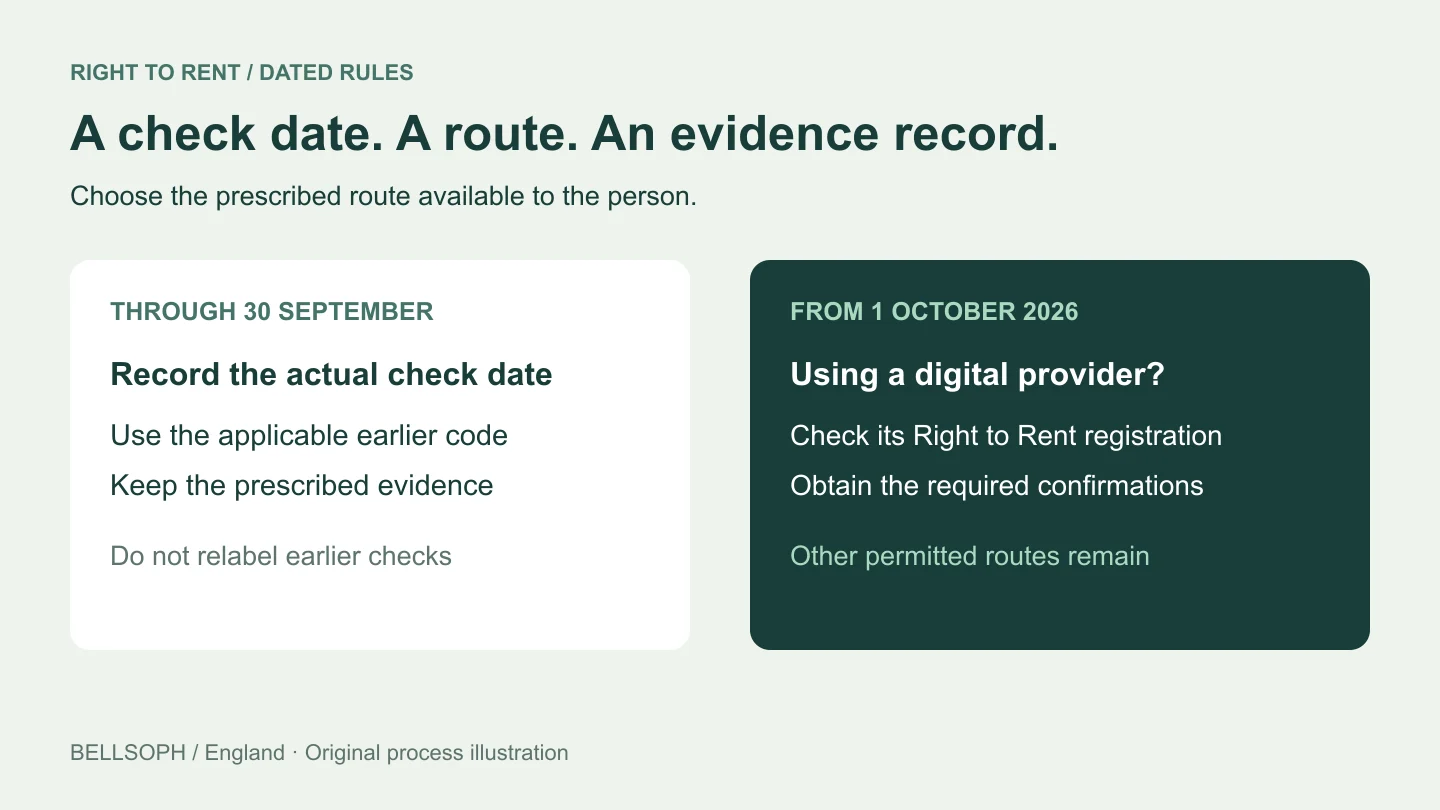
Right to Rent checks apply to residential letting in England. From 1 October 2026, landlords who choose digital verification must use a provider registered for Right to Rent, obtain the required confirmations, match the result to the prospective occupier and retain the prescribed evidence. Manual checks and the Home Office online service remain available where appropriate; every tenant does not have to use a commercial digital provider.
This guide separates the rules applying before October from the changes taking effect on 1 October, using official sources checked on 21 September 2026. It provides general information, not advice on an individual's immigration status or tenancy. The dated record below helps organise work; completing it does not itself establish a statutory excuse against a civil penalty.
What changes on 1 October 2026
The Home Office published the new code on 30 June. Regulations 1 and 4 of SI 2026/700 provide for commencement and the Right to Rent amendments on 1 October 2026. This is a scheduled change to prepare for, rather than a rule already in force on this page's September update date.
Section 1 of the October Home Office code applies it when an initial or repeat check is required on or after 1 October. It also explains that prescribed checks already carried out are assessed against the code in force when they were made. Keep the actual check date, the deadline and the source version separately. Do not assume that a later tenancy start date invalidates an otherwise correctly completed September check.
| Point to check | Before 1 October 2026 | From 1 October 2026 |
|---|---|---|
| Relevant code | Existing Home Office code and applicable landlord guidance | October code for relevant initial and follow-up checks |
| Digital provider | Existing IDSP rules; certification is recommended rather than mandatory under the pre-October code | Provider must be registered with the relevant Right to Rent note; obtain the prescribed service confirmations |
| British or Irish passport through the digital route | Valid passport, including a valid Irish passport card | Current, or expired by no more than six months; expired documents require passive authentication |
| Other digital documents | Follow the existing permitted evidence routes | Specified List A or B documents can qualify where supplied to the provider digitally by or on behalf of their issuer |
| Manual or Home Office online check | Available where the person can use the relevant prescribed route | Still available where appropriate; a commercial provider is not compulsory for every check |
The pre-October code's IDSP section explains the existing standard. Do not apply the new expired-passport digital concession early. Equally, do not carry an old statement that registration is optional into an October provider workflow.
Identify the adult occupiers and choose their route
Check prospective adult occupiers aged 18 or over who will use the property as their only or main home, including people not named on the agreement. Apply the process consistently, regardless of a person's name, accent or appearance. The scheme has exclusions: use the official code to check whether an arrangement falls within scope rather than treating every residential licence as identical.
A child turning 18 during an existing tenancy does not need an immediate check solely because of their birthday. Where follow-up checks are due for existing occupiers, include someone who has since become an adult, as explained in section 2 of the October code. When buying a tenanted property, obtain the previous check evidence and any follow-up dates; do not assume that a completed purchase establishes a fresh statutory excuse.
Manual documents
Where a manual check is permitted, obtain the acceptable evidence, check that it appears genuine and belongs to the holder, make the required clear copies in a format that cannot subsequently be altered and record the date. Use the applicable Home Office List A or List B, including the number and combination of documents required. A locally saved document list can become stale.
Follow the official presence and document-handling requirements. A video call does not turn an emailed photograph into an original document. Under the October code, where an authoritatively issued digital document is permitted, take reasonable steps to verify its validity and source. That does not mean any scan sent by an applicant becomes acceptable digital evidence.
Home Office online checks
Use the landlord's share-code service, with the occupier's Right to Rent share code and date of birth. Check the result yourself, match the photograph to the person and retain the dated response. Viewing an applicant's own account screen is not the landlord check.
The October code directs eVisa holders to the Home Office online route. British and Irish citizens cannot obtain a share code and must not be disadvantaged for that reason. A provider's identity result and a Home Office immigration-status result serve different purposes; do not substitute one for the other without meeting the prescribed route.
Landlord Checking Service
Use the Landlord Checking Service where official guidance directs it, such as relevant outstanding applications, appeals or cases where the Home Office must verify status. The October code also addresses applicable technical problems with the online service. Record the request reference, response and resulting follow-up requirement. An unanswered support ticket or a failed app scan is not a positive check result.
Check the digital provider, person and evidence separately
For October checks using a Right to Rent digital verification service provider, sometimes shortened to RtR DVSP, complete each of the following stages. Paying for a service does not by itself satisfy the landlord's checking duties.
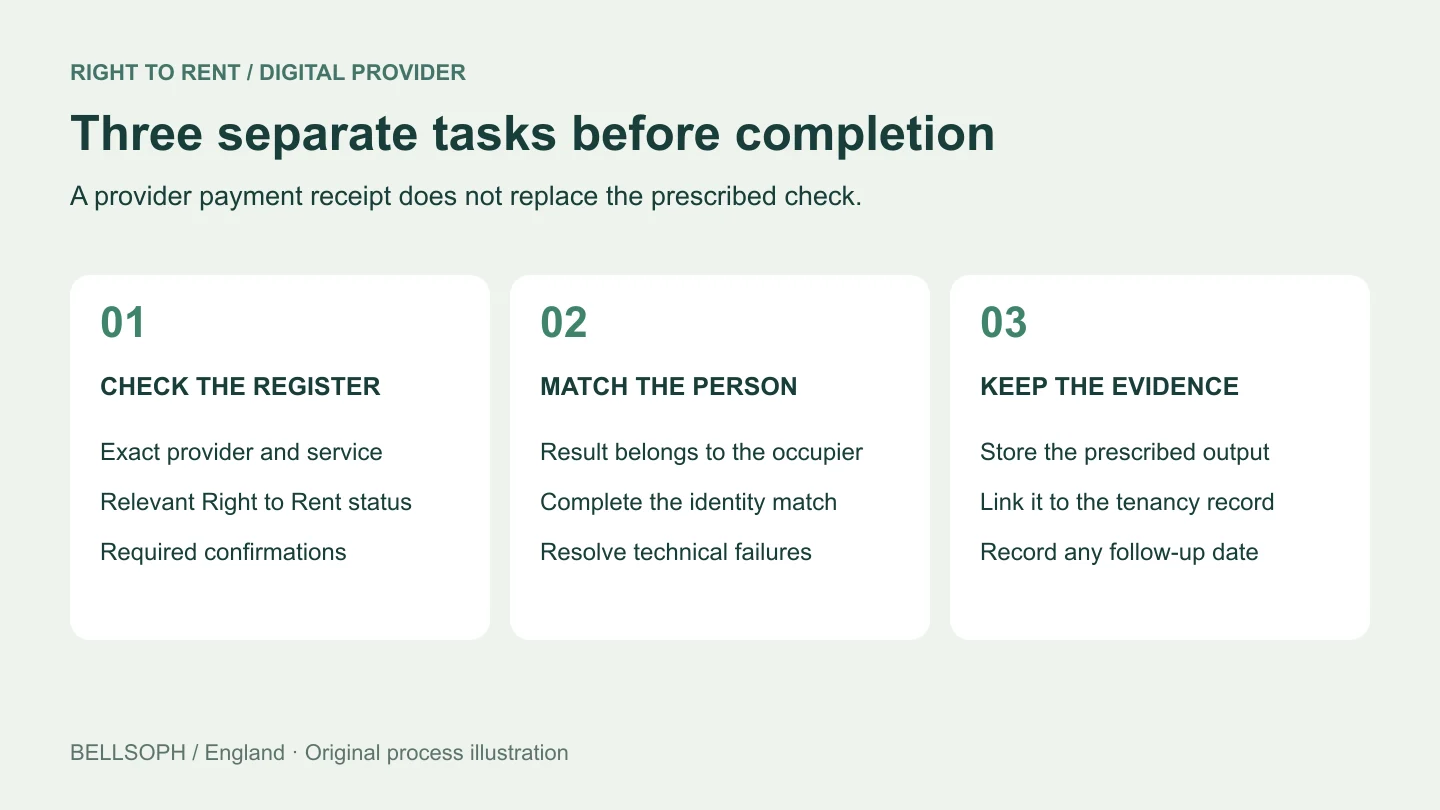
*Original process illustration. The provider result, person match and retained evidence are separate tasks.*
1. Verify the service's current registration
Start with the official register guidance and open the live digital verification services register. Find the provider and the actual service you intend to use. Check the relevant Right to Rent status, rather than relying on a supplier logo, a general identity certificate or a right-to-work listing.
Record the service reference and date checked. Obtain the provider's confirmation that it is registered with the relevant note and that the particular identity check is supplied in accordance with the Right to Rent supplementary code. These confirmations are specified in regulation 4; your own register screenshot is useful process evidence but does not replace them.
If the required status or confirmation cannot be established, resolve it with the provider or use another prescribed route available to that person. Do not mark the check complete while the evidence is missing. This guide does not endorse or certify any provider.
2. Match the result to the occupier
Satisfy yourself that the output's photograph and biographic details relate to the person presenting for the tenancy. The October code permits this comparison in person, by video call or through facial recognition supplied by an appropriate RtR DVSP.
If using digital facial recognition for a manual or Home Office online check, the October requirements also require the relevant registered provider. Where facial recognition is used, retain the prescribed images and provider confirmation in the required form. A failed technical match calls for a reasonable opportunity to establish identity through the permitted process, not an unsupported conclusion about immigration status.
3. Retain the complete output
Keep a clear copy of the check, the required provider confirmations and, where applicable, the facial-image comparison evidence. Link these to the adult occupier's restricted tenancy file and record when the person match was completed. The code requires check evidence to be kept throughout the tenancy and for one year afterwards; the legislation includes specific retention requirements for facial-image evidence.
Distinguish a provider's emailed receipt from the prescribed result. A payment receipt, “verified” badge or spreadsheet tick alone does not show which evidence was checked or that it relates to this occupier.
Which expired-passport rule applies?
The digital route from October can accept a British passport or Irish passport or passport card that is current or expired by no more than six months. Where an expired document is used through this route, the October code requires passive authentication, meaning verification of the document's chip and data. It is not permission to upload any old passport photograph to any identity app.
Manual List A has its own conditions for current or expired British and Irish passports and Irish passport cards. The six-month digital limit is not a blanket limit for those manual checks. Check the relevant list, the document and the holder together, using the route actually being completed.
The new code also allows specified digitally issued List A and List B documents through a registered provider where supplied by or on behalf of the issuer. Do not generalise this into acceptance of every electronic document. If a provider cannot complete the proposed route, establish which alternative is available before deciding the application has failed.
Copy a dated Right to Rent check record
Use one record per adult occupier. Keep identity documents and sensitive results in a restricted evidence location, with the operational register pointing to it. The following fields are an organisational aid, not an official Home Office form or a guarantee of compliance.
| Record field | What to enter |
|---|---|
| Property, tenancy and adult reference | Internal references linking this check to the correct letting and person |
| Check required by / actual check date | Separate dates; never replace the actual date with the file-upload date |
| Route and applicable source | Manual, Home Office online, digital provider or LCS; code/version used |
| Provider and register check | Where relevant, exact service, register reference/status and lookup date |
| Result and required confirmations | Restricted file reference for the check output and provider or Home Office confirmation |
| Person match | How and when identity was matched; reference to required comparison evidence |
| Statutory-excuse timing | Continuous or time-limited outcome, with the official basis for any follow-up date |
| Unresolved action | What is missing, who will resolve it and by when |
| Evidence access and retention | Restricted location, responsible person and disposal review linked to tenancy end |
For file naming, version control and retrieval, use the landlord record-keeping guide. Avoid copying passport numbers or complete check outputs into a general maintenance or rent-payment spreadsheet. A colleague needs to find the authorised evidence without gaining unnecessary access to every identity document.
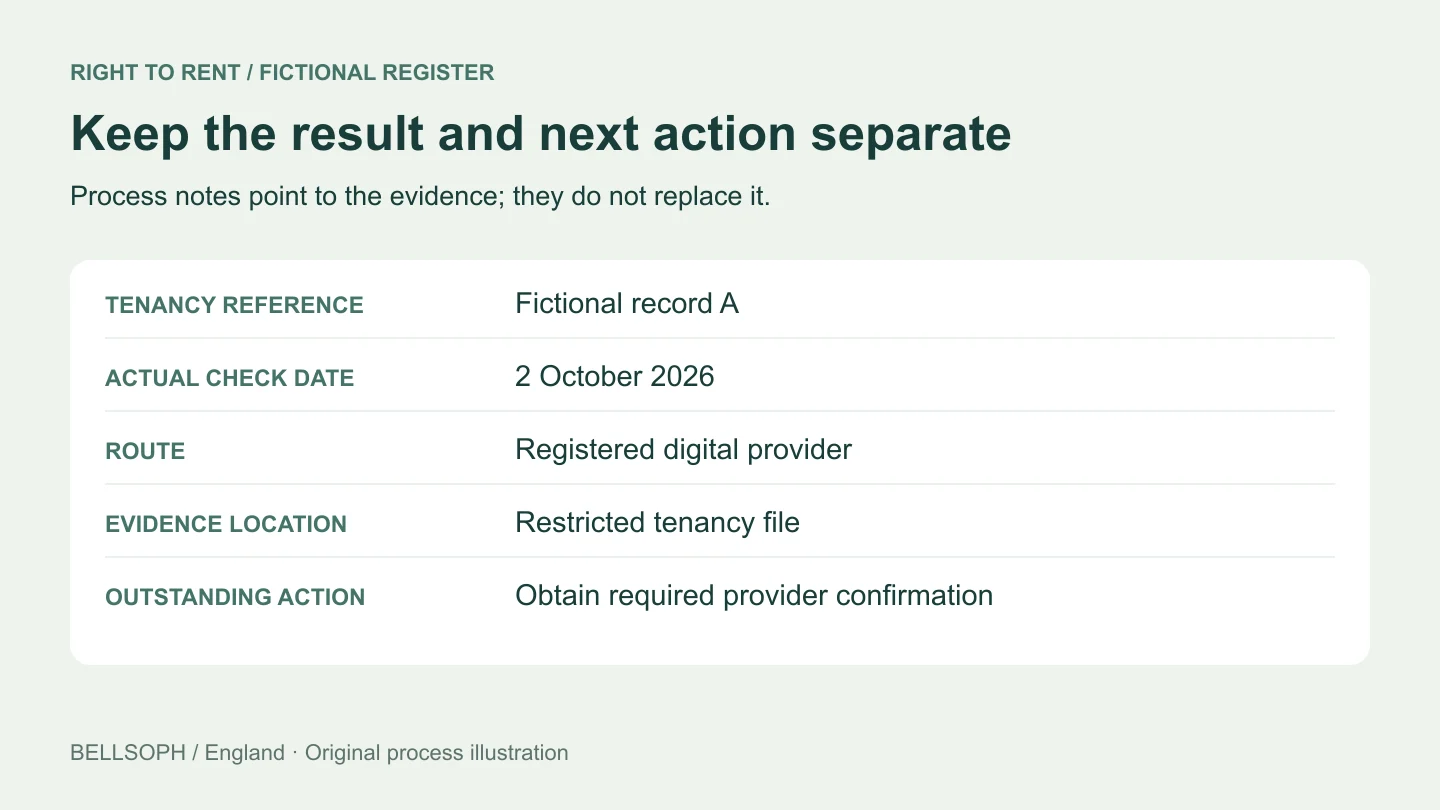
*Fictional record layout without personal identifiers. An outstanding action remains visible until its evidence is obtained.*
Two transition examples
Check completed on 30 September. A fictional agent carries out a permitted manual check on 30 September for a tenancy beginning on 2 October. They record the actual date, retain the prescribed evidence and meet the applicable initial-check timing. The October code says earlier prescribed checks are assessed against the code in force when made. The start date alone is not a reason to relabel the check as an October digital check or repeat it automatically.
Digital check required on 2 October. A fictional landlord plans to use a provider on 2 October. A certificate saved in September is not enough to establish the required current registration. The landlord checks the register entry, obtains the relevant confirmations, matches the result to the occupier and stores the complete evidence. If the proposed passport has been expired for more than six months, they do not use the new digital concession; they consider whether a prescribed manual route is available.
If an applicant cannot or does not wish to use the commercial digital route, explain the permitted alternatives fairly. The October anti-discrimination code says people must not receive less favourable treatment because a different checking route is required. Where possible, subject to business requirements, allow a reasonable period to produce evidence.
Initial deadlines, follow-ups and missing results
An unlimited-right check can be completed before the residential agreement is entered into. For time-limited rights, the initial check must be made and recorded no earlier than 28 calendar days before the tenancy starts. The code describes limited overseas-applicant circumstances where checking before occupation is permitted. Do not turn that exception into a general practice of checking after every tenancy has started.
For a time-limited statutory excuse, section 5 of the October code describes the expiry as the latest of 12 months after the check, expiry of permission and expiry of the document evidencing the right. Complete the follow-up before that excuse expires, applying the current route and evidence requirements. The GOV.UK follow-up page is a useful starting point; keep the basis for the actual date rather than assigning everybody an annual check.
If a follow-up shows no continuing right or the occupier does not cooperate, follow the current Home Office reporting instructions promptly, before the time-limited excuse expires, and retain the report reference. A later report cannot establish an initial excuse where the required initial check was never performed. Seek appropriate help for an unresolved individual case; a record template cannot determine a person's status.
Where an agent accepts responsibility, document in writing which initial checks, follow-ups and reports it undertakes. Section 4 explains when civil-penalty liability transfers to an agent. This written agency arrangement is distinct from simply purchasing an identity check from a digital supplier.
Keep records secure and make the next action visible
Use the Home Office evidence period for Right to Rent material and review disposal when the tenancy ends. The ICO storage-limitation guidance explains why personal information should not be retained indefinitely just because storage is available. Limit access, document the retention purpose and arrange secure disposal; do not invent one retention period for every landlord document.
Place checks alongside other duties in the England landlord compliance checklist. To coordinate work across several rental properties, assign a person to each unresolved check and follow-up. Bellsoph's property-management workspace can help organise property records and tasks; the statutory checking decision and prescribed evidence still come from the appropriate checking process.
Questions about October Right to Rent checks
Must every check be digital from October?
No. The new registration requirement applies when a landlord chooses the relevant digital provider route or uses the specified digital identity technology. Manual checks and the Home Office online route remain available where appropriate to the person and evidence.
Does an old provider certificate prove current registration?
No. Check the live service entry and relevant Right to Rent status, and obtain the required provider confirmations for the check. Registration, the person's result and retained evidence are separate parts of the process.
Does an unsuccessful digital check prove someone cannot rent?
No. A technical failure does not itself determine immigration status. Give the person a reasonable opportunity to verify identity and use the authorised alternative or Home Office checking route where applicable.
Should all existing tenants be rechecked on 1 October?
The code change is not a universal recheck date. Identify genuine follow-up obligations and apply the code relevant to those checks. Keep valid earlier evidence with its original date; do not rewrite historical records as if the new provider performed them.
Sources
- Home Office: Right to Rent code from 1 October 2026 · Accessed 21 Sept 2026
- Home Office: code applying before October 2026 · Accessed 21 Sept 2026
- SI 2026/700: Right to Rent amendments · Accessed 21 Sept 2026
- Home Office: avoiding discrimination from October 2026 · Accessed 21 Sept 2026
- OfDIA: find registered verification services · Accessed 21 Sept 2026
- OfDIA: live digital verification services register · Accessed 21 Sept 2026
- GOV.UK: landlord share-code checking service · Accessed 21 Sept 2026
- GOV.UK: follow-up checks · Accessed 21 Sept 2026
- ICO: storage limitation · Accessed 21 Sept 2026