
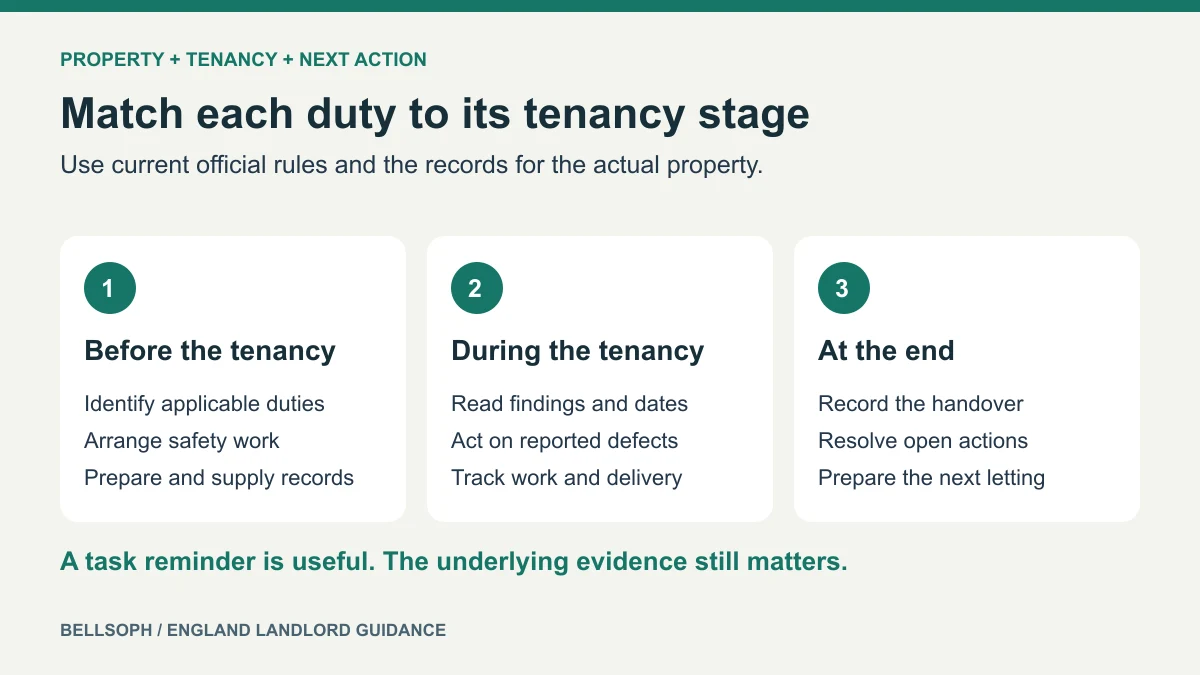
Build your landlord compliance checklist around the property, tenancy stage, applicable duty and next action. Check the safety records and tenancy documents, then keep separate evidence of any required delivery to tenants. A calendar reminder tells you when to act; it does not prove that a check happened or a document was supplied.
For a 2026 landlord compliance checklist covering UK properties, start with each property's nation. This guide covers private rented homes in England, using official guidance checked on 13 September 2026. Scotland, Wales and Northern Ireland have different frameworks. The table is a starting point for identifying duties, not a certificate that a particular letting complies with every rule.
England landlord checklist at a glance
Use one row for each applicable duty. The dates below describe different triggers: do not turn them into a single annual renewal schedule. Read the linked official guidance for scope and exceptions.
| Check | Timing or trigger | Evidence to connect |
|---|---|---|
| Gas safety, where applicable | Annual check of landlord-provided appliances and flues | Issued record, follow-up work and tenant supply evidence |
| Electrical installation | At least every five years; use any earlier date in the report | Inspection report, required remedial confirmation and supplied copies |
| EPC and energy standard | Check before marketing or letting; EPC normally valid for ten years | Certificate, rating and applicable exemption evidence |
| Smoke and carbon monoxide alarms | Required provision; new-tenancy day test and reported faults | Alarm locations, dated test and repair record |
| Tenancy deposit | Protection and required information within 30 days of receipt, where applicable | Scheme confirmation, information supplied and delivery evidence |
| Right to Rent | Before a new tenancy; follow-up where required | Authorised check result, check date and follow-up basis |
| Written tenancy information | Depends on when and how the tenancy was agreed | Correct information, version, recipients and supply evidence |
| Licensing and property condition | Check local requirements and respond to hazards or changes | Council decision, licence conditions and tracked actions |
GOV.UK's landlord responsibilities also cover safe homes, equipment and fire duties. Flats, HMOs and unusual tenancy arrangements may need additional checks. Use the Property Law and Regulations hub to reach the detailed guides rather than treating this table as exhaustive.
Work through the tenancy stages
Before advertising and agreeing a letting
Confirm the address, local authority, occupancy and tenancy type. Check EPC requirements early and establish whether the council requires a licence. The official HMO licensing page directs landlords to their council, including where a smaller HMO may need a licence. Record the actual decision and conditions for that address.
Prepare the safety work, Right to Rent process and relevant tenancy information before their respective deadlines. Give the agent or manager a named task owner for each item. “The agent handles it” leaves an avoidable gap if nobody knows who checks the returned evidence.
Before occupation and on the first day
Check that required reports are complete, match the property and have been supplied when required. Record the first-day alarm test separately from an earlier contractor visit. Keep the move-in record linked to this tenancy, even if the same safety document also covers another tenancy at the property.
During and at the end of the tenancy
Monitor report dates, unresolved work, document delivery and changes that could affect the applicable duties. Route reported defects into the rental property maintenance checklist and log. An urgent safety issue must not wait for a monthly paperwork review.
At the end, record the handover, outstanding repairs and deposit outcome. Official deposit guidance requires return within ten days of agreement on the amount. Close the tenancy's tasks only when their own actions are complete, and assess the next letting afresh. A previous tenant's delivery record cannot establish supply to a new tenant.
Read the safety documents, not just their dates
Gas checks and maintenance
HSE's landlord guidance requires a Gas Safe registered engineer for the applicable annual checks. Keep the check record for two years; supply it to existing tenants within 28 days and new tenants before they move in. Electronic supply has conditions, including tenant agreement and ability to access it.
A gas service and a safety check are different activities. Read any defects and connect the follow-up work to the issued record. Keep access correspondence when appointments fail, and follow HSE guidance; a booking confirmation is not a completed check. The landlord gas safety guide provides the specialist context.
Electrical inspection and follow-up
The England electrical safety guidance requires a qualified person to inspect installations at least every five years. The report, usually an EICR, sets the next inspection date. Required remedial or investigative work must be completed within 28 days, or sooner where the report specifies it.
Existing tenants must receive the report within 28 days of inspection; new tenants before occupation. Keep the findings, next date and remedial confirmation visible as separate fields. Follow the official guidance for council copies and completion evidence, with the EICR remedial work and evidence as supporting reading.
EPC validity and minimum efficiency
GOV.UK's EPC guidance says to order the certificate before marketing and gives a ten-year validity period. Separately, the current minimum energy efficiency guidance generally requires in-scope private rented properties to reach E, unless a valid exemption is registered.
Keep the certificate's identity, rating and date alongside any applicable exemption and its conditions. A valid certificate does not by itself establish that the rating permits the letting. Use the rental property EPC guide for the wider topic, and recheck official guidance before relying on a future standard.
Smoke and carbon monoxide alarms
For homes covered by the England alarm rules, provide at least one smoke alarm on each storey containing living accommodation. A carbon monoxide alarm is required in a room used as living accommodation with a fixed combustion appliance, excluding gas cookers. Check scope and HMO licence conditions separately.
Ensure prescribed alarms work on the day a new tenancy begins, and repair or replace them once informed they are faulty. Record the location, test date, result and any follow-up. A photograph showing an alarm's presence does not demonstrate that it worked.
Keep tenancy checks and deposit evidence together
For an England assured periodic tenancy deposit, protection in an approved scheme and the required information for tenants have separate requirements within the same 30-day period from receipt. Keep the actual receipt date, scheme reference and information supplied together. Do not calculate the deadline from a later move-in date. The deposit protection guide covers the detailed process.
Right to Rent checks apply in England and cover adult tenants before a new tenancy, including adults not named on the agreement. Apply the process fairly to all relevant applicants. Use the correct checking route and identify whether a follow-up check is required; do not assign every person an arbitrary annual expiry. See the Right to Rent checks from October 2026.
Keep sensitive identity evidence in controlled storage. The working register can reference the evidence without reproducing passport details in a widely shared table.
Separate the 2026 changes from future registration
For relevant existing tenancies with written terms, the general 31 May 2026 Information Sheet deadline has passed. Check what was actually supplied. The official Information Sheet guidance requires the exact PDF, delivered on paper or as an electronic attachment; a bare link is insufficient. Managing agents also have a supply duty.
Some valid notices served before 1 May lead to a later one-month supply period when the notice ceases to be valid or proceedings finish without possession. Check that transitional guidance against the tenancy's facts. Record missing evidence honestly and address unresolved duties promptly; never backdate a record. Our Information Sheet guide explains the distinctions.
For new tenancies made after 1 May, written key-term information is required before signing or agreeing the tenancy. Existing entirely oral agreements also required this information by 31 May. An old agreement and a new tenancy therefore need different checks.
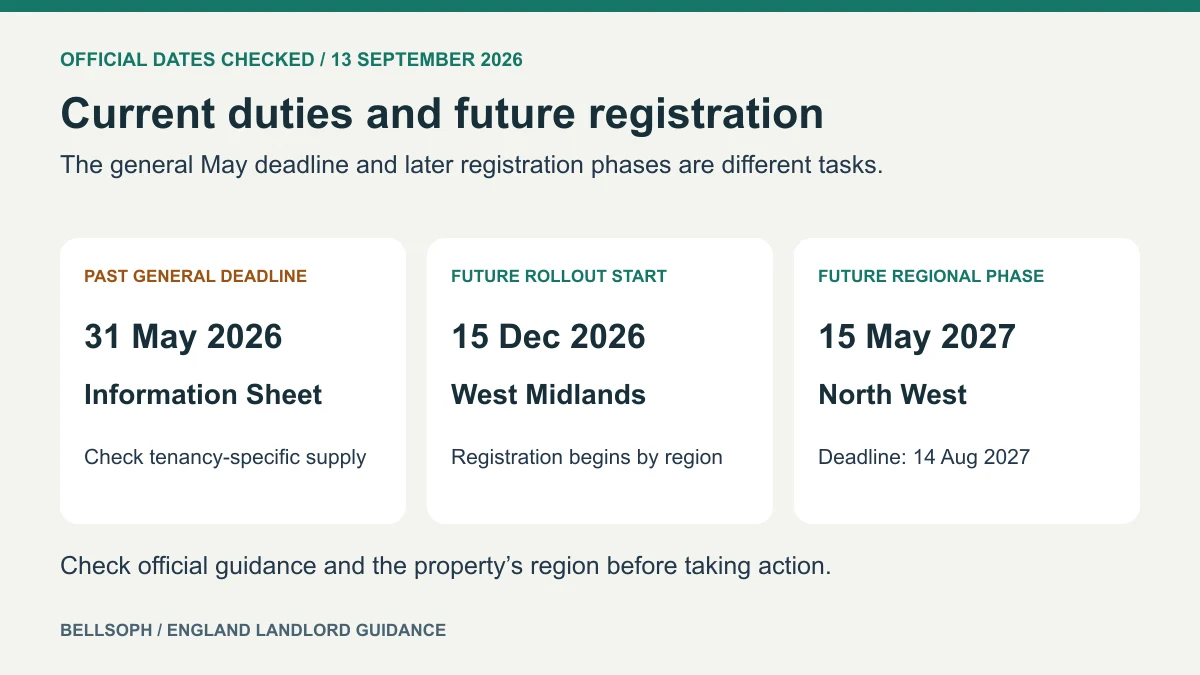
Dates checked on 13 September 2026. Future registration depends on the property's region.
The government's rental registration timetable schedules rollout from 15 December 2026, starting with the West Midlands. The North West phase starts 15 May 2027, with a 14 August 2027 deadline. These are future dates at this guide's update, not evidence of a service already open today. Identify the property's region and use the PRS Database guide for the detailed timetable. Preparation does not replace today's safety or tenancy duties.
Copy a compliance action register
Use this field list in a spreadsheet or property-management system. One row should describe a specific duty for a property or tenancy, with a responsible person and a traceable next action.
| Field | What to enter |
|---|---|
| Property and tenancy | Stable references, address and relevant tenancy |
| Duty and jurisdiction | What applies, England scope, and the source checked |
| Document and provider | Record reference, issuer and actual issue or check date |
| Required next date | Report date, applicable deadline or event trigger, with its basis |
| Operational review | Your earlier administrative follow-up date, labelled separately |
| Supply evidence | Exact version, recipient, date, method and evidence reference |
| Status | Evidence checked, action outstanding, evidence missing, or not applicable with reason |
| Responsibility | Named owner, next action and completion evidence |
The following fictional example shows why a single “expiry” column is inadequate. The operational dates are suggested administrative reminders, not additional legal deadlines.
| Record for fictional P014 | Required date or trigger | Operational review | Next action |
|---|---|---|---|
| Gas check completed 01/09/2026 | Annual next check; record the applicable deadline | 01/08/2027 booking review | Manager arranges access and engineer |
| EICR issued 01/09/2026 | 01/09/2029, as specified in this fictional report | 01/08/2029 booking review | Manager follows the earlier report date |
| Information Sheet sending record absent | Check tenancy-specific duty and actual supply | 14/09/2026 evidence follow-up | Agent locates sending evidence or addresses missing supply |
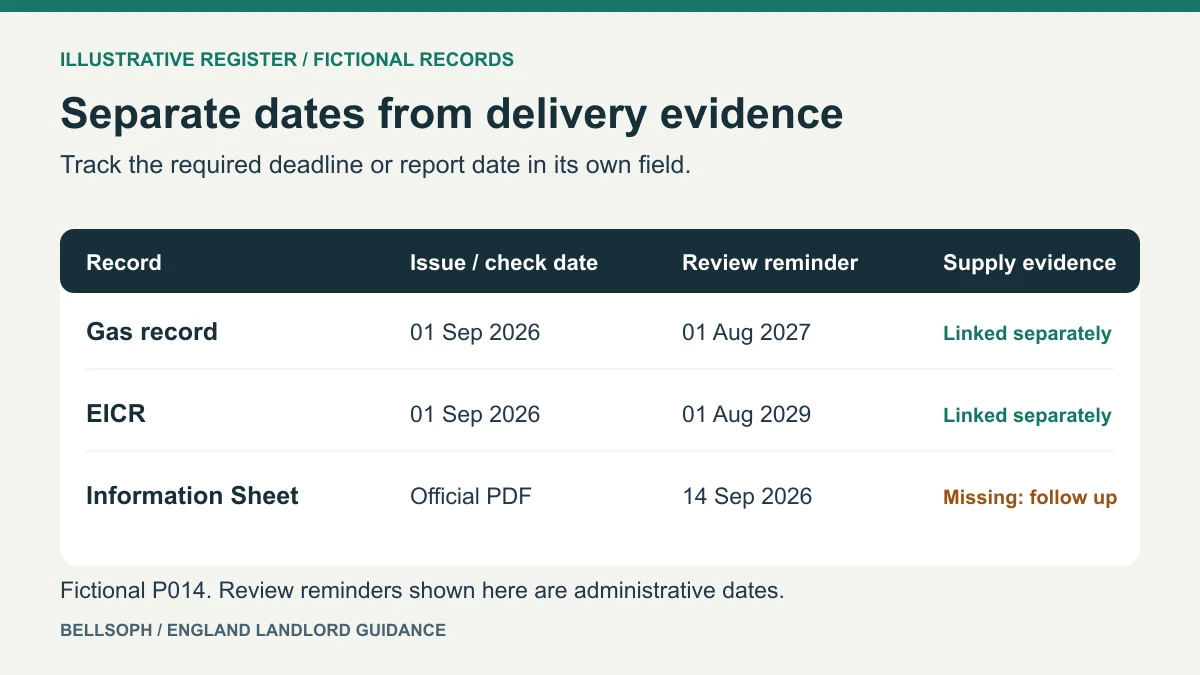
A document date and a review reminder do not establish delivery. Fictional property and records.
Use precise status descriptions. “Evidence missing” means you cannot establish what happened from the file; it does not justify guessing that the task was completed. “Not applicable” needs a recorded reason and a recheck if circumstances change. A report requiring work stays connected to that open action even after its PDF has been filed.
For the detailed folder structure, versions and retrieval process, use the landlord record keeping checklist. This compliance register identifies duties and actions; the document index locates their evidence.
Review the portfolio monthly and act between reviews
Choose a regular review date and one person to run it. Monthly is an administrative routine, not a universal statutory inspection frequency. Review each property's upcoming triggers, overdue actions and unresolved evidence:
- Check new tenancies, occupancy changes and reports received since the previous review.
- Read upcoming deadlines and arrange access or contractors early enough to act.
- Open outstanding findings and confirm who is resolving each one.
- Check required document supply against actual recipient and sending records.
- Refresh any source whose rule or implementation date may have changed.
- Record decisions, next actions and a cover owner for absences.
Do not move an overdue deadline forward simply to clear the list. Keep its history and create the corrective action. When an issued record is incomplete or contradictory, ask the issuer to clarify it rather than editing the certificate yourself.
For several properties, Bellsoph's property-management workspace can be considered alongside your existing records and task process. Test whether the workflow keeps responsibility and evidence understandable. Use the landlord costs calculator for planning estimates, with actual contractor costs recorded separately.
Questions about landlord compliance checklists
Which certificates does every landlord need?
There is no identical certificate bundle for every property. Check the property's equipment, tenancy, jurisdiction and licensing position. Gas records, electrical reports and EPCs also perform different functions. Start with the applicable-duty table and verify exceptions with the relevant official source.
Are all checks annual?
No. Gas checks, electrical inspection dates, EPC validity, tenancy events and operational reminders follow different patterns. Read the actual report and rule. A monthly register review helps spot work; it does not renew a certificate or replace a required inspection.
Can I use this checklist outside England?
Use the register structure, but replace the duties and sources with those for the property's nation. Do not carry England's Right to Rent or 2026 tenancy-information rules into another jurisdiction simply because the landlord lives in England.
Sources
- GOV.UK: Landlord responsibilities · Accessed 13 Sept 2026
- HSE: Gas safety for landlords · Accessed 13 Sept 2026
- GOV.UK: Electrical safety standards · Accessed 13 Sept 2026
- GOV.UK: Energy Performance Certificates · Accessed 13 Sept 2026
- GOV.UK: Minimum energy efficiency standards · Accessed 13 Sept 2026
- GOV.UK: Smoke and carbon monoxide alarms · Accessed 13 Sept 2026
- GOV.UK: Tenancy deposit protection · Accessed 13 Sept 2026
- GOV.UK: Deposit information for tenants · Accessed 13 Sept 2026
- GOV.UK: Who needs a right-to-rent check · Accessed 13 Sept 2026
- GOV.UK: Right-to-rent follow-up checks · Accessed 13 Sept 2026
- GOV.UK: Renters Rights Act Information Sheet 2026 · Accessed 13 Sept 2026
- GOV.UK: Written tenancy information · Accessed 13 Sept 2026
- Housing Hub: Register your rental property · Accessed 13 Sept 2026
- GOV.UK: HMO licensing · Accessed 13 Sept 2026