
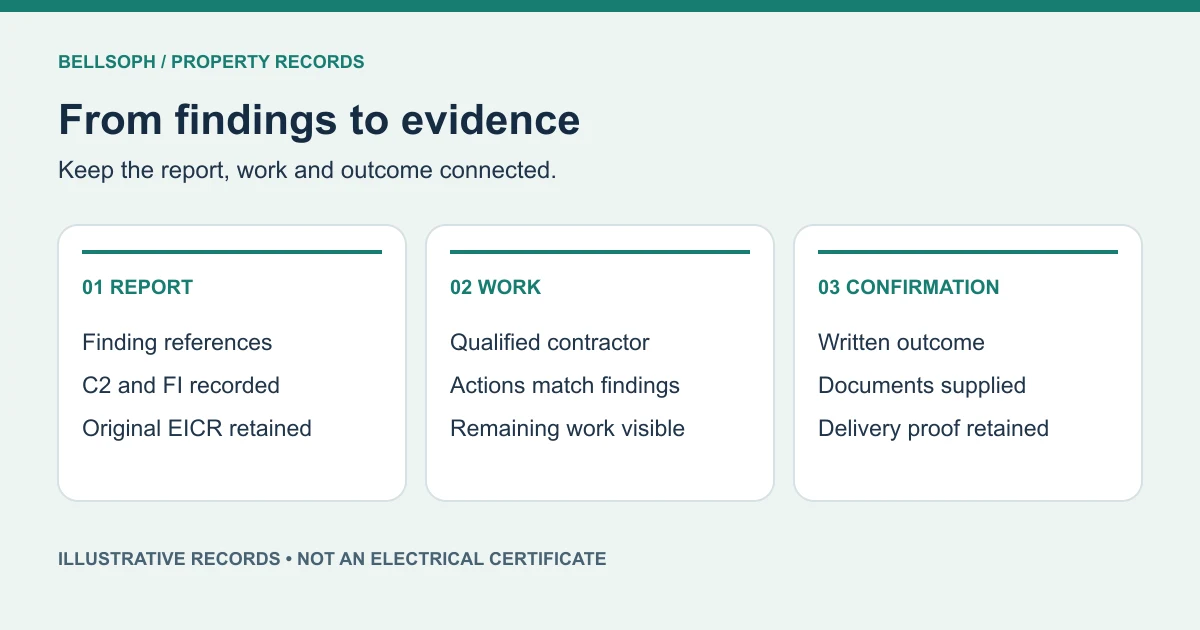
Keep the original EICR and connect each finding to the electrician's work, written confirmation and delivery record. A paid invoice, a booked visit or an uploaded certificate alone does not show that every finding has been resolved or that the required documents have reached the tenant and council.
This guide explains the England private-rented-sector workflow, checked against current official sources on 14 September 2026. It includes copyable records for an unsatisfactory report and a fictional partial-completion example. Electrical assessment and decisions about safe use belong to a qualified person; the register organises their findings and evidence.
Read the EICR result before creating reminders
An Electrical Installation Condition Report records the results of inspection and testing of the fixed electrical installation. This includes wiring, sockets, light fittings, the consumer unit and permanently connected equipment. It is different from an invoice or a portable-appliance record. The government electrical safety guide explains the inspection's scope and the responsibilities of landlords and qualified inspectors.
Read the outcome, observations, limitations, inspection date and next inspection date together. Check that the address and report reference match the property. Preserve the complete issued report, including schedules and any explanatory pages, rather than keeping only the page labelled satisfactory or unsatisfactory.
C1, C2, C3 and FI mean different actions
The following table paraphrases the official England guidance. Copy the inspector's actual finding and instructions into your records; do not recode a finding yourself.
| Code | Meaning in the official guidance | Next action to record |
|---|---|---|
| C1 | Danger is present, with a risk of injury | Obtain immediate direction from the qualified person about making the hazard safe and required work. Record any action already taken; do not assume it closes the finding. |
| C2 | A potentially dangerous condition | Arrange the required remedial work with a qualified person and record the report's deadline. |
| C3 | An improvement is recommended | Record the recommendation and decision. C3 alone does not require remedial work for the report to be satisfactory. |
| FI | Further investigation is required without delay | Arrange the investigation, obtain its outcome and track any additional work it identifies. |
C1 and C2 findings require remedial work and make the installation unsatisfactory for continued use in the report. FI also requires action. Do not treat the 28-day limit as permission to leave an urgent hazard unaddressed. If wording or urgency is unclear, contact the qualified person promptly and keep their response with the report.
The next inspection date is a separate field
In England, regular inspection and testing must be at intervals of no more than five years, or by an earlier date required in the latest report. Enter that actual date; do not automatically add five years to every uploaded document. A reminder is an administrative prompt, not a renewal or evidence that electrical standards are met.
A change of tenant does not automatically require another test where the conditions described in the government guidance are satisfied: the inspection is less than five years old and the report requires no further investigative or remedial work. Supply the report before the new tenant occupies. The guidance recommends a visual check before a new tenancy and consideration of earlier testing if damage or other concerns arise. A visual observation does not replace qualified inspection and testing.
Follow every finding through to qualified work
Start with one row for each finding and use the report's reference or page and item number. Ask the contractor to connect their scope of work to those references. A quotation saying only “electrical repairs” makes it harder to establish later which observations were addressed.
Agree access, responsibility for arranging the visit and the documents expected after the work. Check the person's competence for the specific inspection, investigation or remedial work being commissioned. The government guidance links to industry resources for finding qualified people; membership of a scheme should not be presented as a substitute for checking the work's scope and the resulting evidence.
Written confirmation must explain the outcome
Under regulation 3(5), obtain written confirmation from a qualified person that the required work has been carried out and that either the electrical safety standards are met or further investigative or remedial work is required. The second outcome leaves more work to track.
The government guide lists acceptable forms of confirmation including a satisfactory EICR, an Electrical Installation Certificate, a Minor Electrical Installation Works Certificate or other appropriate electrical certification. Ask the qualified person which document is appropriate for the work performed and what it confirms. A new full EICR is therefore not the only possible confirmation in every case.
An invoice can support the payment and contractor history, but payment alone does not establish the required technical outcome. Check the confirmation's property, work references, date and unresolved scope. Keep the original unsatisfactory report linked to it; replacing the original file can remove the explanation of why the work was needed.
Investigation can create another action
If further investigation finds that more work is necessary, regulation 3(6) requires the work and confirmation steps to be repeated. Carry forward the new finding, its timing and the qualified person's instructions. Do not mark the property “all complete” just because an investigation visit took place or one certificate arrived.
Use the maintenance checklist and log for contractor follow-up, while retaining the EICR and technical confirmation as the electrical evidence. The maintenance task and the safety record answer different questions.
Track work and document delivery separately
For the England duties discussed here, the starting event matters. The work clock starts with inspection and testing; the subsequent delivery clock starts when the relevant work is completed. Other report-supply duties apply independently.
| Event | Required timing | Evidence to keep |
|---|---|---|
| Report identifies required remedial or investigative work | Within 28 days starting with inspection and testing, or the shorter period specified in the report | Report date, exact instruction, contractor action and completion evidence |
| That work is completed | Supply the written confirmation and original report to each existing tenant and the local housing authority within 28 days of completion | Documents supplied, recipient, date, method and supporting delivery evidence |
| Routine inspection and testing completed | Supply the report to existing tenants within 28 days | Issued report and supply record |
| New tenant will occupy | Supply the report before occupation | Correct report version and recipient record |
| Prospective tenant requests the report | Supply within 28 days of receiving the request | Request and response dates |
| Local housing authority requests the report | Supply within seven days of receiving the request | Request, report and response record |
These timings come from the current electrical regulations and government guidance. The council copy after required work is a separate duty from responding to a council request for the inspection report. Do not wait for a request before recording the post-work supply action.
For delivery, save what was actually sent, not just a calendar tick. If an email fails, the attachment is missing or a portal submission is rejected, record the problem and follow it up. An acknowledgement can be useful evidence, but do not invent a universal legal requirement to obtain one.
If access or specialist dependencies make completion difficult, keep the chronology of requests, responses, appointments and actions. The government guidance discusses reasonable steps and practical constraints; a note saying “tenant unavailable” does not itself determine whether a duty has been met. Seek appropriate professional help for unresolved access, enforcement or safety questions.
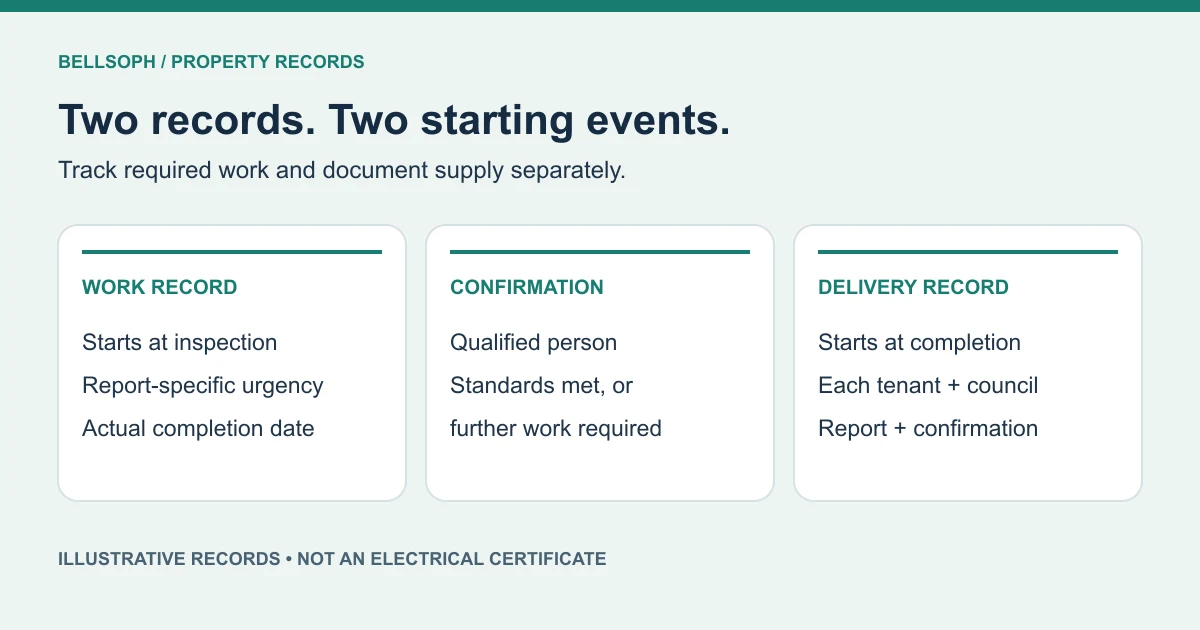
Original administrative illustration: work completion and document supply are separate events.
Copy an EICR remedial-work register
This is an original administrative template, not an official certificate or a safety assessment. Keep technical descriptions in the qualified person's words. Split work and delivery into linked records so several findings or recipients do not disappear inside one oversized cell.
Finding and work record
| Field | What to enter |
|---|---|
| Property and report | Internal property ID, full report reference, inspection date and file link |
| Finding identity | Report item/page reference, code and exact electrician description |
| Required action and deadline | Qualified person's instruction, report-stated period, recorded due date and the event it runs from |
| Responsibility and access | Responsible manager, qualified contractor, agreed access date and contact history |
| Work completion | Actual completion date, work reference and supporting record |
| Confirmation | Document type, reference, issuer, date and file link |
| Remaining scope | Further investigation or work still required, including the next action |
| Administrative review | Person checking the record, review date and any missing evidence |
Document-delivery record
Use one row for each recipient and sending event. Link every row to the same property, report and relevant completion record.
| Recipient | Documents and versions | Due date basis | Sent and evidence | Follow-up |
|---|---|---|---|---|
| Each existing tenant | Original report plus relevant written confirmation | Completion date and applicable 28-day period | Actual date, method, destination and saved proof | Missing attachment, failed delivery or other unresolved issue |
| Local housing authority | Same report and confirmation pack | Completion date and applicable 28-day period | Council destination, submission reference and saved copy | Rejected submission or missing document |
Before closing the administrative record, check that the work outcome is clear, unresolved findings have actions, the required recipients have been supplied and the next inspection date is retained. The person reviewing the register checks completeness of records; they do not certify the electrical installation.
Work through a fictional C2 and FI case
Fictional property P014 has report E-014, inspected on 1 September 2026. It contains a C2 finding and a separate FI finding. The example illustrates record handling only; it does not prescribe safe waiting periods or technical repairs.
On 4 September, the qualified contractor completes the work relating to the C2 finding, but the FI investigation remains outstanding. The manager receives an invoice that afternoon. The C2 row records the reported work date and “confirmation requested”; the overall report remains open. The invoice is retained as supporting evidence, without being treated as a statement that electrical standards are met.
On 5 September, written confirmation arrives identifying the C2 work and expressly noting the unresolved FI scope. The manager links it to the original report, checks the applicable supply duty and records delivery to each existing tenant and the council. Each recipient has their own event and proof. The FI row still shows the contractor, the report's instruction and the next appointment.
If the investigation identifies additional remedial work, create a linked action and repeat the relevant work and confirmation steps. If it confirms the standards are met, retain that qualified conclusion and complete its delivery records. The overall status changes only when the actual findings and evidence justify it, not when a progress bar reaches the end.
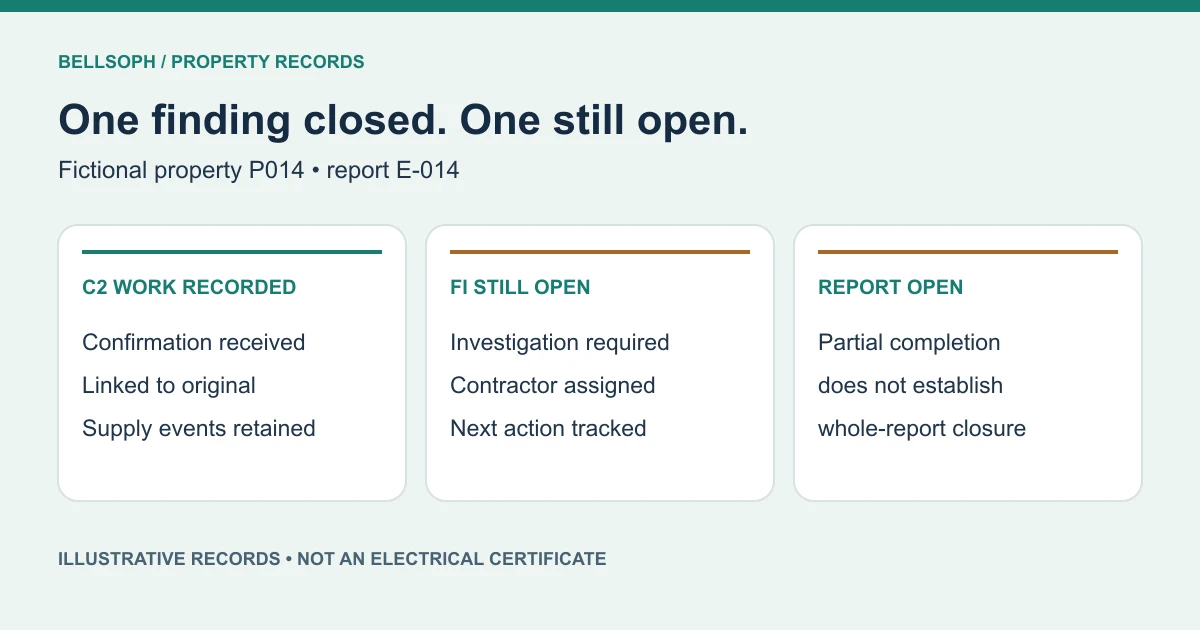
Fictional example: closing one finding does not close the whole report.
Keep the correct jurisdiction and enforcement wording
England
This guide's main workflow concerns England private landlords. The regulations have exceptions, so check whether the tenancy falls within their scope. The current government publication also covers social housing, including separate equipment requirements and transitional dates. Those social-housing provisions must not be copied into a private landlord's calendar.
Regulation 11 now sets a maximum financial penalty of £40,000 for a breach of the specified electrical duties. This is a ceiling, not an automatic fine for every case. Councils also have remedial enforcement and cost-recovery powers, explained in the electrical guidance.
The government's electrical guide directs readers to different penalty guidance for offences before 1 May 2026 and offences from 1 May 2026. A historic notice needs its own legal basis and dates checked. Do not assume today's maximum retrospectively determines an older case, or that every housing penalty follows the same procedure.
Scotland and Wales
Scotland has its own Repairing Standard. The Scottish Government's electrical-installations guidance describes electrical inspection covering installations and equipment, before first letting and then at intervals of no more than five years. Use that regime's requirements for Scottish properties.
In Wales, the Rent Smart Wales property-conditions guidance states that a valid electrical condition report must be supplied within 14 days of moving in or obtaining a new report. This differs from the England supply timetable. These are brief signposts, not complete devolved compliance checklists. Northern Ireland requirements are outside this guide's scope.
Keep the report useful after the repair
The England guidance requires retention of the report until the next inspection is required or, if later, conducted, unless a newer report supersedes it. Supply the report to the person undertaking the next inspection. Retention of related personal information also needs a purpose: the ICO's storage-limitation guidance does not set one universal period for every landlord file.
Use the record-keeping checklist to organise versions, access and retrieval. Keep electrical actions alongside the other duties in the England landlord compliance checklist. For a shared property workflow, explore keeping property documents and next actions together with Bellsoph. A stored file or software reminder supports administration; the qualified person's assessment and required supply of documents still need to happen.
Questions about remedial-work evidence
Is an invoice enough?
Not merely because it proves payment. The required confirmation must come from a qualified person and explain the work and whether standards are met or further work is required. Check what the document actually establishes.
Must every remedial job produce a second EICR?
No universal second-EICR rule is stated in the government guidance. It identifies several acceptable forms of confirmation. Ask the qualified person which is appropriate and retain the original report with the resulting evidence.
Can I close the report when one C2 is fixed?
Only that finding may be ready to close, subject to the evidence. Keep other C1, C2 or FI items and any newly identified work open until the qualified outcome supports closure. Document delivery must also be tracked.
Does a C3 create the same duty as a C2?
No. C3 is an improvement recommendation; C2 identifies a potentially dangerous condition requiring remedial work. Record the recommendation without changing its classification or overlooking other findings.
Sources
- MHCLG electrical safety guidance · Accessed 14 Sept 2026
- Electrical safety regulations, regulation 3 · Accessed 14 Sept 2026
- Electrical safety regulations, regulation 11 · Accessed 14 Sept 2026
- MHCLG civil penalties from 1 May 2026 · Accessed 14 Sept 2026
- MHCLG civil penalties before 1 May 2026 · Accessed 14 Sept 2026
- Scottish Government Repairing Standard Annex D3 · Accessed 14 Sept 2026
- Rent Smart Wales property-conditions guidance · Accessed 14 Sept 2026
- ICO storage limitation · Accessed 14 Sept 2026