
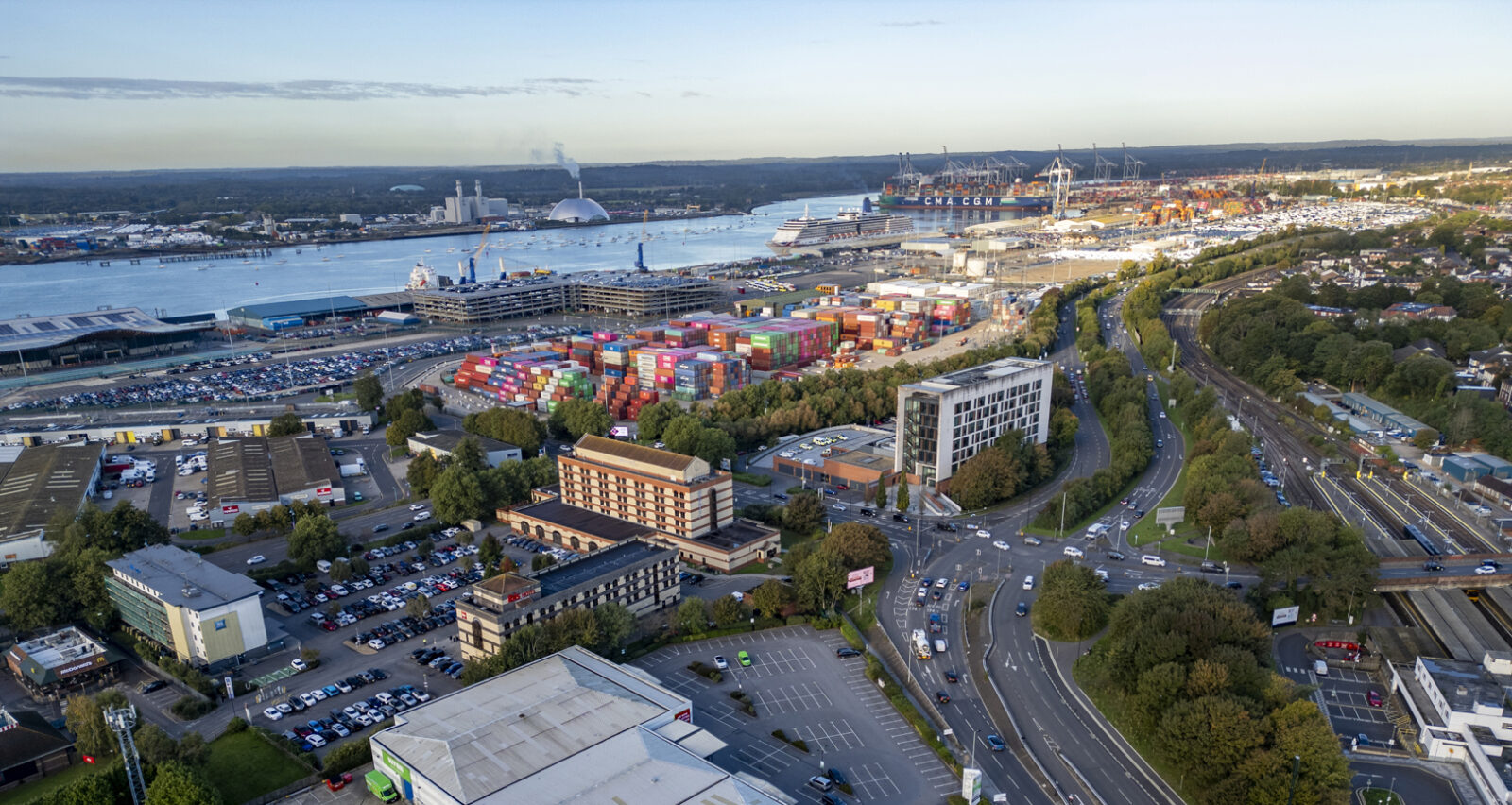
At a glance
| Measure | Verified position |
|---|---|
| Programme type | Long-term city vision, spatial framework, delivery strategy and investment prospectus |
| Study area | Approximately 435 hectares across the city centre, waterfront and adjoining urban land |
| Published horizon | A 20-year programme rather than one construction timetable |
| Housing ambition | Capacity for up to 15,000 homes across the full programme; not a consented total |
| Non-residential ambition | The January 2025 council report records 2 million square feet of commercial, entertainment and leisure floorspace; later consultant copy uses a conflicting square-metre figure |
| Named investment areas | West Bay, Heart of the City, Mayflower Waterfront, Ocean Village and Itchen Riverside |
| Delivery themes | Connected, Destination, Green, Innovation, Neighbourhoods and Waterfront |
| Current phase | Strategy-to-delivery work, including project prioritisation, development advice and promotion |
| Lead bodies | Southampton City Council and the Southampton Renaissance Board |
| Strategic advisers | Montagu Evans-led team, including Prior + Partners, Grant Thornton, Mott MacDonald and Vail Williams |
What the programme does
The programme gives public bodies, landowners and investors a shared spatial and economic direction. Southampton City Council appointed a Prior and Partners-led consortium in May 2024 to prepare the vision, prospectus and delivery strategy. The council then approved publication of the prospectus in January 2025, before the vision was launched on 14 February 2025.
The work is designed to align development opportunities that previously sat in separate plans. It identifies places where new homes, employment space, public routes, green infrastructure and waterfront access could reinforce one another. Prior + Partners describes its delivery strategy as a route for prioritising interventions, considering funding models and building public-private partnerships.
That strategic role is also its main limitation. The prospectus does not grant planning permission, assemble land, secure infrastructure funding or appoint contractors. Each site still needs its own delivery route, and normally planning consent, before the physical proposals can proceed.
Five named investment areas
The published Southampton Renaissance prospectus maps five investment areas. They overlap with existing neighbourhoods and development sites rather than creating five self-contained projects.
| Investment area | Published direction | What to verify next |
|---|---|---|
| West Bay | A mixed-use innovation and enterprise district around the station, port approaches and western gateway | Site-specific masterplans, land agreements and planning applications, including the former Toys 'R' Us site |
| Heart of the City | Stronger links between the Civic Centre, Above Bar, East Street, the Old Town and cultural destinations | Public-realm programmes, heritage decisions, occupiers and funded delivery phases |
| Mayflower Waterfront | A new relationship between the historic waterfront, parkland, homes, workplaces and visitor uses | Port interfaces, land access, flood and infrastructure work, and planning status |
| Ocean Village | Long-term intensification of an established marina neighbourhood and destination | Individual development applications, access and public-realm commitments |
| Itchen Riverside | Better connections through Chapel and Northam, waterfront access and activity around St Mary's Stadium | Northam Rail Bridge funding, site assembly, industrial compatibility and detailed proposals |
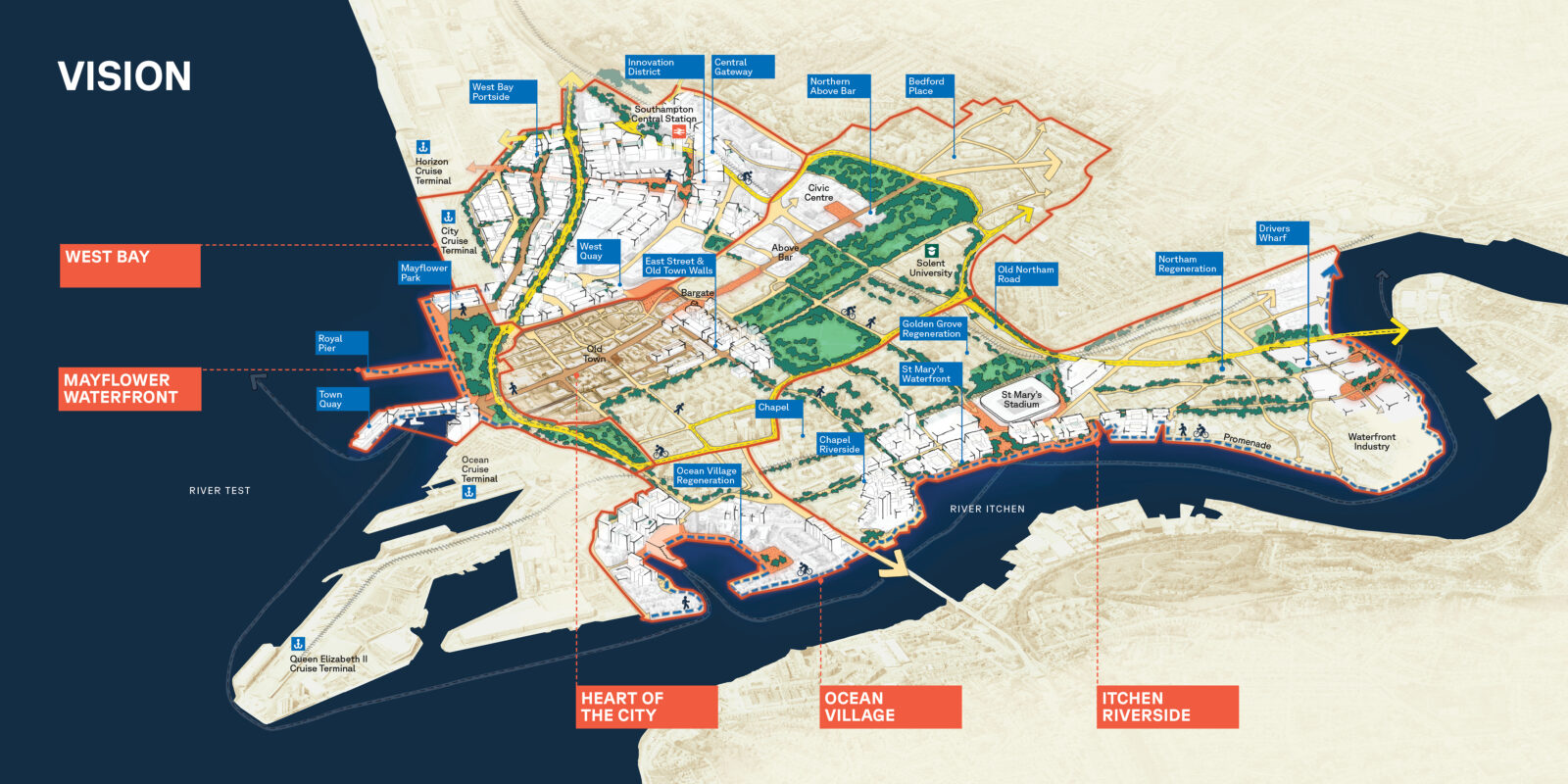
The official project visual identifies West Bay, Heart of the City, Mayflower Waterfront, Ocean Village and Itchen Riverside. Image source: Prior and Partners.
Some 2026 Prior + Partners material describes six Renaissance Area Frameworks, while the public short prospectus and its map name five investment areas. This report uses the five names visible in the published prospectus and treats the later six-framework wording as a point for the programme team to clarify.
Six themes shape the vision
The council's launch material organises the programme around six themes: Connected, Destination, Green, Innovation, Neighbourhoods and Waterfront. These are programme-wide tests, not extra development areas.
- Connected seeks easier movement between the station, city centre, neighbourhoods and waterfront.
- Destination focuses on culture, heritage, events and reasons to spend time in the city.
- Green covers better public space, habitat, climate resilience and healthier streets.
- Innovation builds on the port, universities, marine activity, health and technology sectors.
- Neighbourhoods aims to combine homes with services, jobs and usable public space.
- Waterfront seeks better public access while recognising Southampton's working-port economy.
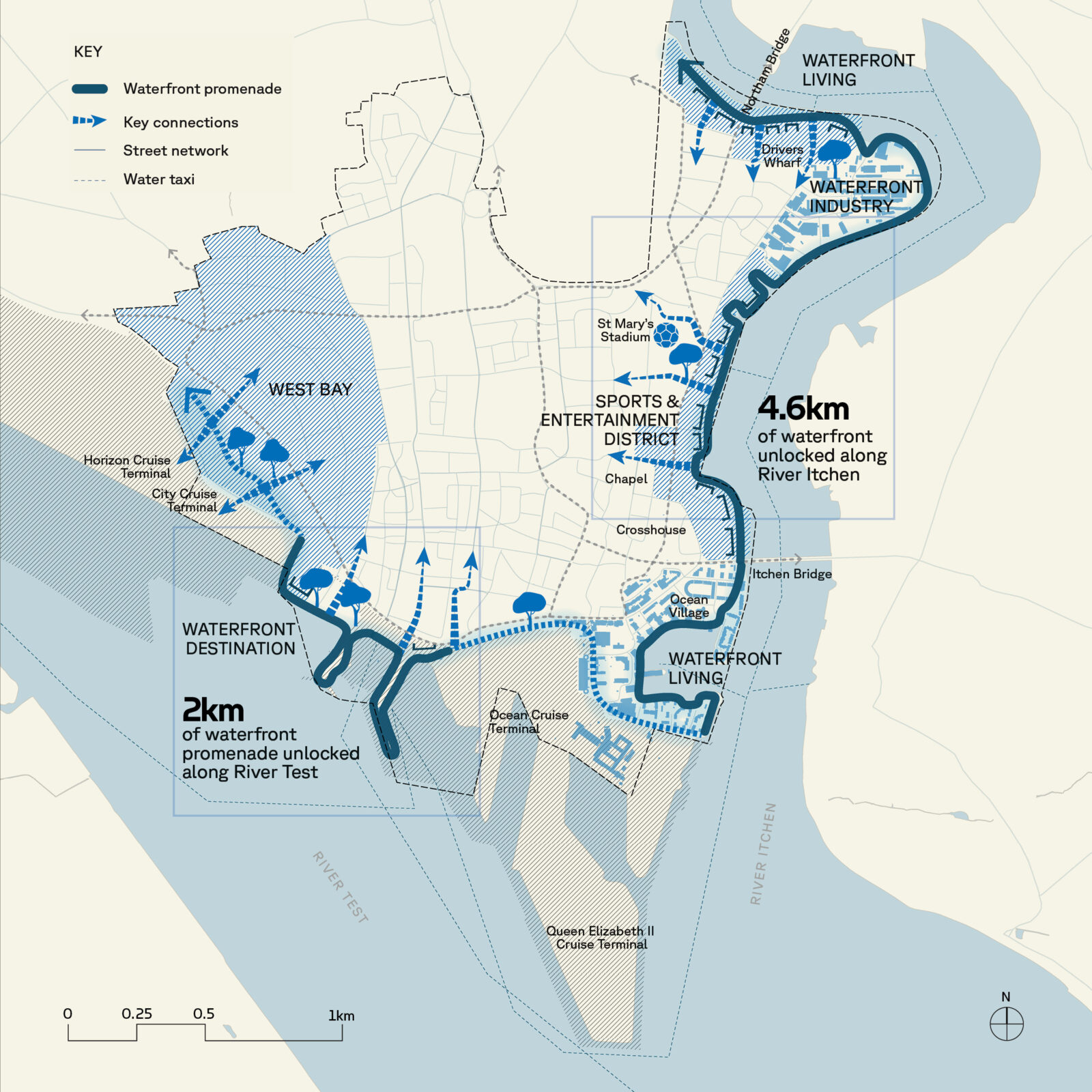
The waterfront framework illustrates long-term connection and promenade ambitions around the River Test and River Itchen; it is a strategic diagram, not an approved works plan. Image source: Prior and Partners.
The themes help explain the ambition, but they do not provide parcel-level details such as height, tenure, affordable-housing obligations or construction dates. Those details must come from later planning and delivery documents.
From vision to delivery
The programme moved into a more delivery-focused phase when a Montagu Evans-led team was selected as strategic development adviser in September 2025. Its remit includes technical analysis and site-specific work on masterplanning, land assembly, planning promotion, commercial structures, funding, development partnerships and procurement. The appointment is evidence of active programme development, but it does not mean every opportunity has a funded scheme.
One identifiable West Bay step followed in January 2026. The council announced that WBS Growth Partnership LLP had acquired the former Toys 'R' Us site beside Southampton Central station. The partnership is exploring a mixed-use neighbourhood focused on innovation, enterprise and education, with offices and homes. The January announcement said meanwhile uses or demolition could be considered during 2026 while plans develop; it did not announce a planning permission or main construction start.
The council's 2026/27 corporate priorities add an operational test: establish a clear Southampton Renaissance programme of projects that can be monitored by the Board. This is a useful shift from broad vision to accountable project tracking. Future reviews should look for the named priority projects, budgets, owners and milestone dates resulting from that work.
Transport remains closely connected to delivery. In April 2026 the council said Northam Rail Bridge remained a candidate for Major Road Network support, but still required funding approval and an Outline Business Case. The bridge is relevant to Itchen Riverside, although its inclusion in the vision must not be presented as confirmed funding.
Scale figures need careful interpretation
The January 2025 Cabinet supporting report describes a vision spanning more than 400 hectares, with development opportunities over 98 hectares, potential for 15,000 homes and 2 million square feet of commercial, entertainment and leisure floorspace. The 435-hectare study-area figure is also stated on the Prior and Partners project page.
A September 2025 consultant announcement instead says more than 2 million square metres of commercial and non-residential floorspace. That unit is materially different from the council's square-foot figure. Until the programme team publishes a reconciled schedule, the council Cabinet figure is the safer public reference and the discrepancy should remain visible.
Neither headline capacity is a delivery count. Sites may overlap with existing permissions, later frameworks can change capacity, and infrastructure or viability constraints can reduce what proceeds. Project totals should therefore be recorded from individual applications and decisions, not added mechanically to the strategic ambition.
Governance and partnerships
The Southampton Renaissance Board brings together the council with major city institutions and infrastructure operators. Published membership includes Associated British Ports, the University of Southampton, Solent University, University Hospital Southampton, Southampton Football Club, Network Rail, transport operators and business organisations.
Cabinet created the formal board and approved a masterplanning delivery framework in December 2022. The board is an advisory and partnership body: formal planning, funding and land decisions remain with the organisations that hold those powers. This distinction matters when assessing announcements, because board support is not the same as statutory consent.
Housing and property context
The framework could support substantial new housing over two decades, particularly where underused land can be connected to jobs, transport and public space. Southampton's Housing Strategy 2026-2031 links housing-led schemes to regeneration while also acknowledging difficult viability conditions. That makes delivery sequencing, tenure and infrastructure funding more important than the headline 15,000-home capacity.
Effects on individual homes, sale prices or rents cannot be reliably isolated from wider market conditions. Improved public space, connections and amenities may change how some locations are perceived, while land assembly and construction can bring disruption. The evidence reviewed does not support a numerical price, rent or return forecast.
Anyone assessing a property should work at site and street level. Relevant checks include the adopted planning position, precise development boundary, proposed tenure, affordable-housing obligations, building height, flood risk, port or industrial activity, service charges, parking, transport works and expected construction phasing.
Risks and points to monitor
| Watch point | Why it matters | Evidence to monitor |
|---|---|---|
| Vision is not consent | Programme capacity can be mistaken for approved development | Planning applications, committee decisions and legal agreements for each site |
| Floorspace unit conflict | Two published sources use square feet and square metres for the same headline ambition | A corrected council or programme schedule with one verified unit |
| Project prioritisation | A 20-year vision needs a funded sequence | The council's promised monitored programme, named sponsors and delivery dates |
| Funding and viability | Major infrastructure and mixed-use sites require viable funding packages | Business cases, grant decisions, development agreements and procurement notices |
| Land and port interfaces | Waterfront access must coexist with operational land and multiple owners | Land agreements, ABP engagement, flood work and site-specific masterplans |
| Housing detail | Strategic capacity says little about tenure, affordability or timing | Application schedules and affordable-housing commitments |
| Planning-policy relationship | The framework can inform policy but is not itself the adopted Local Plan | Emerging Local Plan consultation, examination and adoption documents |
| Delivery language | Partnerships, awards and promotion do not prove construction | Verified demolition, contract, start-on-site and completion announcements |
Detailed project history
| Date | Milestone | What happened | Source |
|---|---|---|---|
| 20 December 2022 | Governance and delivery framework approved | Cabinet approved the masterplanning delivery framework and establishment of the formal Southampton Renaissance Board. | Southampton City Council decision record |
| 21 May 2024 | Masterplanning team appointed | The council announced Prior + Partners as lead of a five-consultancy team preparing the vision, prospectus and delivery strategy. | Council appointment announcement |
| 28 January 2025 | Prospectus approved for publication | Cabinet approved publication after agreement by Renaissance Board members and endorsed promotion and next-stage delivery work. | Masterplanning Programme decision |
| 14 February 2025 | Renaissance Vision launched | City institutions and development-sector representatives launched the vision around six programme themes. | Council launch report |
| 16 September 2025 | Strategic development adviser selected | A Montagu Evans-led multidisciplinary team was selected to turn the vision into project and area delivery strategies. | Prior and Partners delivery update |
| 22 January 2026 | West Bay site partnership announced | WBS Growth Partnership LLP acquired the former Toys 'R' Us site and began developing mixed-use proposals beside the central station. | Council partnership announcement |
| 24 February 2026 | Monitored project programme made a corporate priority | The council's 2026/27 priorities called for a clear Renaissance programme of projects monitored by the Board. | Corporate Plan delivery priorities |
| 2 April 2026 | National award shortlist announced | Southampton Renaissance was shortlisted in the Promoting Economic Growth category. | Planning Awards shortlist |
| 4 June 2026 | Planning Award won | The programme won the national Planning Award for Promoting Economic Growth. | Prior and Partners award result |
| 29 June 2026 | Delivery approach reviewed after award | Prior + Partners published a review of how economic evidence, spatial planning and investment priorities were combined in the programme. | South Denes and Southampton review |
Current assessment
Southampton Renaissance has progressed beyond an early concept: governance is established, a published spatial and economic framework exists, a strategic development adviser is in place, and the council has committed to a monitored programme of priority projects. The West Bay partnership and Northam Rail Bridge business-case work show how parts of the vision are beginning to connect to site and infrastructure activity.
It is nevertheless a programme in the strategy-to-delivery phase, not one live construction project. The most useful next evidence will be the council's prioritised project list, reconciled capacity figures, site-specific planning applications, funding decisions, land agreements and verified starts. The page should be updated when those events occur rather than treating promotional activity or awards as physical delivery.
Rental impact note
Rental impact is qualitative at this stage. Treat the rent and sales discussion as evidence-led context, not a promise of future price or rent movement.