
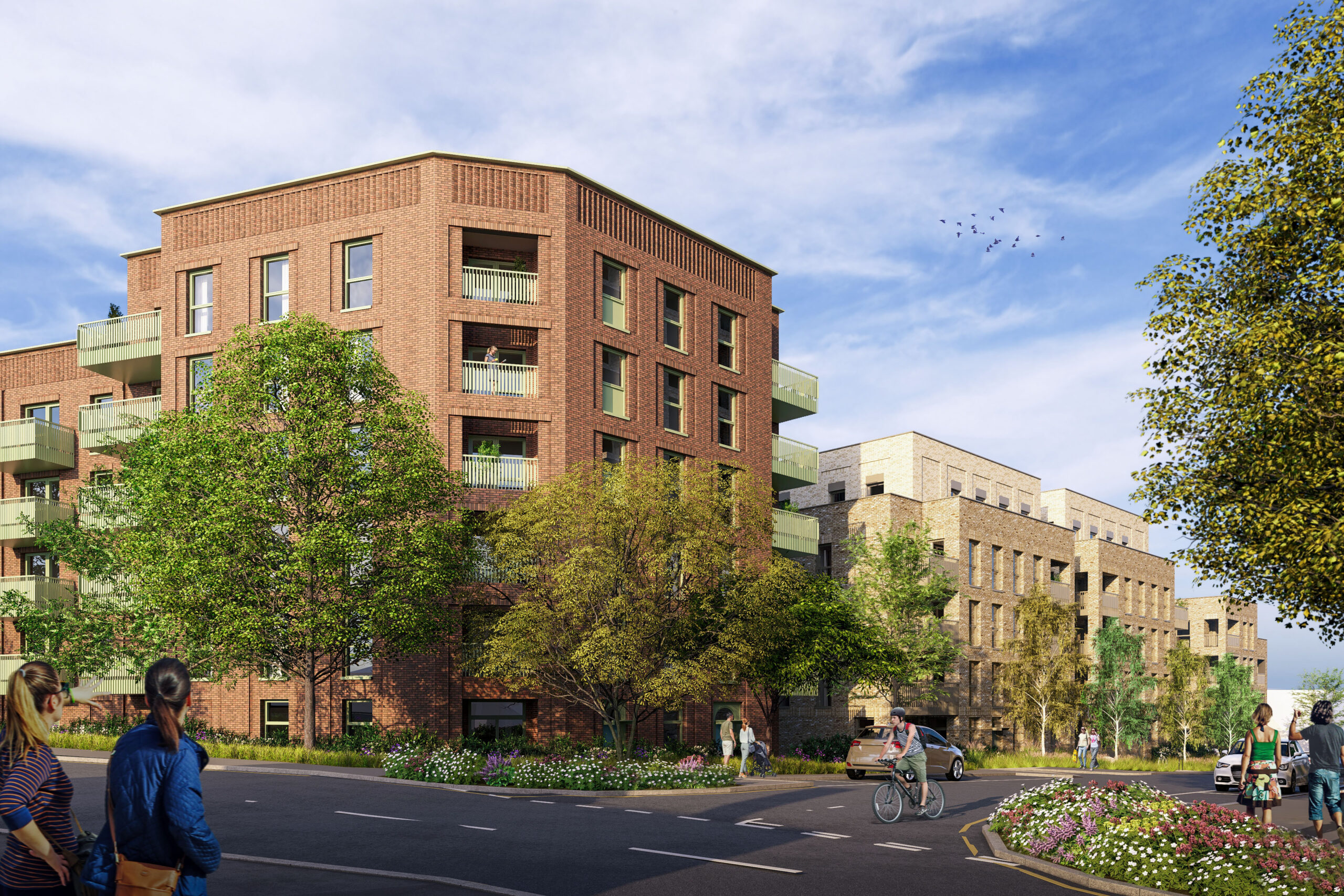
The project has passed an important land-assembly milestone: the council's published notice confirms its compulsory purchase order on 22 July 2026. Physical delivery needs a more qualified description. Site preparation and demolition are evidenced, while the July programme expected Block A's main works to begin in autumn 2026. The sources checked on 28 September do not establish that permanent foundations or superstructure have subsequently started.
What has been approved?
The January 2026 planning announcement follows the planning committee's unanimous decision in October 2025 and the Greater London Authority's two-stage review. The permission is recorded as 25/02016/OUT. Its hybrid structure matters: detailed approval for one phase does not mean every part of the estate has the same delivery status.
The council's Statement of Reasons sets out 225 affordable homes in Phase 1, comprising 215 social-rented and ten shared-equity homes. Phase 2 proposes up to 115 open-market homes, with all detailed matters reserved. The 225 and 115 are components of the overall maximum of 340; they should not be added to that total again.
Project facts
| Component | Scope | What the evidence establishes |
|---|---|---|
| Existing estate | 191 homes | The redevelopment baseline, not an occupied-home count |
| Phase 1 | 225 affordable homes | Full planning permission; delivery is phased |
| Phase 2 | Up to 115 homes | Outline permission; detailed design and funding remain separate steps |
| First new block | 30 homes across six storeys | First site handed to Lovell; completion remains prospective |
| Wider facilities | Pre-school, community space, play and landscaping | Planned benefits, not a list of completed facilities |
The estate is in SE25, within the London Borough of Croydon. It is not a CR0 town-centre project. The council's estate record identifies 1–87 Regina Road as SE25 4TW. Nearby regeneration schemes and off-site rehousing are not additional phases of this permission.
Why the estate is being rebuilt
Regeneration followed serious failures in housing conditions. The May 2021 regulatory notice records breaches of the Home Standard, including repairs and conditions at Regina Road. That notice was withdrawn on 30 April 2025 after the regulator said the issues giving rise to it had been resolved. Withdrawal should not be mistaken for completion of the redevelopment.
The November 2022 cabinet paper examined the ageing large-panel-system buildings and the options for their future. Consultation and resident involvement preceded the decision to rebuild. This history explains why the scheme's central purpose is housing quality and residents' living conditions, rather than a speculative property-market opportunity.
The resident ballot ran from 26 April to 22 May 2023. It recorded 88.1% support among votes cast, with an 81.7% turnout. A positive ballot established resident support for demolition and rebuilding within the defined boundary; planning approval, funding and construction contracts followed through separate processes.
What has actually happened on site?
The council timeline records completion of demolition at 1–87 Regina Road in January 2026, followed by the Lovell contract and a site start in March. Lovell's 27 March announcement describes handover of the first site for a six-storey block containing 30 homes. It also identifies the pre-school's relocation to Carmichael Road.
Those milestones do not, by themselves, establish the progress of permanent residential structures. The July resident newsletter, particularly pages 3 and 7, describes site preparation and clearance, with early drainage works expected. It places Block A's main works in autumn 2026, the first 30 completions in 2028 and Phase 1 completion in 2031. These are programme expectations that may change.
The council's demolition page separately records the Portland Bill Pre-School building as demolished in March 2026. The July newsletter describes clearance of the former pre-school site. These refer to different steps in preparing the site; neither proves that the whole estate is cleared. The same newsletter says 110A was vacant with demolition due, without establishing its subsequent completion.
The July newsletter was still the newest newsletter linked from the council's news and updates page when checked. No later direct source reviewed for this report verifies a permanent-home construction milestone. That is a limit of the available evidence, rather than proof that no further work has occurred.
The compulsory purchase order is confirmed
The published confirmation notice states that Croydon confirmed the order on 22 July 2026, following removal of all objections and notification that it could exercise the confirming authority's powers. This supersedes the earlier position in the July newsletter, which described submission to the Planning Casework Unit.
The CPO webpage retains that older narrative alongside links to the confirmation notice and endorsed order. The dated notice is therefore the relevant evidence for confirmation.
Confirmation advances land assembly. It does not demonstrate that every interest has transferred, every household has moved or every later construction area is available. This report does not infer an operative date, completed acquisition or individual compensation entitlement from the confirmation date.
Homes, public space and resident arrangements
BPTW's project design brings the buildings around a central green space with play and recreation, alongside walking and cycling routes, a pre-school and community hub. The architect describes a layout informed by South Norwood's villa and mews buildings, with larger family homes at ground level and private outdoor space.
These are design intentions. Illustrations cannot establish the final appearance, delivery date, accessibility or management arrangements of the completed estate. BPTW's broad description of 340 council homes also differs from the council's phased tenure breakdown; this report uses the latter's 215 social-rented, ten shared-equity and up-to-115 open-market distinction.
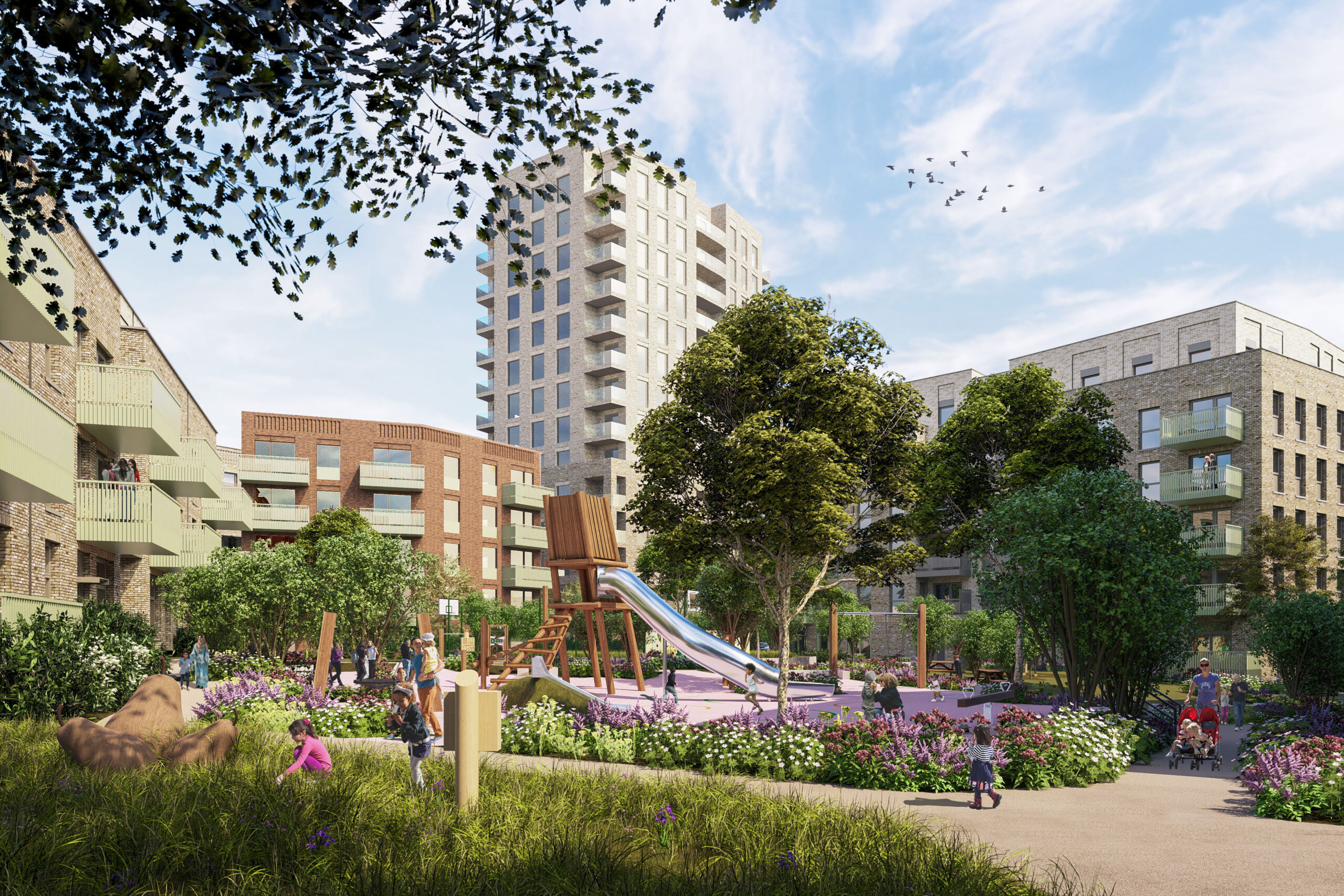
The proposed central play and landscape area. Image: BPTW's Regina Road project. Planting, buildings and facilities shown here are illustrative proposals.
The 2023 Landlord Offer sets out the commitments presented to residents, including rehousing arrangements and options for tenants and homeowners. The practical outcome depends on household circumstances, the relevant offer and the delivery sequence. It would be misleading to convert these commitments into a universal moving date or identical financial entitlement for everyone.
Construction must also be read alongside the needs of households who remain on the estate. The July programme identifies continuing rehousing and homeowner negotiations. Safe access, temporary parking arrangements, repairs and clear information about works remain material considerations during the transition. The project should be assessed through the experience of existing residents as well as the eventual number of homes.
Funding and delivery dependencies
The council's CPO funding evidence estimates Phase 1 at approximately £171 million, supported by £52.25 million of GLA grant, £1.258 million of Brownfield Land Release Fund support, and council Housing Revenue Account resources and borrowing. These are a dated budget and funding description, not certified expenditure or a final construction outturn. The January news announcement's rounded £54 million grant headline should not be treated as a different verified GLA allocation.
The same evidence distinguishes Phase 2's developing funding case from Phase 1. Outline permission is not proof that the second phase is financed or contracted. Later delivery depends on detailed approvals, land availability, procurement and a workable funding programme. The report does not assign a completion date to those additional homes.
What this means for the local property market
The housing and rental effects remain qualitative. If delivered, better homes, safer routes and useful public spaces could change how residents experience the immediate neighbourhood. Those benefits depend on the quality of the completed work and its maintenance, not simply on permission or a contractor appointment.
The transition can also bring disruption: construction traffic, changing access and the loss of usable space while works proceed. Effects can differ between individual streets, buildings and stages. A whole-estate housing maximum does not describe the number of new homes available today, and replacement homes should not be confused with wholly additional supply.
No project-specific evidence reviewed here supports a numerical house-price or rent effect. Borough-wide market movements would not isolate the contribution of Regina Road. Owners and landlords should treat the scheme as a delivery and neighbourhood watchpoint, with attention to the location and timing of each phase.
What to watch next
- Permanent works at Block A: a dated contractor or council progress record identifying foundations or structural work would support a stronger construction description.
- Programme changes: compare future updates with the July expectations of first completions in 2028 and Phase 1 in 2031, without treating either as guaranteed.
- Land and resident moves: follow acquisition and vacant possession separately from CPO confirmation.
- Later phases: look for detailed approvals, delivery instructions and funding evidence before treating the outline homes as committed construction.
- Usable public facilities: opening, access and management arrangements matter alongside the published designs.
The July CPO confirmation advances the land-assembly process. The main unresolved delivery question is how far permanent new-home construction has progressed beyond the documented preparation stage. Future reporting should follow those distinct milestones rather than treating all activity as completed regeneration.