
Project facts
| Topic | Current public position |
|---|---|
| Programme owner | Reading Borough Council |
| Geography | Multiple council-owned and regeneration sites across Reading, including RG1, RG2 and RG30 |
| Current phase | 89 homes on site; Battle Street mobilising for construction; Southcote Lane and Dee Park Phase 3 in pre-planning or planning work |
| Current new-build pipeline | 362 council-owned homes by 2029, excluding acquisitions |
| Delivered before the current pipeline | 421 homes by December 2025, including new build and acquisitions |
| Homes on site | 42 at Hexham Road, 30 at Dwyer Road and 17 at Amethyst Lane |
| Next principal schemes | 62 homes at Battle Street, 14 proposed at Southcote Lane and an expected 190 at Dee Park Phase 3 |
| Tenure aim | Council-owned affordable homes, with the current programme intended to increase homes let at social rents |
| Acquisitions | At least 37 additional homes expected over four years, accounted for separately from the 362 new-build pipeline |
| Funding model | Housing Revenue Account borrowing, Right to Buy receipts, Section 106 receipts and Homes England grant, subject to scheme viability |
| Delivery window | Active completions during 2026/27; wider pipeline through 2029, with some acquisition delivery into 2029/30 |
| Latest verified programme review | 15 June 2026 Policy Committee report and meeting |
The current position
The most advanced current group consists of three developments already under construction:
- Hexham Road: 42 one-bedroom flats and a day opportunities centre for adults with profound and multiple learning disabilities;
- Dwyer Road: 30 homes, including larger family houses and flats intended to support downsizing; and
- Amethyst Lane: 17 family homes and a respite-care facility.
Together they provide 89 homes. The council's 10 June 2026 progress announcement said all three remained scheduled to complete within the 2026/27 financial year. That is the strongest current delivery evidence in the programme.
The next group is less uniform. Battle Street has planning permission, a construction partner and a stated summer 2028 completion target, but its detailed design, cost plan and site mobilisation have continued into 2026. Southcote Lane remains at feasibility and pre-application stage, while Dee Park Phase 3 is expected to deliver 190 homes only after a planning route, land work and viability are resolved. Reporting all 362 homes as "under construction" would therefore be inaccurate.
The 362 pipeline also excludes acquisitions. The June committee report describes at least 37 acquisitions over four years, including Local Authority Housing Fund homes and a continuing programme of smaller purchases. Those homes can expand the council's stock, but they should not be added to the 362 and then described as new-build delivery.
The 89 homes currently on site
Hexham Road: The Willows
Hexham Road in Whitley is the largest of the three active schemes, with 42 one-bedroom homes above a specialist day opportunities centre. Thirty-six flats are intended as sheltered housing for people aged 55 or over and six are general-needs homes. The ground-floor care facility is arranged around a courtyard garden.
The council's November 2025 construction update recorded completion of the four-storey structural frame. Morgan Sindall is the construction partner and Gleeds is identified as architect. The scheme is to be called The Willows, recalling the care home that previously occupied the site.
This is more than a housing-count project. It combines accessible council housing, options for older people who may wish to downsize and a replacement care facility. If completed as described, it could release some larger existing council homes while adding specialist support in the south of Reading. Those effects depend on allocations and service operation after handover, not construction alone.
Dwyer Road
Dwyer Road in Southcote will provide 30 affordable council homes on the former care-home site. The approved mix includes a five-bedroom house, other three- and four-bedroom houses, and one- and two-bedroom apartments. That range responds to a recognised shortage of larger affordable family homes as well as demand for smaller properties.
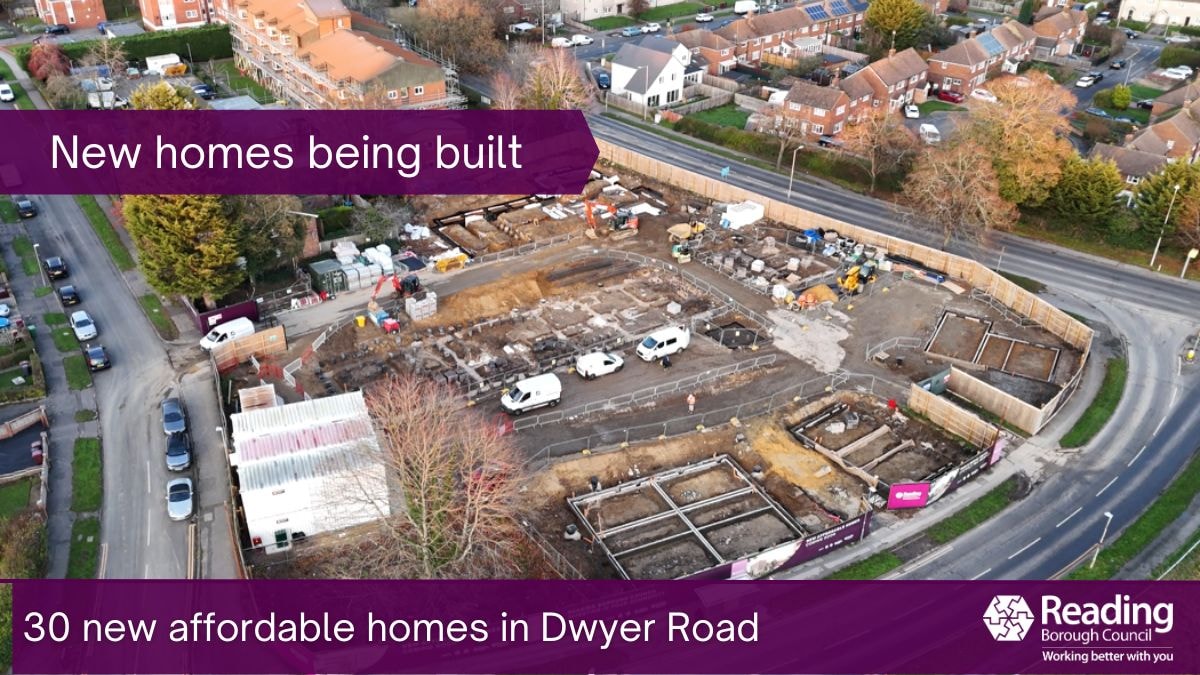
Groundworks at Dwyer Road in late 2025, with foundations visible across the former care-home site. Image source: Reading Borough Council.
Planning permission was confirmed in December 2023. Work began in summer 2025, and the council's December 2025 site update said most groundworks were complete and the first bricks had been laid. Francis Construction is the delivery partner. The same update stated that residents were expected to move in during 2027, which is consistent with completion in the 2026/27 financial year.
Amethyst Lane
Amethyst Lane provides 17 affordable family houses alongside a new respite-care facility. The housing mix comprises ten three-bedroom and seven four-bedroom homes. Planning permission was approved with Dwyer Road in December 2023 after the required Section 106 agreements.
The council reported Hexham Road and Amethyst Lane on site by the first quarter of 2025/26. The June 2026 update retained Amethyst Lane within the 89 homes expected to complete during the financial year. Public reporting is less detailed than for Hexham Road and Dwyer Road, so practical completion and handover remain the next evidence points to monitor.
Battle Street: 62 homes and care facilities
Battle Street will redevelop the 1.3-acre former Central Pool site at the corner of Battle Street and Bedford Road. The consented mix is:
- 20 general-needs homes;
- 29 sheltered one-bedroom flats for people aged over 55;
- 13 supported-living flats; and
- an older person's day opportunities centre.
The design follows Passivhaus principles and includes solar panels, electric-vehicle charging, new planting, gardens, roof terraces and a courtyard. The programme combines mainstream housing with adult social care, so completion of the care facility and supported accommodation matters alongside the headline home count.
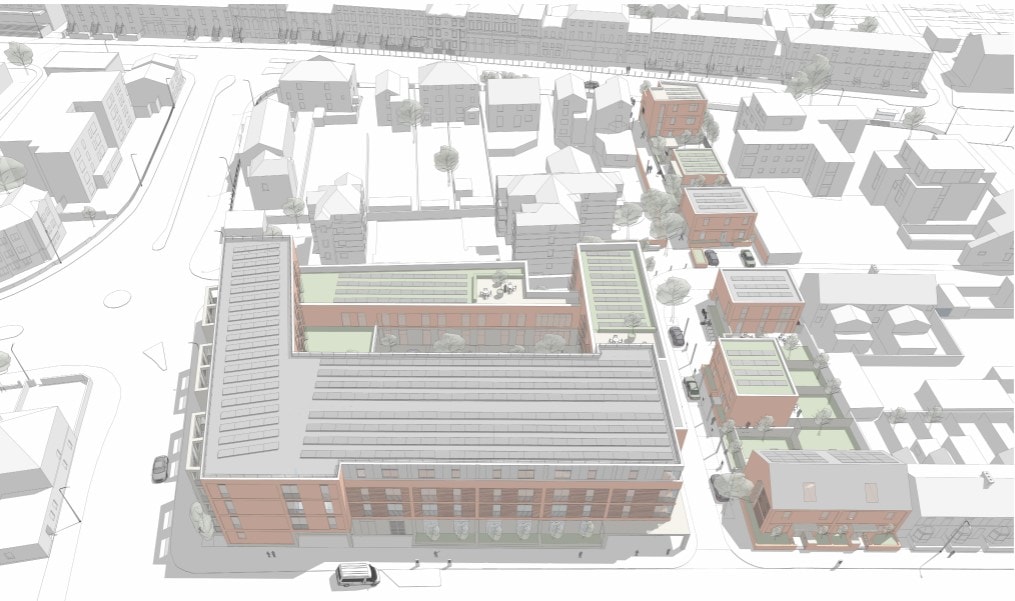
The approved Battle Street proposal on the former Central Pool land. It is a design visual, not a photograph of completed construction. Image source: Reading Borough Council.
Planning committee approved the scheme in March 2023. Delivery took longer than the early programme suggested. By March 2026, GRAHAM had been named as construction partner and the council said remedial work would precede a summer start. The 15 June 2026 committee report described the detailed design and full cost plan as being finalised and targeted a late-summer 2026 start on site. The homes and day centre are stated to complete in summer 2028.
The report also identifies private rights, including rights of light, that could restrict delivery. It proposes using statutory powers under Section 203 of the Housing and Planning Act 2016 where justified, with compensation under Section 204. That legal route is an enabling protection, not proof that every private-right issue has already been resolved.
Southcote Lane and Dee Park Phase 3
The former Southcote Library site is being tested for 14 council-owned homes: ten two-bedroom flats, three three-bedroom flats and one wheelchair-accessible one-bedroom flat. The June 2026 committee paper places it at feasibility stage, with a multi-disciplinary team progressing RIBA stages 0 to 3 and a pre-application planning submission. Further community engagement is promised as the design develops.
Earlier monitoring recorded demolition and diversion works at Southcote Lane, but those enabling activities should not be confused with construction of an approved 14-home scheme. The home total and mix remain indicative until an application is submitted and determined.
Dee Park Phase 3 is the largest pipeline component, expected to provide 190 homes with a range of sizes including larger family homes. The first two Dee Park phases delivered 515 homes, 60 extra-care apartments, a community centre, a shop and school refurbishment. Phase 3 builds on that longer estate-regeneration programme but does not yet have the same delivery status as the first two phases.
The council has procured work for a new Locally Equipped Area for Play and Local Area for Play near the community centre, with the play scheme expected to start in autumn 2026. That is a separate consented improvement and should not be reported as commencement of the 190-home phase.
For Phase 3 itself, the June paper seeks land appropriation and a route to address rights of way, access rights, easements and possible rights of light. It states that a further update will follow once planning permission has been obtained. A submitted and validated housing application, determination, final tenure mix and delivery agreement are therefore key future milestones.
What has already been delivered
The current programme rests on a delivery record extending back to 2013. A January 2021 council report said the programme had then delivered 173 homes, comprising 138 new builds and 35 acquisitions. By December 2025, the council's total had reached 421.
Recent completed examples include 37 homes at North Street, 15 key-worker flats at the former Arthur Hill pool, smaller infill sites and 46 homes at Wensley Road. The Wensley homes formally opened in January 2026, with allocations intended to allow existing estate residents to remain in their community.
Acquisitions form another strand. Sixteen council homes at Watchman's Place were acquired through a Section 106 agreement in August 2025. The June 2026 report says the council plans to acquire four additional properties a year under Phase 4, alongside Local Authority Housing Fund delivery.
This history is useful evidence that the council can complete and let homes, but it does not remove the planning, funding or construction risks attached to the future 362-home pipeline.
Funding and delivery controls
The programme uses a blend of:
- Housing Revenue Account borrowing;
- retained Right to Buy receipts;
- developer contributions secured through Section 106 agreements; and
- Homes England grant where available.
The Housing and Communities Service Plan associated £70.921 million of Housing Revenue Account resources and £9.493 million of General Fund resources with the programme to 2028, while warning that the figures were subject to variation and did not cover every scheme's full cost. The later June committee report keeps detailed scheme forecasts in a confidential financial annex.
Every scheme must continue to pass viability tests before construction. Costs, grant availability, borrowing, rental income and long-term maintenance all affect the 30-year Housing Revenue Account business plan. An approved programme budget therefore does not guarantee that every early-stage site will proceed with its current home count.
The June report also sought permission for grant bids, acquisitions, contracts, land appropriation and statutory action where private rights obstruct development. Readers should distinguish those delegated authorities from completed procurements or unconditional construction commitments.
The council's recorded discussion is available in the 15 June 2026 Policy Committee webcast, beginning at agenda item 10.
Housing and affordability implications
The programme's direct purpose is to expand council-owned housing available at affordable or social rents. That is materially different from a private development carrying a smaller affordable-housing percentage. The homes are intended to remain within the council's stock and serve households on the housing register, older residents, people needing supported living and households needing larger family homes.
The council's March 2026 plan says house prices in Reading are 9.5 times average household incomes. That affordability pressure helps explain the focus on social rent and specialist provision. Delivering 362 homes would not resolve the borough's housing shortage by itself, but it could reduce reliance on more expensive temporary or private accommodation for some households and widen options within the council stock.
The effect will depend on actual handovers, allocations and tenure. Early-stage sites may change through planning and viability. The correct evidence to track is completed and occupied homes, not only committee approvals or pipeline totals.
Rental-market implications
The programme primarily adds council-owned homes rather than conventional market-rent apartments. Its most direct rental effect is therefore qualitative: more social-rent and supported housing could give eligible households an alternative to the private rented sector and may reduce some pressure on temporary accommodation.
At borough scale, 362 homes delivered over several years are unlikely to determine market rents on their own. Reading's private rents will continue to reflect employment, household demand, mortgage costs, wider supply and the mix of new development. The programme should not be used to forecast private rent falls, rental returns or capital growth.
There may be localised effects around individual sites. New homes, public-realm work and community facilities can improve an estate's physical environment, while construction can temporarily affect traffic, noise and access. Evidence should be assessed site by site and after delivery rather than converted into a blanket "regeneration premium."
Sustainability and design
Reading's stated approach is to build to Passivhaus principles where possible, using a fabric-first design intended to reduce heat loss, emissions and running costs. Dwyer Road, Battle Street and other phases also refer to solar generation, electric-vehicle charging, sustainable materials and biodiversity improvements.
These commitments are valuable for council tenants because energy performance affects household bills as well as carbon emissions. However, "Passivhaus principles" is not necessarily the same as certified Passivhaus performance. Completion-stage energy evidence, air-tightness testing, overheating assessment and post-occupancy performance will provide stronger proof.
Accessibility also needs to be judged beyond minimum housing numbers. The programme includes wheelchair-accessible homes, sheltered flats, supported living, respite care and day opportunities facilities. Final design, staffing, transport and long-term service funding will determine whether those facilities meet residents' needs.
Risks and watchpoints
- Construction handover: confirm practical completion and occupation of the 89 Hexham Road, Dwyer Road and Amethyst Lane homes.
- Battle Street mobilisation: verify a substantive construction start, final contract position and progress toward summer 2028.
- Southcote Lane planning: look for consultation, a validated application and a confirmed housing mix.
- Dee Park Phase 3 consent: track the 190-home application, land appropriation, rights, tenure and delivery partner.
- Programme accounting: keep the 362 new-build pipeline separate from the 421 already delivered and the additional acquisition programme.
- Grant and viability: confirm Homes England awards and whether each scheme remains viable within the Housing Revenue Account plan.
- Social-rent delivery: check final tenancy and allocation arrangements rather than relying on broad affordability language.
- Design performance: verify energy, accessibility and biodiversity commitments through detailed approvals and completed buildings.
- Community facilities: monitor delivery and operation of the Hexham Road, Battle Street, Amethyst Lane and Whitley Wood facilities.
Detailed programme history
| Date | Milestone | What happened | Source |
|---|---|---|---|
| 2013 | Programme established | Reading's Local Authority Newbuild Programme began as councils regained capacity to build and acquire homes for their own stock. | January 2021 Policy Committee report |
| 17 July 2017 | Phase 2 investment approved | The programme had delivered 63 of its first 148 homes; Policy Committee considered up to £19.9 million for the next phase, then estimated at around 100 homes. | July 2017 Policy Committee report |
| October 2018 | Borrowing cap removed | Removal of the national Housing Revenue Account borrowing cap expanded councils' ability to finance new housing. | January 2021 Policy Committee report |
| 18 January 2021 | Wensley and wider pipeline advanced | Reading recorded 173 delivered homes and about 110 more in progress while approving land and delivery steps for Wensley Road. | January 2021 Policy Committee report |
| 9 November 2022 | Phase 4 progressed | The council proposed a further £29.6 million for up to 87 homes and continued acquisitions. | Phase 4 committee report |
| 1 March 2023 | Battle Street approved | Planning committee approved 62 homes and care facilities on the former Central Pool site. | Reading Borough Council confirmation of the approved scheme |
| 6 December 2023 | Dwyer and Amethyst approved | Planning permission was approved for 30 homes at Dwyer Road and 17 homes plus respite care at Amethyst Lane. | Reading Borough Council planning announcement |
| 20 January 2025 | Construction and feasibility authority | Policy Committee advanced Hexham Road, Dwyer Road and Amethyst Lane toward construction and funded feasibility for Battle Street, Southcote Lane and Dee Park Phase 3. | June 2026 LANB report recording the decision |
| Summer 2025 | Active construction expanded | Dwyer Road moved on site; Hexham Road and Amethyst Lane were also recorded in delivery. | Council Plan quarter-two monitoring |
| 14 August 2025 | Watchman's Place acquired | Sixteen new homes transferred to council ownership through a Section 106 agreement. | Reading Borough Council acquisition announcement |
| 24 November 2025 | Hexham Road structure completed | The council marked completion of The Willows' four-storey structural frame. | Reading Borough Council Hexham Road update |
| 3 December 2025 | Dwyer Road first bricks laid | Groundworks were mostly complete and vertical construction was beginning. | Reading Borough Council Dwyer Road update |
| December 2025 | Delivered total reached 421 | The council recorded 421 homes delivered through new build and acquisitions since the programme began. | June 2026 LANB report |
| 28 January 2026 | Wensley Road opened | Forty-six new council homes formally opened as part of the wider estate-improvement project. | Reading Borough Council Wensley update |
| 18 March 2026 | Battle Street delivery updated | GRAHAM was identified as construction partner, with a summer 2026 start and summer 2028 completion stated. | Reading Borough Council Battle Street announcement |
| 10 June 2026 | Current 362-home pipeline published | Reading identified 89 homes due in the financial year and detailed Battle Street, Southcote Lane, Dee Park and acquisition plans. | Reading Borough Council programme announcement |
| 15 June 2026 | Programme reviewed by Policy Committee | The committee considered updated budgets, grant authority, contracts, acquisitions, land powers and next steps across the programme. | Committee report and recorded meeting |
Current assessment
Reading's Local Authority Newbuild Programme has a substantial completed track record and three active construction sites. The 89 homes now on site provide stronger near-term evidence than the broader 362-home ambition. Battle Street also has a defined partner, consented mix and delivery window, although its physical construction milestone still needs verification.
The remainder should be treated as a pipeline. Southcote Lane is in feasibility and pre-application work; Dee Park Phase 3 still needs a planning and land route; acquisitions operate under a separate count. The programme is therefore credible and active, but its final scale and timing depend on funding, viability, planning, procurement and handover at each individual site.
For residents, the strongest potential benefit is not a speculative property-price effect. It is the addition of council-owned social-rent, sheltered, supported and family housing, together with care and community facilities. Progress should be measured through consented schemes, substantive starts, completed homes and occupied tenancies.
Rental impact note
Rental impact is qualitative. The programme primarily expands council-owned affordable and social-rent stock; it does not support a numerical forecast for private rents, rental returns or capital values.