
Project facts
| Topic | Current public position |
|---|---|
| Site | Council-owned former Civic Centre land around Hosier Street, Dusseldorf Way and The Hexagon, Reading RG1 |
| Site area | 5.2 acres, or about 2.1 hectares |
| Development partners | Reading Borough Council and McLaren Living |
| Current phase | Development agreement signed; land, lease, design and pre-planning work continuing |
| Publicly stated value | £250 million development ambition, not a confirmed construction contract value |
| Housing ambition | More than 600 homes, with 30% described as affordable across a range of tenures |
| Other uses | 40,000 sq ft of workspace, retail, food and drink uses, a 102-bedroom hotel and a community hub |
| Public realm | A proposed Hexagon Square, improved setting for Reading Minster and Charter Market provision on Hosier Street |
| Planning status | No verified Minster Quarter Central application or consent identified; the neighbouring Broad Street Mall scheme has a separate planning position |
| Programme | Council service planning runs to March 2032; detailed construction and completion dates remain unconfirmed |
The current position
Signing the development agreement in November 2025 was the most important recent commercial milestone. It confirmed McLaren Living as the council's delivery partner and established a contractual route for the project to advance. Earlier council papers explained that the agreement was intended to place obligations on the selected developer to progress design, formal planning consent and a start on site.
The agreement did not itself grant planning permission. McLaren's announcement said it would continue working with the council, stakeholders and the community as plans progress. The distinction matters: the published housing, hotel and commercial-space figures describe the current development proposition, but they can still change through design, consultation, viability work and the planning process.
Land arrangements advanced again in early 2026. The council's open-space disposal notice covered approximately 1.5 hectares within the wider site and proposed long leases to the developer. The objection period closed on 19 March 2026. On 13 April, the Policy Committee considered “Land at Minster Quarter Central”; the council's meeting record shows the recommendations were approved. These are enabling legal decisions, not evidence that building work has started.
The most accurate description in July 2026 is land and design work before a planning application. The next decisive public milestones should be consultation material, a submitted application with a fixed schedule of accommodation, planning determination, satisfaction of development-agreement conditions and a funded construction programme.
What is proposed
The current vision is for a mixed-use neighbourhood rather than a single apartment development. McLaren Living's development-agreement announcement sets out four principal elements:
- more than 600 homes, including a 30% affordable-housing commitment across different tenures;
- 40,000 sq ft of workspace, retail, food and drink space, plus a 102-bedroom hotel;
- a community hub and local employment opportunities; and
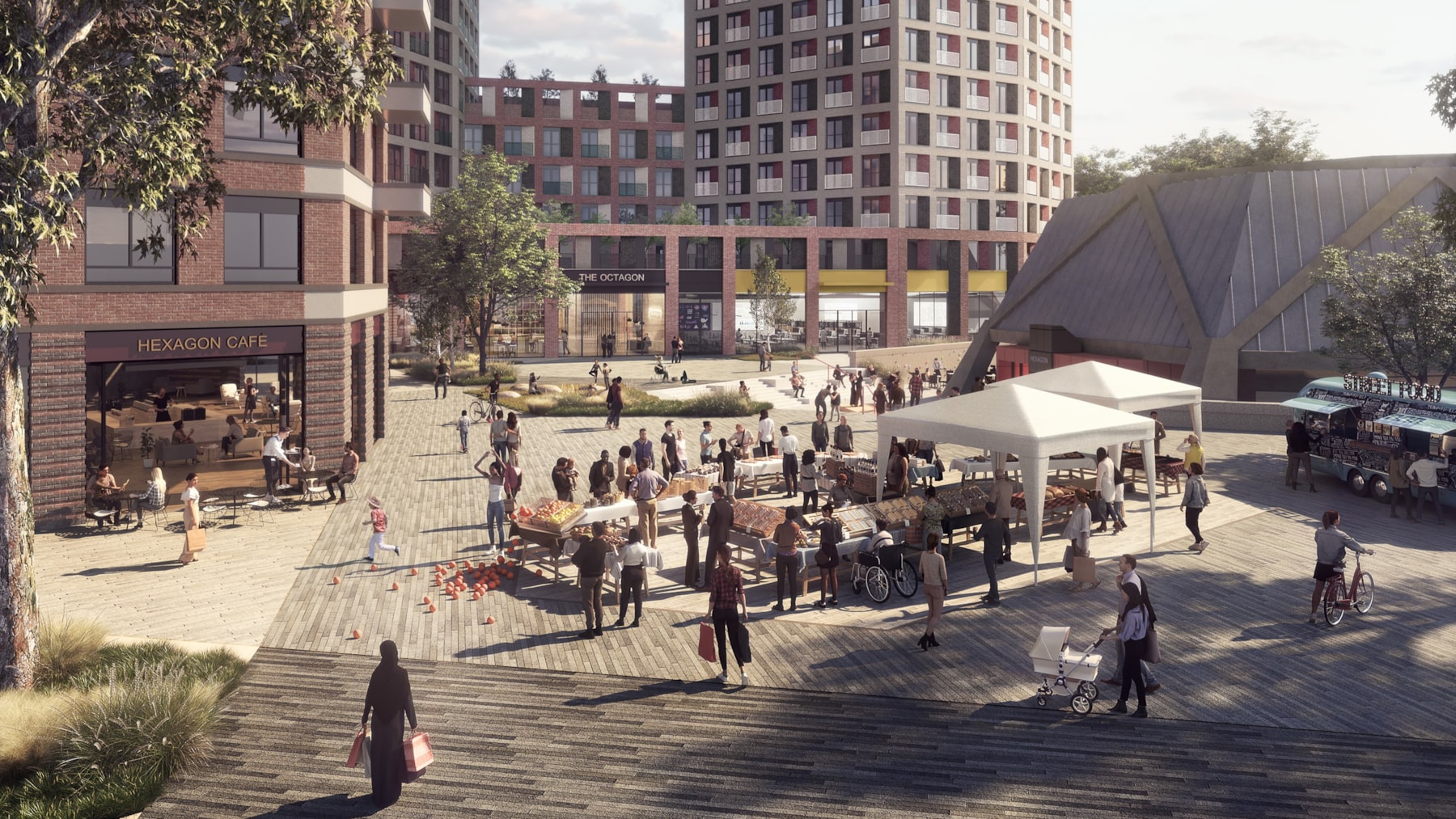
- new public realm, led by a proposed Hexagon Square between the theatre and the new buildings.
The council also wants to retain provision for the Charter Market on Hosier Street, improve the route and setting around Reading Minster and turn Dusseldorf Way into a greener boulevard. Dedicated pedestrian and cycle routes, all-electric energy systems, on-site renewable generation and a biodiversity net gain formed part of the vision presented when McLaren was selected in 2024.
These details are substantial enough to explain the intended place, but they are not a substitute for a planning application. Building heights, the exact number and tenure of homes, access, servicing, public-realm ownership, hotel delivery and environmental performance will need to be tested in formal documents.
A site shaped by the 1970s redevelopment
Minster Quarter's physical complexity comes from Reading's 1970s civic redevelopment. The Hexagon, shopping centre, car parks, roads and raised pedestrian structures were designed as a connected system. That legacy creates level changes, ageing concrete structures, difficult servicing arrangements and overlapping land interests.
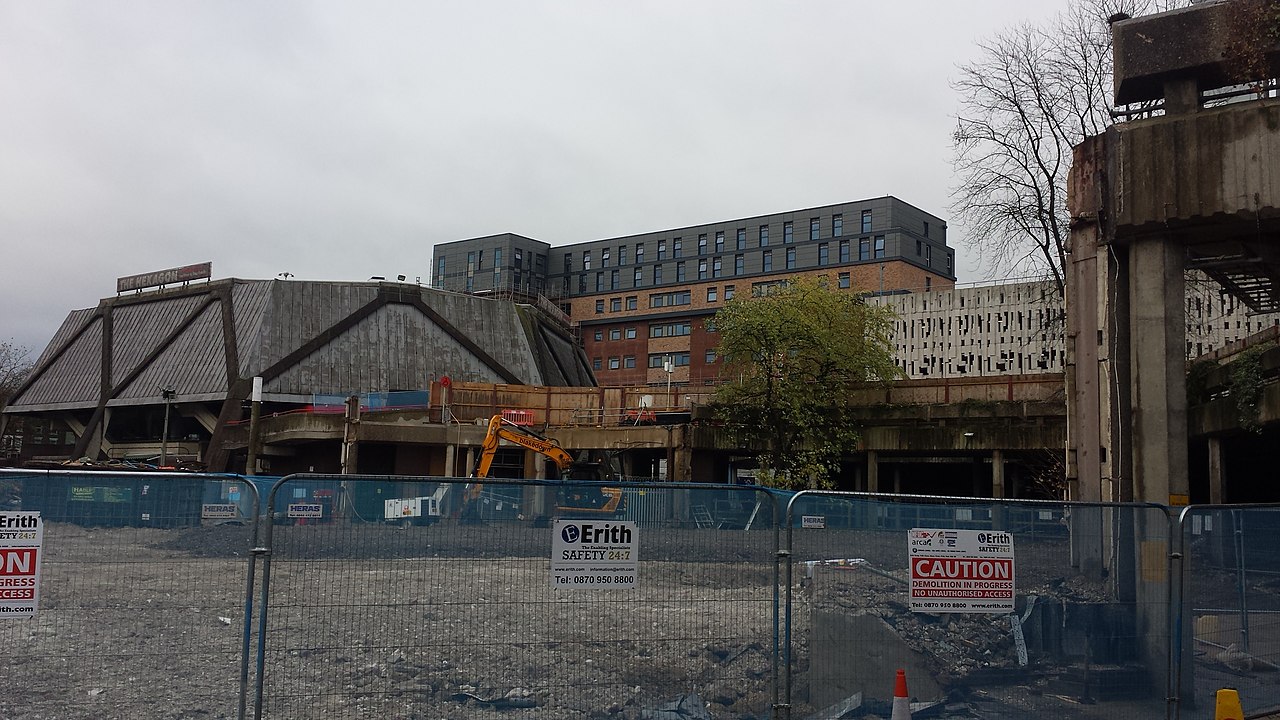
The former Civic Offices site after demolition in November 2016, with The Hexagon visible to the left. Photograph by Chris j wood, licensed CC BY-SA 4.0. Image source: Wikimedia Commons.
The cleared land is strategically strong: it is in the town centre, close to shops and services and roughly a ten-minute walk from Reading station. At the same time, its relationship with the Inner Distribution Road, Broad Street Mall, The Hexagon and adjoining owners means delivery must be coordinated rather than planned as an isolated red-line site.
The council's December 2018 Minster Quarter Area Development Framework established the long-term direction for reconnecting this part of Reading's historic centre. The site also sits within the West Side Opportunity Area in the Local Plan. Those policies support substantial mixed-use development, but do not grant consent for McLaren's current scheme.
The Hexagon and cultural setting
The Hexagon is intended to remain an active cultural anchor, not become an object left behind new housing. The proposed Hexagon Square is designed as its civic forecourt, while the council has separately pursued a studio-theatre extension and improvements to its cultural facilities.
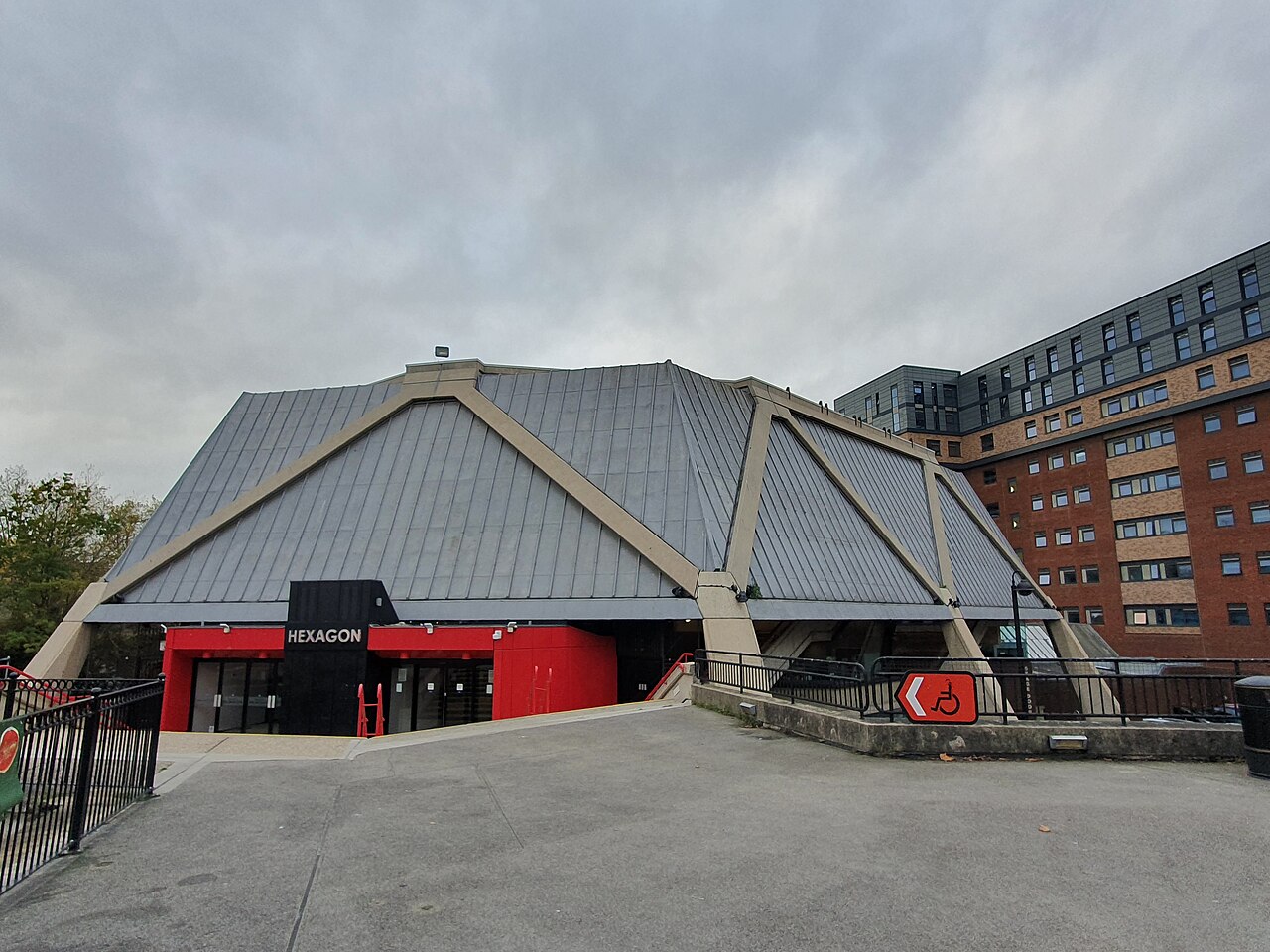
The Hexagon theatre in November 2022. The proposed new public square would reshape the venue's surrounding townscape. Photograph by Gazamp, licensed CC BY-SA 4.0. Image source: Wikimedia Commons.
The cultural projects have their own approvals, budgets and delivery decisions. They should not be reported as if they form one planning consent with Minster Quarter Central. They are connected through placemaking and public realm, and the council's 2024 committee material described the studio theatre as a contribution to the wider Minster Quarter ambition.
The relationship will need careful construction planning. The Hexagon must continue to operate safely while adjoining sites change, and future access, servicing, crowd movement and event management must work with a new residential population.
Minster Quarter Central and Broad Street Mall are separate schemes
The name “Minster Quarter” is used for a wider regeneration area containing several landholdings. Minster Quarter Central is the council-owned former Civic Centre site covered by this report. Broad Street Mall is a neighbouring, separately owned development led by AEW with McLaren Living as developer. The former Thames Valley Police site, the Magistrates' Court and cultural projects form other pieces of the wider area.
This distinction prevents a common status error. Reading's Planning Applications Committee resolved in April 2025 to grant the Broad Street Mall proposal permission subject to a Section 106 agreement. That decision does not provide consent for Minster Quarter Central.
The two McLaren-led schemes are nevertheless interdependent. A September 2025 council report described access, car-park, construction logistics and land-management agreements needed across both sites. It also recorded a wider ambition of more than 1,200 homes when the two principal developments are combined. A coordinated build sequence could reduce conflict and create coherent routes; unresolved interfaces could delay either project.
Funding, leases and delivery controls
Reading Borough Council secured £2 million from the Brownfield Land Release Fund in 2021. The funding was intended for preparatory work, including changes to concrete structures, access roads, utilities and early site release. It should not be confused with full funding for the £250 million scheme.
The council chose a development-agreement and long-lease structure instead of selling the land without delivery controls. The January 2024 developer-selection report said the agreement would protect obligations on planning progress, delivery pace, affordable housing and public realm. It also identified land appropriation, title work and interface agreements as necessary implementation tasks.
The council's current Infrastructure, Economy and Capital Project Service Plan places partnership delivery between July 2022 and March 2032. That is a council programme window, not a promise that all homes will complete on a particular date. A credible construction timetable will require planning, lease conditions, funding, procurement and coordinated logistics to be resolved.
Housing and affordability
More than 600 homes would be a major addition to central Reading's housing supply. The stated 30% affordable commitment is particularly important in a high-demand town where the council's wider plan seeks delivery of more than 800 homes a year. The 2024 announcement referred to a range of affordable tenures and more family-sized homes, although the final tenure schedule and bedroom mix have not yet been published through an application.
The strongest housing test is therefore not the headline number alone. Readers should look for the planning schedule, the definition of “affordable,” the split between social or affordable rent, other rented products and ownership tenures, and any review mechanism linked to viability. Phasing also matters: a percentage across a whole masterplan does not reveal when affordable homes will be built or how they will be distributed.
The proposal may improve access to town-centre homes and services, but it should not be used to promise house-price growth. Values will reflect the broader Reading market, interest rates, supply, affordability and the quality and timing of delivery. The scheme's direct effects remain qualitative until planning and construction establish what is actually coming forward.
Local economy and town-centre activity
The economic case rests on bringing residents, hotel guests, workers and visitors into an underused part of the town centre. Active ground floors around Hexagon Square and Dusseldorf Way could improve footfall between the cultural venues, Broad Street Mall, St Mary's Butts and Hosier Street. The proposed hotel and commercial space would broaden activity beyond residential use.
McLaren and the council also refer to local jobs, including around 100 post-construction roles when the developer was first selected. That figure is an aspiration associated with the proposed mix, not a verified net-employment forecast. Future planning and development-agreement documents should show how local employment, training, procurement and community-space commitments will be measured.
Construction would create temporary demand for trades and suppliers. Longer-term benefits depend on the commercial units being occupied, the public spaces being managed well, the Charter Market retaining a workable location and the cultural offer drawing visitors. Empty or weakly serviced ground-floor units would not deliver the same outcome as a genuinely active mixed-use quarter.
Rental implications
A development of this scale would create substantial new rental supply if Build-to-Rent or other rented tenures form part of the final mix. McLaren Living's business includes Build-to-Rent and co-living, but the tenure of every Minster Quarter Central home has not been fixed publicly. It is therefore too early to describe the project as a particular rental product or to estimate rents.
New town-centre homes could attract households valuing rail access, cultural amenities and nearby employment. At the same time, adding hundreds of units increases supply and competition. The balance will depend on phasing, unit sizes, service charges, affordable provision and the separate Broad Street Mall pipeline.
Landlords and buyers should track real delivery evidence rather than assume a regeneration premium. Consultation, application documents, consented tenure, a signed funding route, start on site and completed occupation are progressively stronger signals. No numerical rent, rental return or capital-growth effect is supportable at the current stage.
Public realm, access and environmental commitments
The proposal's quality will be judged as much by the spaces between buildings as by the housing total. The current vision promises a new civic square, a greener Dusseldorf Way, better pedestrian and cycle connections, space for the Charter Market and an improved approach to Reading Minster.
The council also selected a bid described as all-electric, energy efficient and capable of maximising on-site renewable generation, with biodiversity gain. Those are design commitments awaiting technical proof. A planning application should provide whole-life carbon, overheating, energy, drainage, ecology, wind, daylight and transport evidence suitable for a dense town-centre scheme.
Accessibility should be tested across the site's level changes and links, not only within new buildings. The project needs legible step-free routes between St Mary's Butts, Hosier Street, The Hexagon, Broad Street Mall and the western neighbourhoods. Servicing and construction traffic must also be reconciled with theatre audiences, market activity, buses, cyclists and pedestrians.
What to watch next
- Public consultation: detailed drawings, building heights, routes and a fixed accommodation schedule.
- Planning application: confirmation that Minster Quarter Central, rather than the neighbouring mall, has entered the statutory planning process.
- Affordable-housing schedule: tenure definitions, bedroom mix, phasing and delivery protections for the stated 30% commitment.
- Land and lease completion: evidence that the long leases and any appropriation or title requirements have been completed.
- Construction interfaces: a coordinated access and logistics plan covering Broad Street Mall, The Hexagon and Minster Quarter Central.
- Funding and procurement: a funded programme, contractor appointments and dates that move beyond an indicative council window.
- Public-realm management: long-term responsibility for Hexagon Square, Dusseldorf Way and Charter Market space.
- Environmental evidence: measurable energy, carbon, biodiversity, drainage and overheating performance through planning.
Detailed project history
| Date | Milestone | What happened | Source |
|---|---|---|---|
| December 2018 | Development framework adopted | The council adopted the Minster Quarter Area Development Framework to guide reconnection and mixed-use regeneration across the wider area. | Reading Borough Council framework |
| November 2019 | Local Plan adopted | The wider Minster Quarter formed part of the West Side Opportunity Area in Reading's Local Plan. | Reading Borough Council planning policy |
| June 2021 | Delivery approach advanced | Policy Committee approved professional support and preparation of the council-owned site for a development-agreement route. | July 2022 committee report recording the decision |
| October 2021 | Brownfield funding awarded | Reading secured £2 million for enabling and site-preparation work intended to help release the first phase. | Reading Borough Council announcement |
| July 2022 | Vision and procurement approved | Policy Committee approved the project vision, priorities and authority to market the opportunity and select a partner. | July 2022 public committee pack |
| September 2022 | Development opportunity advertised | The formal procurement sought a private-sector partner for the council-owned site. | Find a Tender notice |
| Summer 2023 | Final bids evaluated | Shortlisted bidders submitted best and final offers, which the council assessed against quality, commercial and delivery criteria. | Developer-selection report |
| 22 January 2024 | Preferred bidder approved | Policy Committee selected the highest-scoring bidder, later announced as McLaren Living, and declared relevant land surplus to requirements. | Developer-selection report |
| 8 February 2024 | McLaren publicly named | The council announced McLaren Living and presented the £250 million, 600-plus-home vision. | Reading Borough Council announcement |
| 2024 to early 2025 | Due diligence continued | The partners worked through technical, legal and commercial due diligence before pre-application consultation. | February 2025 council response reported by Reading Today |
| September 2025 | Cross-site logistics advanced | The council set out land, access and construction-management interfaces between Broad Street Mall and Minster Quarter Central. | September 2025 Policy Committee pack |
| 3 November 2025 | Development agreement signed | Reading Borough Council and McLaren Living confirmed the signed agreement for Minster Quarter Central. | McLaren Living announcement |
| 26 February 2026 | Open-space disposal notice issued | The council proposed granting long leases over approximately 1.5 hectares of open-space land within the site. | Reading Borough Council public notice |
| 13 April 2026 | Land recommendations approved | Policy Committee considered land at Minster Quarter Central and approved the recommendations following the statutory notice process. | Reading Borough Council meeting record |
Current assessment
Minster Quarter Central has a credible public owner, an appointed development partner, a signed development agreement and a detailed mixed-use ambition. Those are stronger foundations than an uncommitted masterplan. The 2026 land decisions also show that legal preparation is continuing.
The project has not yet crossed the planning or construction threshold. The published CGI and headline numbers should be presented as the current vision, not an approved design. Delivery confidence may rise when consultation produces a fixed proposal, a planning application is submitted, the affordable-housing and environmental commitments are secured, and a funded build programme is announced.
For Reading, the opportunity is significant: new homes and active public space could reconnect a fragmented civic area with the historic town centre and strengthen The Hexagon's setting. The main risks are programme slippage, cross-site logistics, design and viability changes, and dilution of the affordable-housing or public-realm offer before consent.
Rental impact note
Rental impact is qualitative at this stage. Treat the housing and rental discussion as evidence-led context, not a promise of future rent, rental return or capital-value movement.