
Project facts
| Topic | Current public position |
|---|---|
| Site | Former Poole Power Station site, Hamworthy, Poole, BH15 |
| Land area | About 40 acres, or 16 hectares |
| Ownership | BCP Council, following acquisition completed in 2020 |
| Current phase | Development brief, technical due diligence, funding and delivery-route work |
| Housing ambition | About 900 homes in recent council reports; earlier policy and acquisition material used 830 or 850 |
| Other uses | A residential-led mixed-use neighbourhood with non-residential space, jobs and public realm |
| Planning status | Strategic allocation and development work, but no current site-wide planning consent or submitted delivery scheme identified |
| Homes England role | Due diligence and option development; a final role as funder, enabler or delivery partner has not been announced |
| Delivery programme | Long-term and not confirmed |
The current position
The clearest current account is BCP Council's January 2026 Regeneration Progress Report. It says the council spent the previous 12 months preparing a costed delivery strategy and development brief, intended to guide a future planning application and phased development. That work is complementary to a draft Poole Quays Design Code and a 2023 characterisation study, but the council cautions that those documents do not presently carry planning weight.
Homes England secured a £250,000 revenue budget for its own due diligence, including surveys and infrastructure cost work. The findings confirmed that significant enabling works are needed before above-ground residential construction can begin. The council said options would be prepared once Homes England clarified whether it wished to act as a funder, enabler or delivery partner. A sale or joint venture could then be considered alongside any funding package.
No later official public decision was identified confirming that one of those routes has been selected. There is also no announced master developer, site-wide planning submission or construction start. The practical description is therefore pre-planning and funding strategy, not delivery.
Why the housing numbers differ
Several housing totals appear in the public record because the site has passed through different owners, policy documents and design exercises.
- The council's current Holes Bay project page still uses the acquisition-era figure of up to 830 homes.
- The 2019 acquisition strategy referred to 850 homes in the Poole Local Plan.
- A previous private-sector concept consulted on in 2011 and submitted in outline in 2012 proposed about 1,350 homes, but that route later stalled and is not the council's present scheme.
- The council's 2024 regeneration update described approximately 900 homes.
- The 2025 regeneration report used an aspiration of 900-plus homes alongside non-residential space and a choice of tenures.
About 900 homes is the most useful current shorthand, but it remains a capacity ambition rather than an approved total. A future planning application, environmental work, infrastructure design and viability testing could change the number and mix.
What the place is intended to become
The consistent policy direction is a new waterfront neighbourhood rather than a housing estate isolated from its surroundings. Council material links the former power station land with Hamworthy, Poole Old Town, the town centre, the working port and nearby regeneration sites. The long-term intention includes homes across different tenures, non-residential space, jobs, public realm and better access to the water.
The council's 2021 vision launch described low-carbon housing and new employment and commercial opportunities. The subsequent FuturePlaces exercise explored a waterfront urban village and asked residents about architecture, green space, materials and public realm. Those ideas remain useful evidence of ambition, but they are not equivalent to planning approval.
BCP Council's acquisition video provides a short official introduction to the site and its public ownership.
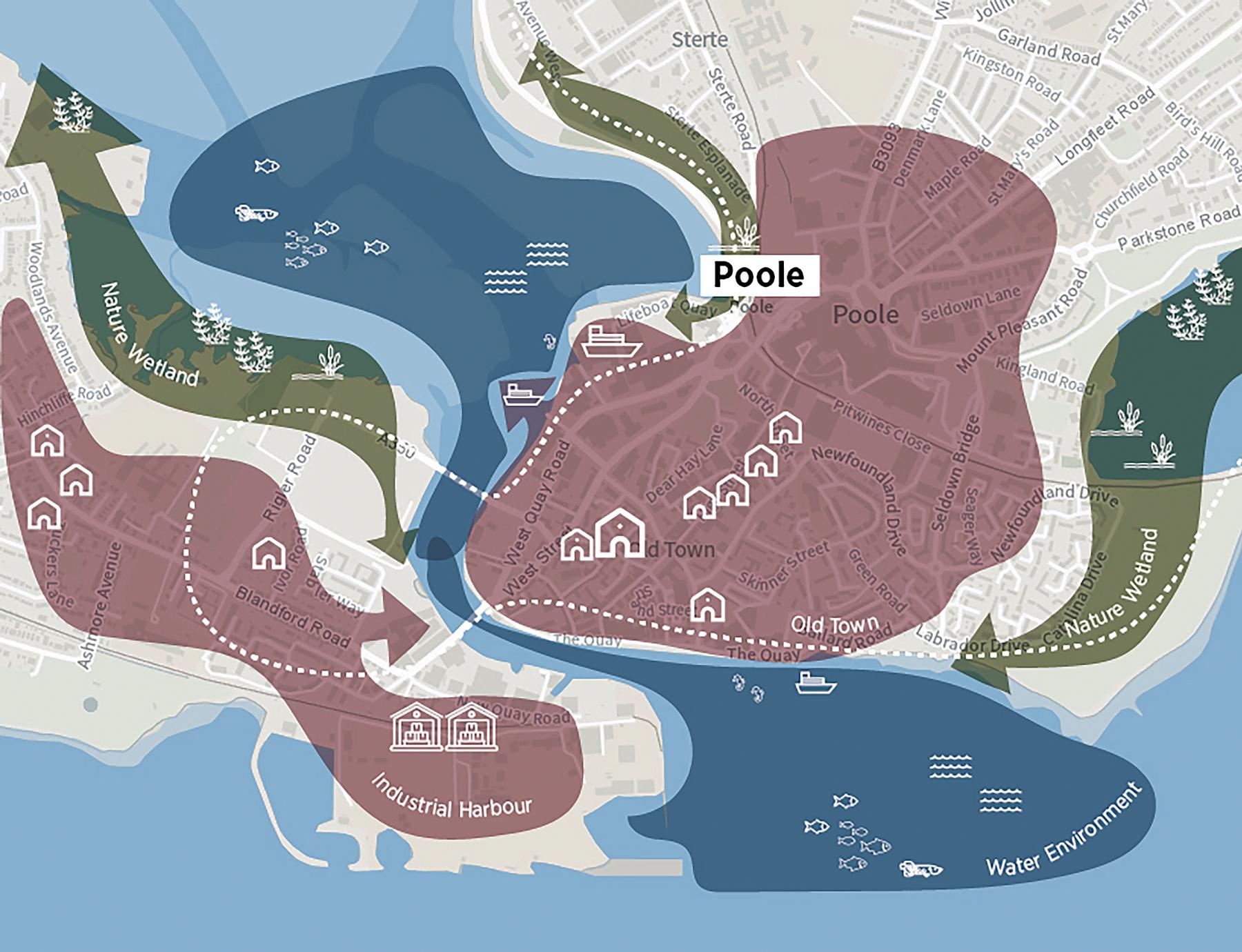
This 2021/22 concept work shows Holes Bay in relation to Poole, Hamworthy, wetland and harbour character areas. It was commissioned through FuturePlaces and should not be read as a current planning application or consented layout. Image source: C.F. Moller Architects.
Planning and ownership history
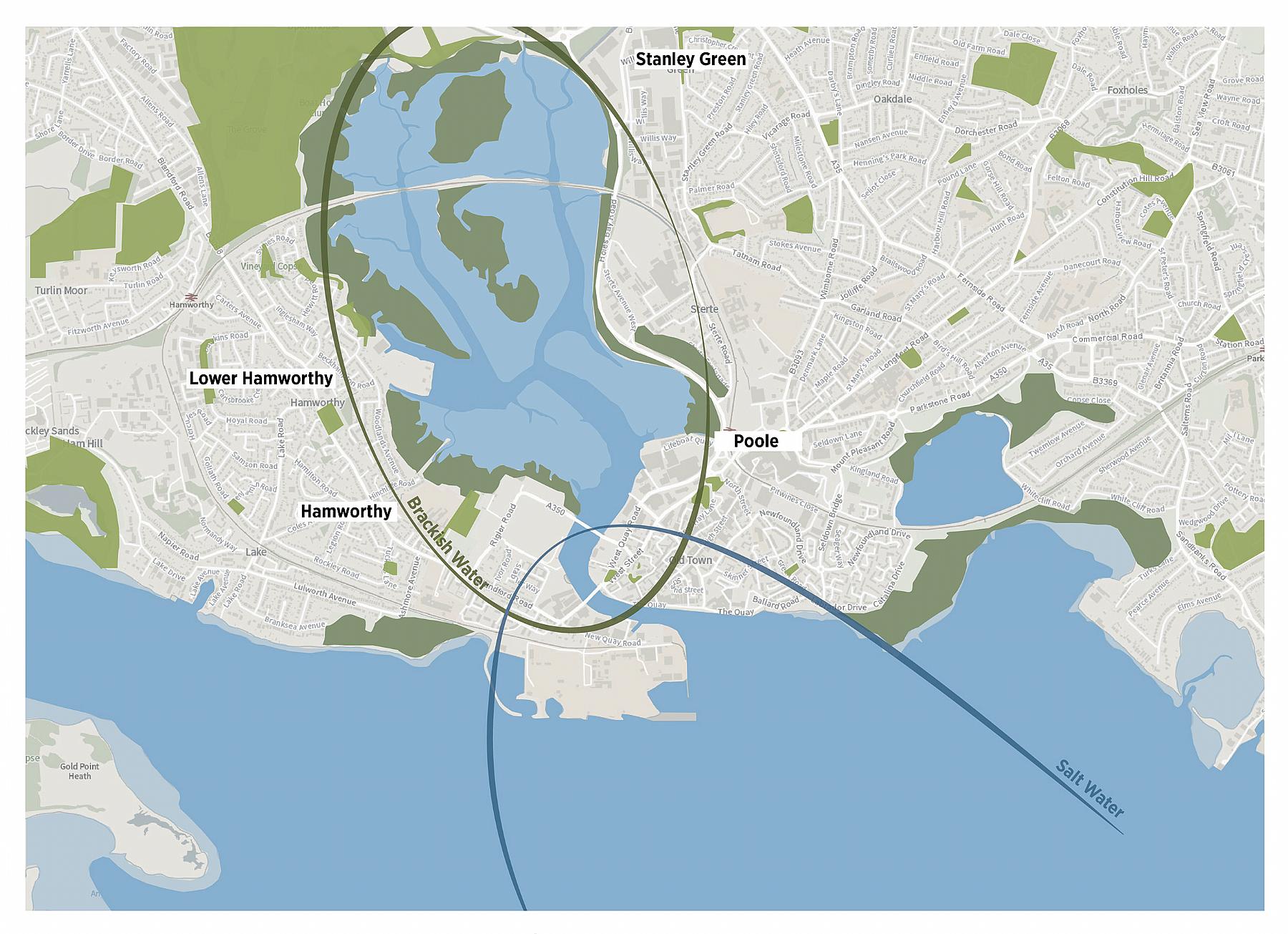
The site's difficulty is not a shortage of proposals. It has been allocated for development for decades, while private plans, infrastructure funding and public-sector delivery models have changed around it.
After the power station closed in 1994, the land remained vacant. A private owner consulted on a large mixed-use proposal in 2011 and submitted outline plans in 2012. By 2017, the former Borough of Poole was pursuing £5 million of Dorset Local Enterprise Partnership funding to help close the infrastructure viability gap. The report warned that without intervention the site could remain undeveloped.
The private-sector route subsequently stalled. BCP Council considered an acquisition strategy in July 2019 and reached an agreement in principle with L&Q Estates and Land Improvements Holdings in 2020. The purchase completed in September 2020, supported by the £5 million Local Growth Fund allocation. Public ownership reduced land-control uncertainty, but it did not remove the cost of preparing an industrial waterfront site for development.
FuturePlaces, the council's regeneration company, later commissioned strategic masterplan work and consultation. The council decided in September 2023 to close the company, and the regeneration programme transferred in-house on 1 November 2023. Current council reports distinguish the resulting development brief and delivery strategy from any earlier illustrative masterplan.
The enabling challenge
The former power station platform must be made suitable, accessible and resilient before homes can be built. The main issues identified across council reports are remediation, flood protection, transport infrastructure, utilities, ecological mitigation and the condition of the waterfront edge.
A March 2025 strategic infrastructure report identified £25.4 million that could help support the Local Plan allocation: £11.3 million for flood defences, £6.3 million for land remediation and £4.2 million for transport mitigation. The same report said that funding might not be required from Community Infrastructure Levy receipts if Homes England grant could be secured. These were infrastructure-planning figures, not confirmation that a complete development budget had been approved.
Transport resilience also matters. Poole Bridge and Twin Sails Bridge are the principal links between Hamworthy and Poole town centre. A 2025 Port of Poole Bridges report described reliable bridge infrastructure as a key enabler for the Holes Bay site. That wider bridges programme should not be confused with a construction start on the former power station land.
Ecology, water and public realm
Holes Bay forms part of an ecologically sensitive harbour setting with tidal water, mudflats, saltmarsh and bird habitat. The council's public information on Holes Bay highlights its waterside walking and cycling route and its role within the Great Heath Living Landscape.
The January 2026 update says Homes England consultants were working on biodiversity net gain and flood-risk solutions while the council developed a wider place vision with adjacent landowners. Any future scheme will have to reconcile a substantial housing allocation with habitat protection, flood resilience and a usable public waterfront. These constraints are central to the site's design and viability, not details to resolve after planning.
Earlier planning guidance also expected development to create a public quayside, connect to the port link road and protect the harbour edge. The exact alignment and form will need to be tested through a current planning process.
Funding and delivery route
The council's preferred outcome is partnership delivery, but the structure remains open. Options discussed publicly include a conditional sale, a joint venture, a master developer, forward funding and a stronger Homes England role. The 2025 report said the council had engaged a range of potential partners; the 2026 update recorded contact with more than 20 investors and developers.
Market interest is not the same as an appointed partner. The council's due diligence found that the enabling package is too substantial for a straightforward private development to absorb without public support. The critical next evidence will be a formal decision about Homes England's role, an agreed funding package, a delivery agreement and a planning strategy capable of producing a viable phased application.
Housing and local property context
A scheme of around 900 homes would be material for Hamworthy and Poole, especially if it provides a genuine mix of market and affordable tenures. It could also strengthen the physical relationship between Hamworthy, the town centre and the waterfront. Those effects depend on the final tenure mix, phasing, public realm and supporting infrastructure, none of which is fixed.
The project should not be treated as evidence of guaranteed house-price or rent movement. It is too early to attach a numerical market effect to land that has no confirmed consent, delivery partner or programme. For residents, buyers and landlords, the useful indicators are concrete delivery milestones: a submitted application, an approved infrastructure and remediation package, a signed partner agreement, enabling works and then completed homes.
What to watch next
- Homes England decision: confirmation of whether the agency will fund, enable or help deliver the project.
- Delivery structure: a council decision on sale, joint venture or another partnership route.
- Planning route: publication of the development brief followed by pre-application work, environmental assessment and a site-wide or phased application.
- Enabling funding: an approved package for remediation, flood resilience, transport and utilities.
- Housing mix: a settled total and tenure breakdown, including the affordable-housing offer.
- Environmental design: evidence that flood risk, biodiversity net gain and harbour protections have shaped the layout.
- Programme: dates for enabling works and construction only after the funding and planning dependencies are resolved.
Detailed project history
| Date | Milestone | What happened | Source |
|---|---|---|---|
| 1994 | Power station closed | The former coal-fired power station closed and the waterfront site was left vacant. | BCP Council project page |
| July 2011 | Private consultation began | A previous private owner opened consultation on a large mixed-use waterfront proposal. That proposal did not become the council's present scheme. | Archived private-project history |
| March 2012 | Earlier outline proposal submitted | The former private scheme submitted an outline application for about 1,350 homes and mixed uses; the route later stalled. | Archived private-project history |
| 2015 | Housing Zone designation | Government designated the site as a Housing Zone, strengthening its strategic housing role. | BCP Council acquisition strategy |
| September 2017 | Infrastructure funding route approved | The former Borough of Poole advanced a £5 million Dorset LEP funding package intended to address the site's viability gap. | 2017 council report |
| July 2019 | Public acquisition strategy considered | BCP Council said the private-led development had stalled and considered bringing the land into public ownership. | BCP Council announcement |
| September 2020 | Council acquisition completed | BCP Council completed its purchase of the 40-acre site with support from the £5 million Local Growth Fund allocation. | Dorset LEP completion notice |
| March 2021 | Public vision work launched | The council began early engagement on a low-carbon mixed-use waterfront neighbourhood and a minimum 830-home ambition. | BCP Council vision launch |
| January 2022 | Waterfront design team appointed | FuturePlaces appointed C.F. Moller Architects for strategic masterplan and public-realm work. The output was illustrative, not a planning consent. | C.F. Moller appointment |
| October 2022 | Wider consultation held | FuturePlaces consulted on a waterfront-quarter vision with around 900 homes. | Consultation report |
| November 2023 | Programme moved in-house | FuturePlaces closed and its regeneration assets and work transferred to BCP Council's in-house team. | 2025 regeneration report |
| June 2024 | Planning and technical work restated | The council reported an approximately 900-home direction and outlined development-brief, pre-application and environmental work. | 2024 regeneration update |
| March 2025 | Enabling infrastructure costs identified | Council infrastructure planning identified £25.4 million across flood defence, remediation and transport mitigation, subject to the wider funding route. | Strategic CIL report |
| January 2026 | Due diligence confirmed the funding challenge | The council reported a costed delivery strategy, development brief and £250,000 Homes England due-diligence budget, but said major enabling funding and a delivery route were still needed. | 2026 regeneration progress report |
Current assessment
Holes Bay remains one of the most significant council-owned brownfield opportunities on the south coast, but its scale should not be mistaken for delivery certainty. Public ownership, a strategic allocation and Homes England engagement are meaningful foundations. The unresolved challenge is converting them into a funded remediation and infrastructure programme, a viable planning application and an accountable delivery partnership.
The next material update is not another broad vision. It is evidence that the council and Homes England have selected a route, assigned funding and set out the planning and phasing steps that can move the former power station site from preparation into delivery.
Rental impact note
Rental impact is qualitative at this stage. Treat the rent and sales discussion as evidence-led context, not a promise of future price or rent movement.