

Central Bletchley is a station-led masterplanning programme for two large sites on the east and west sides of Bletchley railway station. Muse was appointed in July 2026 to work with Milton Keynes Development Partnership (MKDP) and Milton Keynes City Council on a residential-led mixed-use neighbourhood with affordable, open-market sale and Build to Rent homes, shops, community facilities and improved public spaces.
The public evidence does not yet identify a project red-line boundary, a committed home total, a submitted mixed-use planning application or a construction programme. The safest current description is masterplanning, with separate enabling works progressing. On 1 September 2026 the council approved procurement for demolition, soft-strip and asbestos-removal works at the Brunel Centre and former Wilko building. That decision prepares east-side land for future redevelopment; it is not planning permission or a construction start for the Muse neighbourhood.
Project facts
| Topic | Current public position |
|---|---|
| Location | Two large sites east and west of Bletchley railway station, within the wider Central Bletchley town-centre area |
| Lead organisations | Muse, MKDP and Milton Keynes City Council |
| Current phase | Masterplanning; separate Brunel Centre and former Wilko demolition procurement approved |
| Proposed uses | Residential-led mixed use, including affordable, open-market sale and Build to Rent homes, retail, community facilities and public realm |
| Development quantum | No project-specific home count, floorspace, height, parking total or phasing published |
| Planning position | No comprehensive mixed-use application or permission verified for the July 2026 project |
| Enabling position | Earlier site acquisition and clearance; council approval to procure Brunel/Wilko demolition and enabling contracts |
| Development funding | No scheme-wide value or fully funded construction budget published |
| Delivery window | No verified construction programme |
| Key distinction | Town Deal and station-access projects support the wider area but are not the Central Bletchley masterplan itself |
What the current partnership covers
The July partnership announcement says Muse will masterplan development on both sides of the station while MKDP leads placemaking on behalf of the council. It describes a new neighbourhood and a better connection between the station and the town centre. The announcement promises a timeline later, but does not give a planning reference, unit schedule, site area, development value, start date or completion date.
The proposed tenure mix is unusually clear at this early stage: homes are intended across affordable, open-market sale and Build to Rent tenures. Retail space, community facilities and public realm are also named. None of those descriptions fixes the eventual number, size, tenure split or layout. Those details will need a published masterplan and, later, an application supported by drawings, technical assessments and an accommodation schedule.
The project name also needs care. The current partners use Central Bletchley for the July 2026 programme. Milton Keynes previously had a 2004 document called the Central Bletchley Regeneration Strategy, but the council says that strategy was revoked when the 2022 Urban Design Framework was adopted. Historic policy and the current Muse partnership should not be treated as the same scheme.
Boundary and capacity remain unconfirmed
The current partners describe two large sites east and west of the station but have not published a definitive red-line plan. The west-side land is associated with the former Police and Fire Station sites. On the east, the Brunel Centre, former Sainsbury and former Wilko holdings provide relevant development context. Earlier documents draw different study and ownership boundaries, so none can safely be presented as the final Muse masterplan boundary.
The Central Bletchley Urban Design Framework covers a broader prospectus area and identifies several opportunity areas, design principles and movement priorities. It is adopted supplementary guidance, not an approved project design. Likewise, the submitted MK City Plan 2050 proposes around 1,000 homes across a wider Central Bletchley policy area. That area-wide capacity is not a verified unit commitment for the two-site partnership.
This evidence boundary matters for public reporting. A future masterplan may include, exclude or phase the known holdings differently. Historic capacity studies, Town Deal allocations and planning briefs describe different areas and programmes. They cannot be added together to establish the current scheme total.
From land assembly to demolition procurement
Public bodies have spent several years assembling, clearing and preparing land around the station. The former Police and Fire Station development brief recorded west-side constraints and design guidance. The brief records that the Fire Station had already been demolished by November 2022. MKDP’s 2024–2027 business plan subsequently describes both former Police and Fire Station sites as demolished and being marketed. These are enabling milestones, not evidence that new mixed-use buildings have started.
On the east side, the former Sainsbury buildings obtained demolition prior approval in July 2023. The 2024 Town Deal review records their demolition as completed in November 2024. The former Wilko store received demolition prior approval in May 2026. Brunel Centre vacant-possession and procurement work continued separately from the new masterplanning partnership.
The key enabling milestone is the council's 1 September delegated decision. It approved further competition to procure demolition contractor work, soft strip and asbestos removal for the Brunel Centre and former Wilko building, and delegated authority to arrange contract awards. The published decision text estimates each contract below £1 million and a combined total of about £1.3 million. The council’s indexed decision record supports that procurement approval; no subsequent award or commencement record was verified at the 20 September check.
That wording authorises procurement, not completed procurement or demolition. A reliable next-stage update should identify the awarded contractor or contractors, contract date, mobilisation, resident and business liaison, site possession, commencement and completed demolition. It should also keep the demolition programme separate from any future application or building contract for the Muse scheme.
Planning and policy status
Plan:MK Policy SD16 provides adopted strategic policy for the wider Central Bletchley Prospectus Area. The 2022 Urban Design Framework is a material consideration that guides design, land use and movement. Neither document grants permission for the current project.
The MK City Plan 2050 examination followed submission on 22 April 2026. The examination website lists hearings opening on 15 September and was updated on 16 September. Its Central Bletchley policy remained emerging rather than adopted at the 20 September check. Examination changes could alter the policy before adoption, so the plan's proposed capacity and land-use language should remain clearly labelled as emerging.
Milton Keynes City Council confirmed Cabinet approval of the long-term Bletchley and Fenny Stratford 2050 Vision in March 2026. On 10 September it announced a proposed Action Plan covering Queensway, Brunel Centre redevelopment, Aylesbury Street, the former Fire Station site, jobs, public spaces and transport. The roadmap announcement anticipated a decision the following week, and the council’s decision schedule lists 15 September. The final decision terms could not be verified at the 20 September check. The Action Plan is therefore not treated here as a confirmed construction programme or proof that individual projects are funded and ready to build.
No current comprehensive application for the Muse mixed-use development was identified in the reviewed official evidence. Prior approvals for demolition are limited to their stated buildings and conditions. They do not approve new homes, shops, community space or public realm.
Transport and public-realm dependencies
Bletchley station is the organising feature of the project. The railway and Saxon Street separate Queensway and east-side sites from west-side land, while the station is expected to gain importance through East West Rail. The masterplan will need to resolve access, servicing, pedestrian routes, public realm and operational interfaces with railway land.
The eastern station entrance is a separate infrastructure project. Government has committed £17 million and the council has said it will contribute up to £5 million if required. The council's funding announcement describes a direct link from the station to Queensway, but that funding should not be presented as finance for the Central Bletchley homes or commercial space.
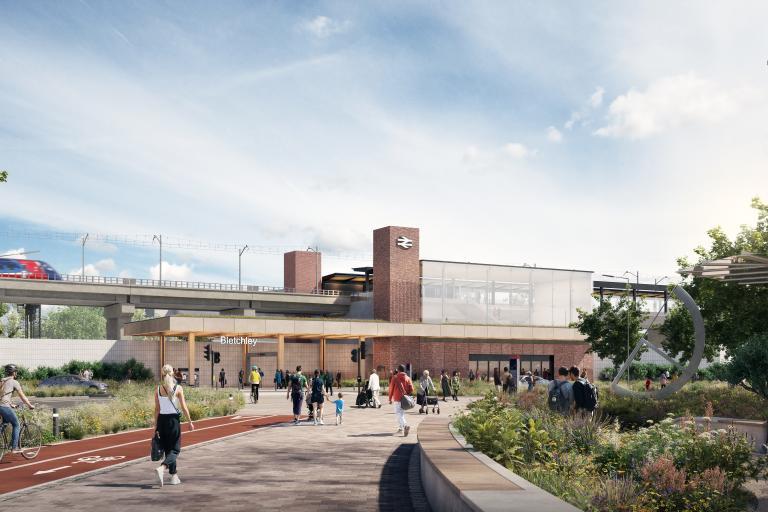
The separately funded eastern station entrance is intended to improve the link between the railway and Queensway. It is an infrastructure dependency, not the Central Bletchley development itself. Image source: Milton Keynes City Council.
Town Deal work along Queensway and around Princes Way, Sherwood Drive and Saxon Street also forms part of the wider regeneration context. The Queensway works announcement scheduled the start for 27 October 2025. The council’s September 2026 roadmap describes Queensway work as ongoing; the earlier planned spring 2026 finish should not be read as evidence of completion. These projects may improve access and the town-centre setting, but they retain their own funding, scope and delivery evidence.
Housing, community uses and delivery
The partnership's stated housing mix includes affordable, open-market sale and Build to Rent homes. That is a policy and masterplanning intention rather than a secured tenure schedule. A planning application will need to set out the unit count, home sizes, affordable-housing percentage, tenure mix, accessibility standards and any viability case.
Retail and community facilities are similarly high-level. No published source reviewed identifies the commercial floorspace, likely occupiers, community operator, parking total or education and health provision. Earlier briefs and policy documents discuss possible uses across the wider area, but they should not be carried into the current scheme unless the partners adopt them.
The development has no verified main contractor, private-finance package, construction start or completion programme. Muse is the masterplanning and delivery partner, but that appointment does not show that a building contract has been awarded. Land assembly, demolition, rail-interface work and planning remain separate gates that can affect phasing.
Funding: separate the programmes
The £22.7 million Bletchley and Fenny Stratford Town Deal supports several projects, including land and enabling work relevant to Central Bletchley. The council’s acceptance letter, dated 24 March 2021, records an offer on 3 March and Board acceptance on 23 March. The Town Investment Plan and later monitoring reports cover a portfolio rather than a single development budget. Spending on site preparation should not be added to station funding or treated as the value of the Muse neighbourhood.
The new eastern station entrance has its own £17 million Government contribution and potential council contribution of up to £5 million. The September demolition procurement decision gives a combined estimate of about £1.3 million for the identified enabling contracts. No authoritative source reviewed publishes a scheme-wide development value, fully funded construction cost or private funding close for the residential-led masterplan.
Local property-market context
The Office for National Statistics reported a provisional average Milton Keynes house price of £330,000 in July 2026 and an average private rent of £1,344 in August 2026. The page was last updated on 16 September 2026. It warns that local estimates use smaller samples, can be volatile and may be revised.
These local-authority figures do not value Bletchley, the two masterplan sites or any future home. If a scheme is later approved and built, new homes, public realm and station access may affect the town-centre housing mix and how people use the area. Timing, tenure, build quality, infrastructure delivery, competing supply and wider market conditions will all matter, so any price or rental effect remains qualitative.
The most useful property evidence for future updates will be completed and occupied delivery, a verified tenure schedule and consistent local sales and rental data. Masterplan images and policy capacity should not be converted into yield, capital-growth or rental forecasts.
How to read the current status
Masterplanning means the partners are defining a development proposition. It does not mean an application has been validated or approved. Prior approval for demolition is limited enabling consent. Procurement approved means the council may run the specified competition and arrange contract awards; it does not prove a contractor has been appointed or work has started.
A robust status upgrade would require new public evidence. Planning submitted needs a valid application and published boundary. Planning approved needs an issued decision notice and clarity on conditions and legal obligations. Under construction needs physical work on the approved development itself, not only clearance, surveys, hoarding or infrastructure works nearby.
The September demolition decision is therefore important without changing the overall project phase. It reduces one east-side preparation uncertainty and provides a more concrete enabling path. The masterplan's scale, planning route, finance and building programme remain unverified.
Detailed project history
| Date | Milestone | Evidence-based interpretation |
|---|---|---|
| 20 July 2004 | Central Bletchley Regeneration Strategy adopted | Historic supplementary guidance; revoked in 2022 |
| March 2019 | Plan:MK adopted | Policy SD16 established strategic principles for the wider prospectus area |
| December 2019 | Central Bletchley Prospectus published | Early programme and site context, not the current masterplan |
| October 2020 | Town Investment Plan submitted | Programme case for Town Deal funding and coordinated regeneration |
| March 2021 | Town Deal Board accepted the £22.7 million offer | The 24 March letter records acceptance on 23 March; this funds a wider portfolio |
| April 2022 | Urban Design Framework adopted | Current supplementary design guidance; the 2004 strategy was revoked |
| November 2022 | Former Police and Fire Station development brief issued | The brief records the Fire Station already demolished; it does not grant mixed-use permission |
| 3 July 2023 | Former Sainsbury demolition prior approval issued | East-side enabling consent |
| 2024 | MKDP business plan records both former Police and Fire Station sites demolished | West-side clearance is distinct from starting new buildings |
| March 2024 | Approved Brunel Centre development brief published | Planning and design guidance for east-side land; sources differ on the approval month |
| November 2024 | Former Sainsbury demolition reported complete | East-side clearance milestone |
| July 2025 | West Bletchley Neighbourhood Plan made | Adopted policy context for land west of the railway |
| 23 October 2025 | Queensway works announced for 27 October | Separate public-realm works; the council reports work ongoing in September 2026 |
| 5 March 2026 | Council announced Cabinet backing for the 2050 Vision and station contribution | Separate area-wide governance and infrastructure funding |
| 22 April 2026 | MK City Plan 2050 submitted for examination | Emerging policy, not adopted development-plan status |
| 21 May 2026 | Former Wilko demolition prior approval issued | Enabling permission; no demolition completion established |
| 20 July 2026 | Muse, MKDP and the council launched the Central Bletchley partnership | Current project reached partner appointment and masterplanning |
| 1 September 2026 | Council approved procurement for Brunel Centre and former Wilko demolition | Enabling procurement authorised; contracts and commencement still to be verified |
| 10 September 2026 | Council announced a Bletchley and Fenny Stratford Vision Action Plan | A 15 September decision was scheduled; its final terms remain unverified here |
| September 2026 | MK City Plan examination moved to the scheduled hearing stage | The programme lists hearings from 15 September; policy remains emerging |
Risks and watchpoints
- No published red line: historic planning areas and landholdings may not match the future application boundary.
- No verified quantum: policy references to around 1,000 homes apply to a wider area and should not be used as the project total.
- Demolition sequence: procurement approval still needs contractor awards, mobilisation and verified completion.
- Planning route: a masterplan, application, technical assessments, public consultation and statutory decision remain ahead.
- Land and rail interfaces: ownership, possession, railway approvals, servicing and construction logistics may affect phasing.
- Affordable housing and Build to Rent: the broad tenure promise is not yet a secured number or percentage.
- Funding: Town Deal, demolition and station allocations are separate; no scheme-wide development funding is published.
- Policy and governance: MK City Plan 2050 remains emerging; the Action Plan’s final decision terms need confirmation.
What to watch next
- Publication of the red-line masterplan, site schedule and development quantum.
- A valid mixed-use planning application with environmental, transport, heritage, design and viability evidence.
- Brunel Centre and former Wilko contractor awards, commencement and completion records.
- The published decision terms and monitoring arrangements for the Bletchley and Fenny Stratford Vision Action Plan.
- Detailed station-interface arrangements and the eastern entrance delivery programme.
- A named main contractor, committed development finance and a dated construction programme.
- Final affordable-housing, Build to Rent, open-market and community-use schedules.