
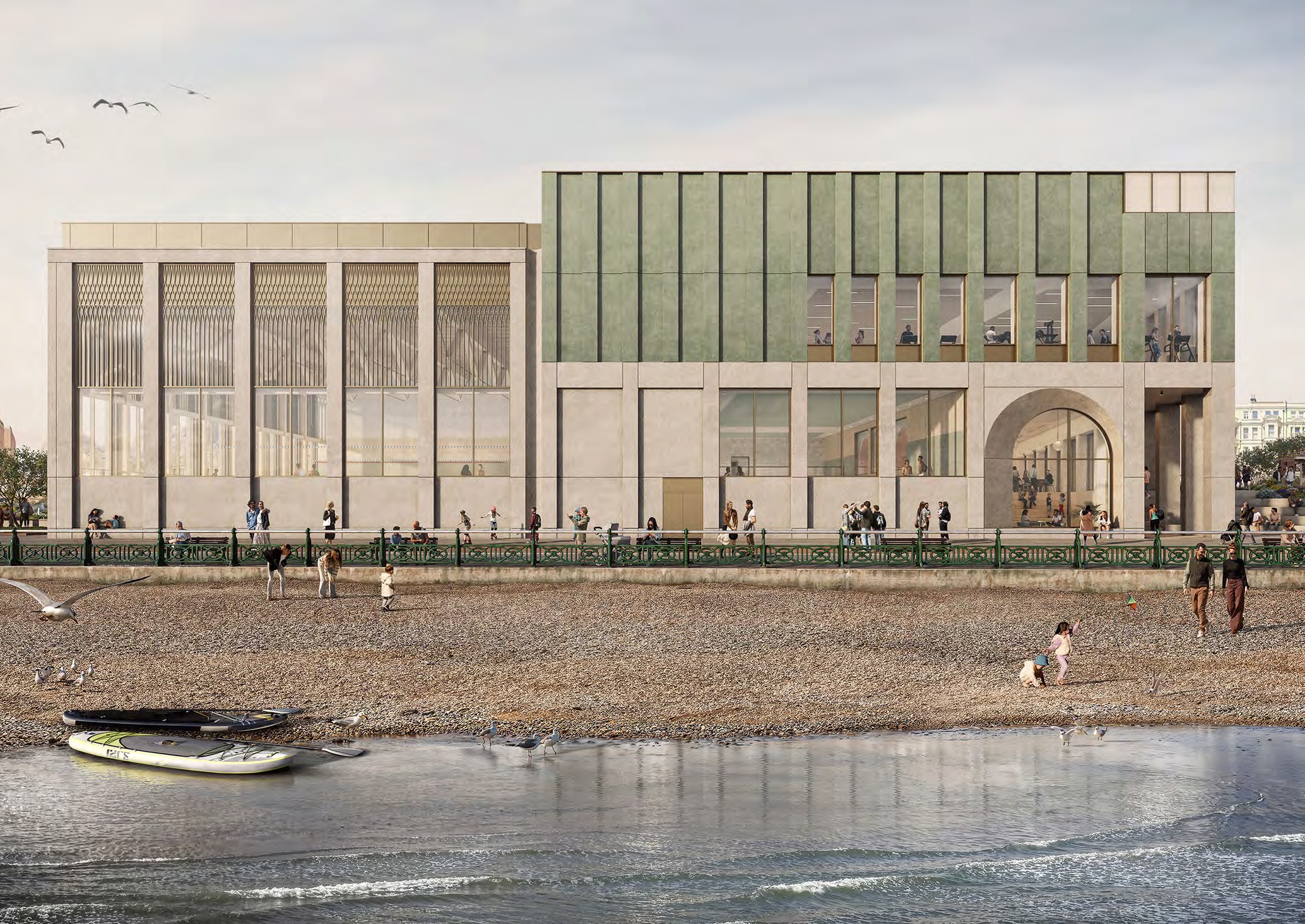
Brighton & Hove's seafront investment prospectus brings restoration projects, transport improvements and future development opportunities into a common framework for 13 kilometres of coastline. Its practical significance lies in coordinating decisions across the waterfront, while each site keeps its own planning, funding and delivery requirements.
The council published the prospectus on 5 June 2026. Since then, one of its most prominent projects has advanced: the planning register records approval of the new King Alfred leisure centre on 14 September. Elsewhere, Madeira Terrace remains a phased restoration project, Black Rock combines completed infrastructure with future development choices, and the Brighton Centre, Marina and Pool Valley have distinct investment propositions. There is no verified single permission, funding package or completion date covering the whole seafront portfolio.
What the prospectus covers
The final council document defines the coastline from Saltdean to Portslade. This is a geographic framework: it is not the boundary of one planning application or a promise to redevelop every property within that corridor.
Its priorities connect the quality of public spaces with easier movement along the coast, maintenance of heritage structures, environmental resilience and investment in leisure and commercial activity. The June launch announcement explains that existing schemes and future opportunities form part of the same long-term direction. That makes it useful for understanding relationships between sites, but it does not replace the evidence needed to assess an individual development.
A completed boardwalk, an approved leisure centre and an illustrative gallery are therefore different kinds of progress. Treating them as equivalent would obscure the remaining decisions and risks. The prospectus itself warns that its speculative illustrations are not current or agreed development proposals.
Project facts
| Question | Evidence-backed position |
|---|---|
| What is the document? | An investment and coordination framework published jointly by the council and Seafront Development Board. |
| Where does it apply? | Approximately 13 kilometres of seafront, from Saltdean to Portslade. |
| When was it published? | 5 June 2026. This report checks subsequent primary evidence through 24 September 2026. |
| What are the principal opportunity sites? | King Alfred, Brighton Centre, Pool Valley, Madeira Terrace, Black Rock and Brighton Marina. |
| Is the portfolio one approved scheme? | No umbrella consent is established by publication; decisions remain site-specific. |
| Is there one construction programme? | No verified portfolio-wide delivery programme. Individual dates below have their own scope and conditions. |
The six opportunity sites
King Alfred: leisure approval and a separate housing opportunity
The most significant verified change since the prospectus was published is the decision on the leisure centre. The planning register for BH2026/00490 records the application as approved, with a decision issued on 14 September 2026. The register shows receipt on 2 March and validation on 5 March 2026.
This advances the position recorded in the 29 July committee minutes, when councillors resolved that they were minded to grant permission subject to the Secretary of State not calling in the application. The committee resolution and the later issued decision are separate milestones; the September register entry provides the current approval status.
The permission concerns the western part of the existing leisure-centre site and public car park. Its recorded proposal includes swimming pools, a sports hall, gym and fitness facilities, children's soft play, event spaces, a café, an undercroft car park and associated public-realm and highway works. It also includes a temporary public car park on part of the lawn west of Hove Street South during construction.
The council's July project announcement describes a phased approach intended to keep the existing centre open while its replacement is built. It names Alliance Leisure, Willmott Dixon and GT3 Architects within the delivery team. Its expected 2028 opening remains an expectation, not a verified completion commitment. Published statements have used differing start-date wording; this report does not treat either planning approval or an earlier forecast as evidence that main construction has begun.
The residential land is a separate proposition. The June prospectus records a City Plan allocation for at least 400 homes and outline masterplanning for 428 units. Those figures are policy and design context, not homes authorised by this leisure-centre application. A residential permission, delivery agreement and construction programme would need to be assessed on their own records.
Madeira Terrace: first-phase restoration and later funding decisions
The council's current restoration page describes Madeira Terrace as an 865-metre Grade II* listed structure. Its condition led to closure to public access between 2015 and 2016. The scale of the work and the available funding mean restoration is being delivered in phases.
Phase 1 now covers 28 arches and a new accessible lift. The council's Phase 1 history records permission in November 2022 and a December 2023 reduction from 40 arches because of increased construction costs. JT Mackley & Co. was appointed in 2024, and work began that November.
Published opening estimates are not fully aligned. The main council page still anticipates 2026 and the June prospectus says the end of 2026, while a February construction update describes completion during the coming winter following further cast-iron testing. These are forecasts, not a confirmed opening date. This report has not verified that the restored section is open; a dated council or contractor completion announcement remains the evidence to watch.
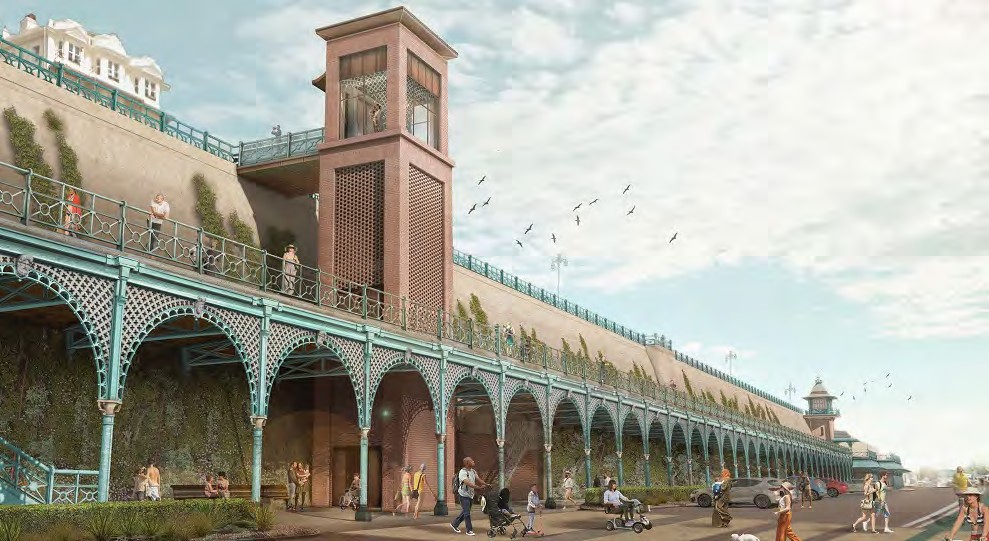
Planned Phase 1 restoration of Madeira Terrace, illustrated by Purcell Architecture and reproduced in the council's June 2026 prospectus. This is a design illustration, not a photograph of completed works.
Historic England's 8 June funding announcement confirms a further £240,000 grant, following £750,000 in 2024. The combined £990,000 supports the first phase. It should not be read as funding for restoration of the entire terrace.
The wider opportunity involves finding a viable approach to later restoration and potential uses around the structure. Commercial concepts and development-value estimates in the prospectus do not establish an approved budget, lease, operator or consent for those later phases. Heritage protection and public access remain central considerations.
Black Rock: delivered infrastructure, future choices
Black Rock has progressed through substantial preparatory investment. The council's description of the completed infrastructure includes a realigned sea wall, coastal defences, a decontaminated and levelled site, a beach boardwalk and improved pedestrian and cycle connections. These works support access and future use; they are not the permanent redevelopment itself.
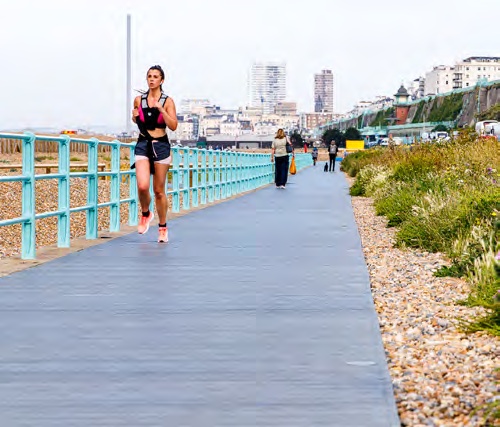
Black Rock boardwalk photograph from the council's June 2026 prospectus. It shows an existing access improvement, separate from the document's speculative development illustrations.
The next decisions should be followed separately. The council's September forward plan, with notice published on 15 September, lists a Cabinet decision on Black Rock's meanwhile use and long-term vision for 15 October 2026. A scheduled decision is not an appointment or contract award, and its date may change.
This review has not verified a selected temporary operator or signed agreement. The current forward plan is therefore the next public decision to follow. Older relative wording on the council project page about permanent development beginning in approximately three years does not establish a current construction commitment.
Brighton Centre: defining the future facility
The Brighton Centre entry concerns renewal of an existing conference and entertainment venue. The June prospectus describes preparation of a strategic brief to establish the future mix of facilities. It illustrates possible modernisation, an extra floor and improved connections towards the seafront and shopping centre.
These ideas explain the council's direction of travel. They do not by themselves establish a funded redevelopment, planning consent, appointed development partner or delivery date. Future reporting should follow the brief and any subsequent business case and application rather than attaching the timetable of another seafront scheme to the venue.
Pool Valley: feasibility and the arrival experience
Pool Valley is presented as a potential public-space and pedestrian-access improvement near the seafront. Its status in the June prospectus is feasibility. The opportunity is to reconsider how the area works as an arrival point and connection between the waterfront and adjoining streets.
The prospectus also discusses a possible relationship with rebuilding the Royal Albion Hotel. That is an opportunity for coordination, not proof of a joint delivery agreement. Its illustrated public square should not be treated as an approved design or construction programme. Nearby public-realm works have their own permissions and budgets.
Brighton Marina: policy context and multiple ownerships
Brighton Marina's entry rests on its role in the City Plan and opportunities to improve housing, workplaces, access and public space. The prospectus recognises the complications created by multiple ownerships and the need for coordination.
A planning-policy allocation is not a new permission. The amount, design and timing of any specific development must be established from the relevant applications and agreements. Improved access through Black Rock is useful context, but does not prove that a Marina scheme has secured finance or started construction.
The Brighton Centre, Pool Valley and Marina descriptions above refer to the published prospectus's individual site entries. No later site-specific consent or delivery commitment for those propositions was verified in this review.
Transport, resilience and existing public spaces
The seafront's condition depends on infrastructure as well as new development. Government funding confirmed on 6 July 2026 provides more than £22 million towards replacing King's Road arches, alongside a £3.9 million council contribution. These structures support the coastal road and space used by businesses below it.
The Department for Transport describes two phases: the bandstand-to-i360 section expected to complete in 2027, followed by a section west of Shelter Hall scheduled for 2029. Those later published dates are more current than the June prospectus's 2026–2028 description. They remain programme expectations for these works, not completion dates for the whole waterfront.
The western A259 active-travel project also has a defined scope. The council's 13 May update covers Fourth Avenue to the city's western boundary, with a two-way cycle lane, pavement and crossing improvements, bus stops and loading and disabled-parking provision. It reported completion of consultation stages, continuing detailed design and contractor selection, with work likely to start in autumn. This announcement alone does not verify a physical start.
The central section has since moved into public consultation. On 14 September 2026 the council launched a six-week consultation on proposals between Fourth Avenue and West Street: Phase 3 runs to the Peace Statue and Phase 4 continues to West Street. The proposals include a separated two-way cycle lane and changes to pavements, crossings, parking and loading. Feedback is intended to shape the final design; consultation does not establish a construction start or completed route.
The western scheme, central proposals and longer-term eastern ideas therefore retain different delivery stages. Existing places such as Hove Beach Park support the waterfront's leisure role, but their earlier delivery should not be attributed to publication of the prospectus.
Governance and the meaning of funding
Cabinet agreed to establish the Seafront Development Board on 17 July 2025. The March 2026 scrutiny report records consultation already under way, including a public event and an online survey scheduled to remain open until the end of April. These steps preceded the June publication; they did not grant permission for the portfolio's individual schemes.
The Seafront Development Board provides advice and coordination. The March scrutiny report describes its relationship with Cabinet and explains that individual investments require business cases through the relevant governance processes. The prospectus is not planning policy.
For readers assessing progress, four financial terms need to remain distinct:
- An awarded grant identifies funding for a stated purpose, such as Historic England's first-phase Madeira support.
- An approved project budget gives authority within a particular scheme; it is not necessarily an external grant or a final construction price.
- A development-value estimate is an appraisal of potential value, not money available to spend.
- An investment opportunity invites interest; it does not demonstrate committed private finance.
Published seafront figures span several of these categories. Adding them together would produce a misleading portfolio total. This article therefore reports only selected verified awards and does not claim that the seafront vision is fully funded.
Planning decisions, land agreements, contractor appointments, discharge of conditions and physical delivery are also separate steps. The King Alfred approval is an important milestone within that sequence, while Black Rock's future Cabinet item is evidence of a forthcoming decision. Neither changes the legal or financial status of the rest of the portfolio.
What this may mean for nearby property
Bellsoph's interpretation of property and rental effects is qualitative. Better access, usable public spaces and reliable leisure facilities may influence how residents, visitors and businesses experience an area. Restoration can also preserve amenities that would otherwise remain closed or deteriorate. The effect depends on what is delivered, where it is delivered and whether it is maintained.
These benefits can sit alongside temporary disadvantages. Road or promenade works may disrupt routes and business access; construction can affect noise and convenience; changes to visitor activity may be welcomed by some occupiers and less useful to others. Effects can differ between streets and buildings even within the same postcode district.
The prospectus does not isolate a seafront property-price premium or establish a causal effect on rents. It supplies no basis for a return projection, a rent-growth forecast or an assumption about an individual home's value. City-wide averages would also describe a much broader market than a particular stretch of waterfront, and would not prove a regeneration effect.
For a property decision, the useful questions are specific: which works affect the route to that building; what remains open during construction; which consent applies; what costs and maintenance obligations attach to the property; and which timetable is supported by a current project record. The prospectus helps identify those questions, while the answers require individual property and project evidence.
Delivery risks and what to watch next
The principal risk is uneven progress across the portfolio. A strong framework can coexist with unresolved funding, heritage, land or design issues at individual sites. Sea exposure and the condition of historic structures add complexity to both construction and long-term maintenance.
The next evidence to watch is correspondingly specific:
- King Alfred: conditions, final construction arrangements and a verified site-start programme following the September approval; keep the housing land separate.
- Madeira Terrace: a confirmed opening of the first restored section and a funded, consented approach to subsequent phases.
- Black Rock: the outcome of the proposed October Cabinet decision, the identity and terms of any meanwhile operator, and a separate route for permanent development.
- King's Road arches: contracts, phasing and delivery updates against the government's 2027 and 2029 expectations.
- A259: contractor appointment and actual start evidence for the western scheme, consultation outcomes and final design for the central section, and separate evidence for eastern ideas.
- Other opportunities: published briefs, business cases and applications that move the Brighton Centre, Pool Valley or Marina propositions beyond their prospectus descriptions.
This report checks public primary material through 24 September 2026. Where a current outcome could not be verified, that limitation is stated; absence of a public confirmation is not proof that no preparatory work exists. The evidence establishes a published framework and a mixed portfolio, including a newly approved leisure centre, ongoing heritage restoration and opportunities that still require further decisions.