
Salford Regeneration Tracker
Major schemes, official source links, location notes and qualitative investor relevance for Salford property research.
Current tracked Salford schemes
Sorted by latest project review or update. Project cards show status, location, relevant postcode districts and research context. Delivery dates and property-market effects carry risk, remain qualitative and are not a guarantee.
Regent Retail Park Regeneration
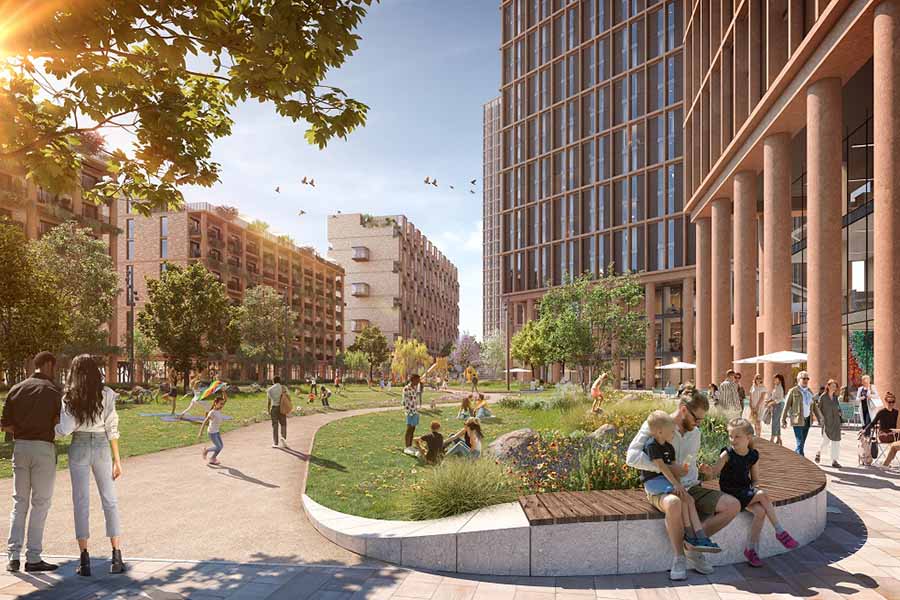
Henley Investment Management proposes 3,300 homes, including 660 social-rent homes, commercial space and a public park at Regent Retail Park. The planning panel resolved to grant permission in November 2025, subject to conditions and a legal agreement. Following a complaint about the earlier decision process, Salford City Council confirmed in August 2026 that the application remains under consideration and must return to the planning panel. The application has not been withdrawn and no date for the fresh determination has been announced.
Current phaseApplication under reconsideration
Irwell River Park Connectivity and Movement Strategy
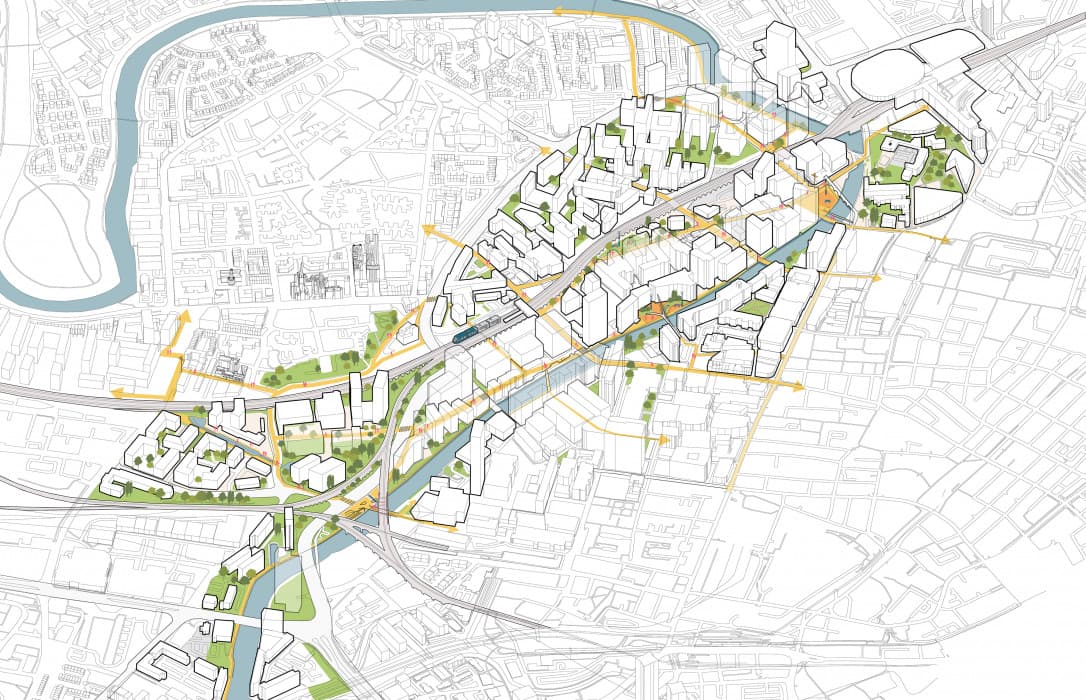
The Irwell River Park Connectivity and Movement Strategy, approved by Salford City Council in April 2025, provides the strategic framework for transforming an 8km riverside corridor into a continuous, accessible urban park. The initiative focuses on active travel, climate resilience, and biodiversity, serving as a material planning consideration for new developments. Recent progress includes the formal approval of funding for modular floating wetlands along the Ordsall riverside, aimed at enhancing ecological health and water quality through a combination of Section 106 contributions and Environment Agency grants.
Current phaseStrategy approved and active

Eccles Town Centre Regeneration
The Eccles Town Centre regeneration is a long-term partnership between Salford City Council and Muse, focused on transforming the area into a sustainable, mixed-use destination. Following the successful demolition of the former shopping centre and multi-storey car park, the project has progressed through extensive community engagement. A draft masterplan, informed by public feedback that concluded in March 2026, outlines proposals for approximately 1,272 new homes, a refreshed retail and leisure offer, a new community hub, and significant public realm improvements to enhance connectivity and green space.
Current phaseMasterplan development stage
Soapworks Regeneration
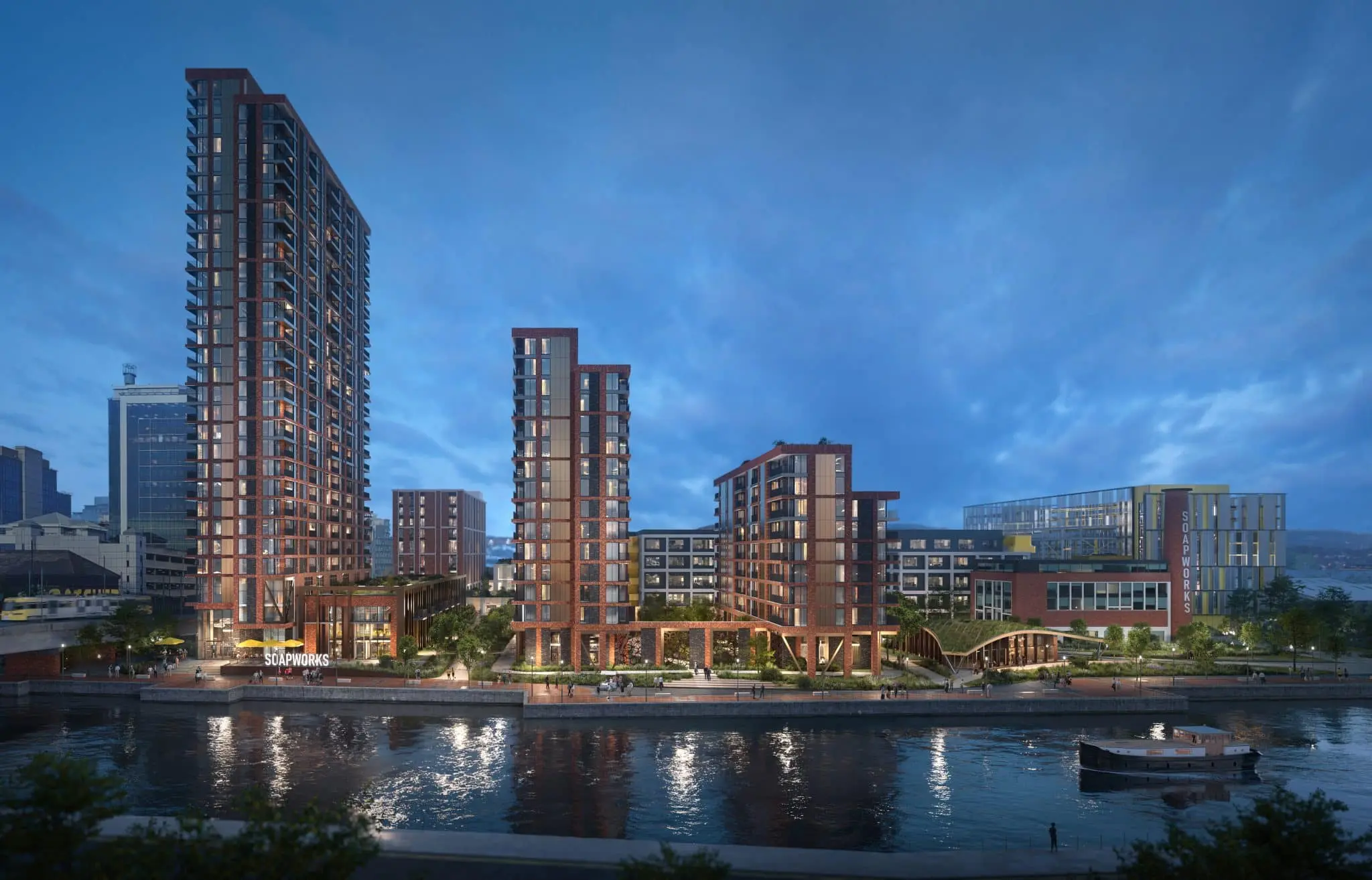
Soapworks is a GBP200 million mixed-use regeneration of the 8.5-acre former Colgate-Palmolive site in Salford. Bankfoot APAM announced hybrid planning consent in May 2025 for 578 homes, including 78 affordable homes, 12,800 sq m of commercial space and a new public park. The owner currently describes the wider scheme as pre-construction with completion in 2028, while the existing office estate remains active and more than 95 per cent let.
Current phasePre-construction and active office leasing

Crescent Salford Masterplan
The £2.5bn Crescent Salford masterplan continues to advance as of August 2026, with significant progress across its residential and infrastructure components. Following the successful delivery of the Willohaus project, momentum is sustained by the recent planning approval for 263 new homes at the Old Adelphi site, with construction anticipated to commence shortly. Concurrently, the Salford Rise infrastructure project, a critical elevated walkway designed to improve connectivity between the University of Salford and the wider innovation district, remains in its final stages of delivery.
Current phaseOngoing delivery and construction

Strangeways and Cambridge Strategic Regeneration Framework
The Strangeways and Cambridge Strategic Regeneration Framework (SRF) is a collaborative long-term vision between Salford and Manchester City Councils to transform a 130-hectare city fringe area. Formally endorsed in November 2025, the framework acts as a material consideration for planning applications, prioritising flood risk mitigation, the delivery of approximately 7,000 new homes across seven neighbourhoods, and the creation of a 60-acre public space known as Copper Park. The project seeks to address historical challenges, including flood risk and poor-quality building stock, while fostering sustainable economic growth and improved connectivity between the two cities.
Current phaseFramework adopted and active