
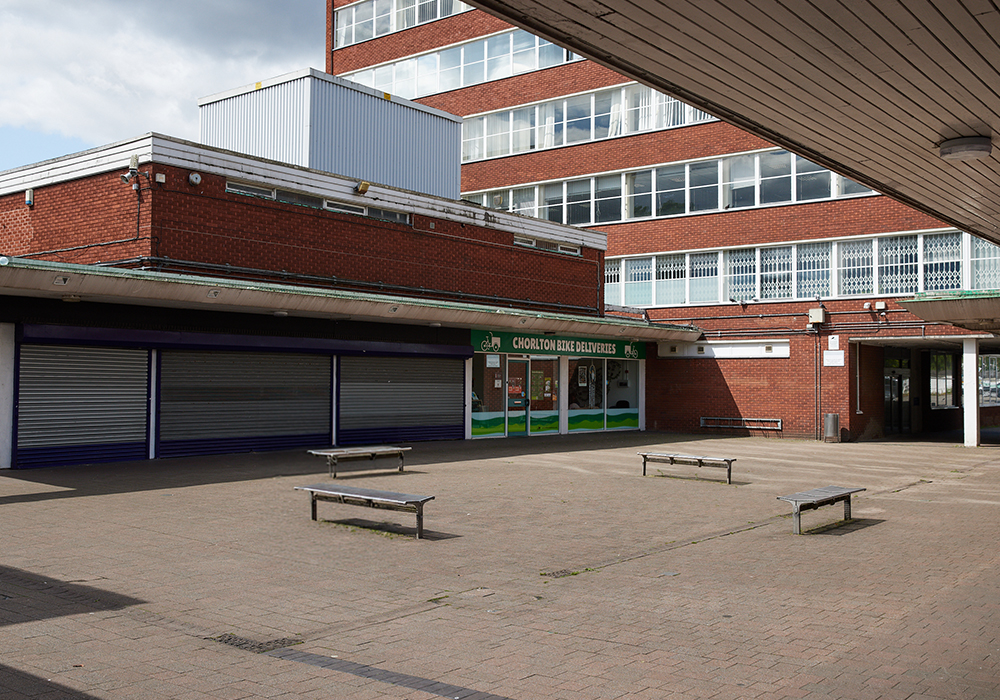
The Chorlton Cross Shopping Centre regeneration is marking a definitive transition from a long-debated strategic concept into an active, on-site delivery programme. Following an extensive community consultation period and subsequent planning approval granted by Manchester City Council in late 2025, the 3.2-acre precinct in the highly sought-after M21 postcode is entering its physical enabling phase. Led by the Manchester-based developer PJ Livesey in a joint venture with the site owner, the Greater Manchester Pension Fund (GMPF), the £100m+ project aims to replace an obsolete 1970s retail precinct and the associated Graeme House office block with a high-density, residential-led mixed-use neighbourhood.
My central judgement is that Chorlton Cross represents the most significant structural intervention in the Chorlton property micro-market in recent history. The core execution risk has fundamentally evolved: it is no longer a question of whether the site can secure planning consent amidst local opposition, but rather how efficiently the developer can navigate the complex demolition phase and the subsequent vertical construction of buildings reaching up to 10 storeys, particularly under the stringent new requirements of the Building Safety Act. With demolition specialist SJ Walchester securing the contract to commence site clearance in mid-June 2026, the initial dismantling operations are scheduled to conclude by August 2026, establishing a targeted delivery window for the new neighbourhood around 2028.
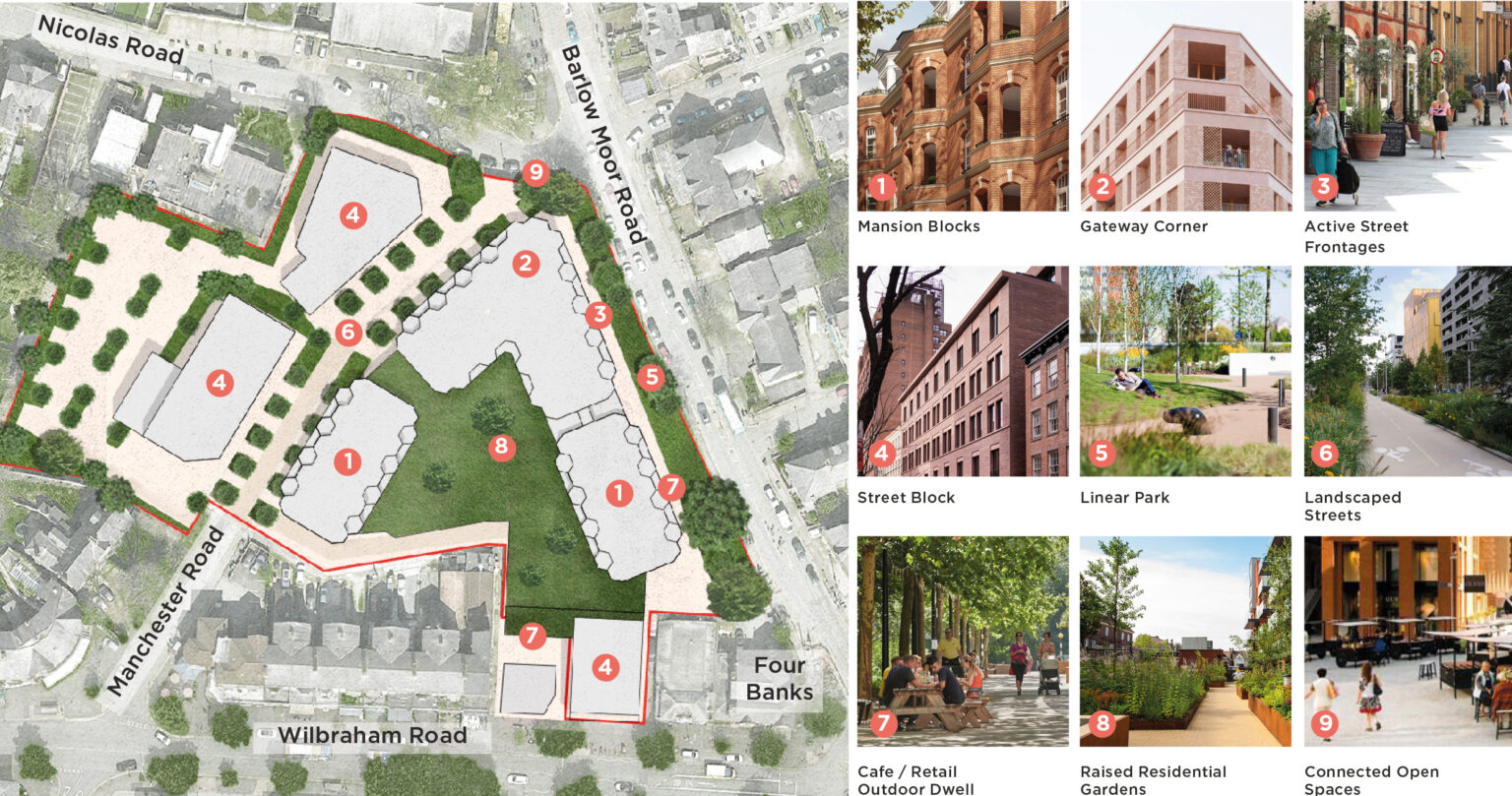
The headline public offer is substantial. The scheme will deliver 262 new apartments across six principal blocks, significantly augmenting the local housing supply in an area defined by low-rise historic stock. This includes an affordable housing provision of approximately 20%, bringing 53 affordable homes to the district. Crucially, 49 of these are designated for social rent and will be managed by Southway Housing Trust, subject to funding confirmation from Homes England. The commercial element introduces a deliberate shift from an inward-facing, isolated precinct to an outward-facing high street model, integrating a 'Makers Yard' tailored for independent and start-up businesses alongside approximately 3,500 sq metres of new public open space.
For the regional property market, the implications are structurally important. Chorlton is traditionally characterised by low-rise Victorian and Edwardian terraces and semi-detached family homes. The introduction of 262 premium apartments addresses a notable undersupply of high-quality, modern flat stock in the M21 area. This is likely to have a dual effect: providing a highly energy-efficient option that retains young professionals and older downsizers within the local community, while theoretically easing some of the intense competition for existing family houses. The current M21 baseline indicates a median flat sales price of £206,000 and average monthly flat rents in the region of £1,135. Investors should anticipate that this new-build stock, supported by Passivhaus design principles, balconies, and immediate Metrolink proximity, is likely to establish a distinct premium over these secondary market averages.
Project overview
The Chorlton Cross Shopping Centre site has long been the primary focal point for south Manchester's urban regeneration ambitions. Situated at the critical junction of Barlow Moor Road, Wilbraham Road, and Nicolas Road,locally referred to as the 'four banks',the 3.2-acre (1.27-hectare) site historically housed an L-shaped shopping precinct built in the 1970s, a 200-space surface car park, and Graeme House, an eight-storey concrete office block. Over the past two decades, this infrastructure has increasingly been viewed as an underutilised, aesthetically incongruous space that disrupted the urban grain of the wider suburb.
The site's journey towards regeneration has been protracted and historically vulnerable to macroeconomic shocks. Previous redevelopment attempts by other prominent regional developers, including a joint venture between Citybranch and Ask Developments, were aborted during the 2009 economic recession. Recognising the latent value of the land, the Greater Manchester Pension Fund (GMPF) acquired the site from Development Securities in April 2014 for £10m, viewing it as a long-term strategic asset that could simultaneously stimulate the local economy and provide sustainable returns for the fund.
Following the adoption of the Manchester City Council Chorlton District Centre Development Framework in 2017, which formally established the principle for a residential-led mixed-use redevelopment, GMPF launched a comprehensive search for a development partner in early 2022. They ultimately appointed the PJ Livesey Group in March 2023. The selection of PJ Livesey,a family-run developer with a 45-year track record in complex brownfield and heritage regeneration across the UK,was a decisive step in moving the project from a theoretical framework to a viable planning application.
Crucially for investor confidence, the delivery structure is underpinned by institutional capital rather than speculative debt. Under the terms marketed during the developer procurement phase, GMPF indicated it would provide the purchaser with 80% of the cash needed to fund the development, without charging interest on the loan, in exchange for a 50% entitlement to development profits. This forward-funding model significantly de-risks the delivery timeline, insulating the project from the high commercial borrowing costs that are currently stalling other major residential schemes across the UK.
The strategic rationale behind the new masterplan is to turn the district centre "inside-out." Rather than funnelling footfall into an enclosed, declining pedestrian precinct that turns its back on the street, the new design,led by Feilden Clegg Bradley Studios alongside landscape architects Randall Thorp,positions active retail frontages directly onto the primary thoroughfares of Barlow Moor Road and Manchester Road. This integrates the site seamlessly with Chorlton's highly successful independent retail scene. Furthermore, replacing surface car parking and vacant retail with 262 apartments creates a dense, captive demographic to support local businesses, directly aligning with the city's broader '20-minute neighbourhood' planning principles.
Official scheme details and delivery timeline
The approved scheme for Chorlton Square represents a significant and deliberate intensification of land use in the district centre. The approved parameters, guided by planning application reference 142652/FO/2025, establish a highly defined residential and commercial footprint.
The most current and defensible public headline capacities for the development, aggregated from official developer communications, planning documents, and council reports, are summarised below:
| Development Component | Confirmed Scheme Details |
|---|---|
| Site Scale | 3.2 acres (approx. 1.27 hectares) |
| Total Residential Units | 262 apartments across six principal blocks |
| Building Heights | Ranging from 4 to 10 storeys (specifically blocks of 10, 8, 7, 6, 6, and 4 storeys) |
| Market Residential Mix | Indicatively 56 one-bed, 135 two-bed, and 15 three-bed apartments |
| Affordable Housing | 53 homes (approx. 20%), including 49 social rent units (16 one-bed, 33 two-bed) managed by Southway Housing Trust |
| Private Amenity Space | All apartments feature access to private outdoor space via balconies or ground-floor gardens |
| Commercial Space | Flexible ground-floor retail units, including a bespoke 'Makers Yard' designed for smaller, independent start-up businesses |
| Public Realm & Landscaping | Approx. 3,500 sq metres (37,000 sq ft) of public open space, a new central walkable square, and the planting of up to 60 new trees |
| Car & Cycle Parking | 182 total parking spaces (164 reserved for residents), positioned at basement and ground level to reduce street dominance, plus secure cycle storage |
| Sustainability Credentials | All-electric infrastructure, on-site renewable energy generation (solar PV), future-proofed EV charging, and a fabric-first approach based on Passivhaus principles |
The physical delivery of the project is now actively advancing. Following the submission and acceptance of a prior notice for demolition, the developer initiated the first physical milestone by closing the precinct car park at the end of May 2026. Site hoardings are currently being erected, which involves closing off the historic cut-through between Manchester Road and Nicolas Road to ensure public safety during heavy machinery operations.
Based on official project communications and contractor appointments, the delivery sequence is operating on the following analytical timeline:
- Q4 2023: Extensive public consultation on the draft masterplan undertaken, resulting in significant design revisions based on community feedback.
- December 2025: Final planning permission formally granted by Manchester City Council's planning committee following a site visit and extensive debate.
- May 2026: Precinct car park permanently closed; site secured and perimeter hoardings erected.
- June 2026: Appointed demolition contractor SJ Walchester commences site clearance and the complex dismantling of Graeme House and the precinct structures.
- August 2026: Demolition and site remediation phase expected to conclude, with viable materials retained for future construction reuse.
- Late 2026 / 2027: Anticipated commencement of the vertical construction phase, subject to Building Safety Act regulatory clearances for the taller blocks.
- 2028: Anticipated practical completion and the phased occupation of residential and retail units.
Planning, infrastructure and transport context
The planning journey for Chorlton Cross has been intricate, highly scrutinised, and reflective of the tension between municipal growth targets and local suburban preservation. The foundational policy document driving this development is the Manchester City Council 2017 Chorlton District Centre Development Framework. This framework explicitly identified the shopping centre as a site requiring comprehensive mixed-use redevelopment to repair the lack of retail activation on its eastern boundary, improve pedestrian permeability, and act as a catalyst for further investment in the district core.
Despite this long-standing policy framework, the specific planning application submitted by PJ Livesey (reference 142652/FO/2025) generated considerable local debate. The council received more than 1,300 representations during the consultation phase, with well-organised community groups such as 'Save Chorlton Centre' and the Chorlton Community Land Trust expressing strong reservations. The primary objection centred unequivocally on the scale, density, and massing of the buildings. Objectors argued that the 10-storey and 8-storey blocks would overshadow the traditional high street, block sunlight, and clash with the predominant two- to three-storey historic character of the suburb.
In response to this robust public feedback, the developers worked closely with city planners to refine the design prior to the final committee vote. The revisions included reducing the visual impact of the blocks from the street level by introducing deeper breaks between buildings, stepping down rooflines on the periphery, and increasing the public green space allocation by over 650 sq metres. Manchester Road was also redesigned as a car-free, fully walkable green route. Ultimately, the council's justification for approval rested on the strategic necessity of brownfield redevelopment and the acute need for housing; the inclusion of 49 social rent units,a tenure critically undersupplied in the M21 area,was a decisive factor in securing the final committee approval in late 2025.
From an infrastructure perspective, the development integrates directly into Manchester's rapidly evolving active travel network. The site sits adjacent to the newly constructed £13.4m Chorlton to Manchester Cycleway, part of the wider Bee Network, facilitating secure, segregated cycling directly into the city centre. Furthermore, the site is positioned within a five-minute walk of the Chorlton Metrolink station, providing rapid, high-frequency transit to Central Manchester, MediaCityUK, and Manchester Airport.
The project's transport strategy deliberately deprioritises private vehicle ownership. By capping resident parking at 164 spaces for 262 apartments (a ratio of approximately 0.62 spaces per unit), the scheme heavily incentivises public transport and active travel use. The pedestrianisation of the Manchester Road cut-through will eliminate historical rat-running traffic, creating a safer, calmer public realm while successfully shifting necessary commercial vehicular servicing access to Wilbraham Road.
Local economy implications
The economic impact of the Chorlton Cross regeneration operates across two distinct horizons: the immediate construction phase and the long-term operational stabilisation of the site.
During the construction phase, the deployment of over £100m in capital expenditure will support substantial supply chain activity and construction employment in the North West. The developer has explicitly committed to material circularity,reusing viable demolition materials from Graeme House and the precinct during the construction of the new neighbourhood where possible. This strategy not only reduces the embodied carbon of the new build but also mitigates the volume of heavy goods vehicle (HGV) traffic moving through the district centre, a crucial consideration for maintaining local economic flow during the works.
However, investors should be aware of the "disruption factor." Major infrastructure works in Chorlton, such as the recent cycleway installation, have historically caused friction with local independent retailers due to restricted access and noise. The developer and the demolition contractor have pledged to manage this carefully by arranging new servicing access for businesses on Wilbraham Road, but temporary localized economic drag during the 2026-2027 heavy construction phase remains a plausible risk.
Long-term, the economic strategy is highly positive, revolving around retail retention and the incubation of local enterprise. By 2024, the existing precinct was characterised by shuttered units, poor sightlines, and low footfall, representing a visible economic drain on the district centre. The new masterplan replaces this dead space with flexible, modern retail units facing directly onto the primary high streets, capturing passing trade.
The most innovative economic intervention within the scheme is the inclusion of a bespoke 'Makers Yard'. This specifically targets independent creatives, start-ups, and artisan retailers who often find traditional commercial leases in high-value, gentrified suburbs like Chorlton prohibitive. By cross-subsidising these smaller, more accessible units within the wider mixed-use scheme, the development aims to preserve the independent commercial identity that draws visitors to Chorlton in the first place. Furthermore, introducing a concentrated density of approximately 400 to 500 new residents directly into the core of the district centre will provide a captive, year-round demographic to support local hospitality, convenience retail, and services, acting as a powerful economic multiplier for the wider 'four banks' area.
Housing market implications
Chorlton (postcode M21) is historically one of South Manchester's most competitive, affluent, and heavily constrained property markets. According to land registry data aggregated for early 2026, the overall average house price in Chorlton stands between £425,000 and £456,000, representing robust year-on-year growth. The market is driven by highly desirable premium family homes, with semi-detached properties regularly achieving averages between £527,000 and £585,000.
However, the local housing market is structurally imbalanced. The area is dominated by large Victorian and Edwardian housing stock, while purpose-built, highly efficient modern flat stock is severely restricted. Recent completed sales data shows that the median price for flats in Chorlton over the last 12 months was £206,000, with prices showing a slight nominal contraction of 4.2% over the previous year, reflecting the older, secondary nature of much of the available flat stock.
Against this baseline, the introduction of 262 new-build apartments is a major market event. Analytically, this influx of supply is unlikely to suppress existing family house prices; rather, it caters to an entirely different market segment that is currently underserved. The Chorlton Square units,featuring modern environmental standards, lift access, private balconies, and secure parking,will likely achieve a significant "new-build premium" over the £206,000 secondary market median.
For the wider housing ecosystem in M21, this scheme provides a vital "right-sizing" mechanism. Older residents currently living in large, energy-inefficient, multi-storey Edwardian properties in Chorlton currently have very few options to downsize without leaving the community altogether. Providing premium, accessible, single-level living in the centre of the village allows these residents to remain in Chorlton, which in turn theoretically releases those larger family homes back into the secondary market for younger families, subtly easing pressure at the top end of the local market.
Rental market implications
The private rented sector (PRS) in Chorlton is characterised by acute tenant demand heavily outweighing available supply. Currently, demographic profiling indicates that approximately 24% of households in Chorlton reside within the private rented sector.
Market data for early 2026 indicates that the average monthly rent for a flat in Chorlton is £1,135. Breaking this down by property size, one-bedroom apartments average £988 per month, two-bedroom apartments command roughly £1,200, and larger three-bedroom apartments stretch to £1,634.
The 209 market-rate apartments at Chorlton Cross will be highly attractive to the professional rental demographic. Given the prime location, the high energy efficiency (which fundamentally lowers tenant utility costs compared to drafty period conversions), and the integration of on-site retail and rapid public transport, these units are highly likely to test the upper decile of the Chorlton rental market. Investors should anticipate that rents for new-build two-bedroom units in this scheme will comfortably exceed the current £1,200 secondary market average, establishing a new ceiling for prime local rents.
Equally critical to the market dynamics is the affordable housing provision. Southway Housing Trust is confirmed to acquire 49 units (16 one-bedroom and 33 two-bedroom flats) specifically for social rent. This is a profound intervention in an area where housing affordability has become a severe barrier to entry. Southway has a proven track record of delivery in the immediate vicinity, having recently partnered with Homes England to deliver 29 affordable homes at the nearby Chorlton Irish Club site. The delivery of these 49 units at Chorlton Cross, contingent on Homes England grant funding, will provide secure tenancies for local families and key workers who have been systematically priced out of the M21 postcode, ensuring a mixed and sustainable demographic profile for the new neighbourhood.
Supply, demographics and demand drivers
To accurately gauge the absorption capacity for these 262 homes, it is necessary to examine Chorlton's specific demographic makeup. Current demographic profiling indicates that households in Chorlton are composed of 31% single occupants, 15% couples, 17% sharers, and 37% families.
This data is revealing: it indicates that 63% of the local population (singles, couples, and sharers) are structurally suited to apartment living. Yet, the physical housing stock of the area is overwhelmingly heavily weighted towards larger terraced and semi-detached houses. This architectural mismatch forces young professionals and sharers into subdividing older houses into Houses in Multiple Occupation (HMOs) or informal flat-shares, which actively removes family stock from the market and artificially inflates capital values.
By delivering a concentrated burst of purpose-built one- and two-bedroom apartments, PJ Livesey is directly targeting this demographic imbalance. The underlying demand drivers supporting rapid absorption are robust:
- Transport proximity: The five-minute walk to the Metrolink provides a reliable, sub-15-minute commute to major employment nodes in the city centre.
- Lifestyle amenity: Chorlton's established, mature ecosystem of independent bars, restaurants, organic grocers, and parks is highly attractive to the target demographic of young professionals and affluent downsizers.
- Environmental quality: The all-electric, fabric-first nature of the new build aligns perfectly with the demographic's growing preference for sustainable, low-carbon living, insulating occupiers from future energy price shocks.
If we apply standard urban occupancy rates of 1.5 to 2.0 persons per apartment to the 262 units, the completed scheme has the capacity to introduce roughly 400 to 520 new residents directly into the immediate district centre, providing a significant boost to local daytime and evening economic activity.
Investor watchpoints and risks
While the project is fully consented, backed by institutional capital, and active demolition is live, investors and stakeholders conducting due diligence should monitor several execution and market risks:
1. Legislative and Construction Sequencing Risks The implementation of the Building Safety Act (2022) introduces stringent new gateway requirements for "higher-risk buildings" (defined as those at least 18 metres in height or at least 7 storeys). Because the Chorlton scheme includes blocks of 10, 8, and 7 storeys, the developer must pass through the rigorous Gateway 2 process with the Building Safety Regulator before vertical construction can legally commence on those specific high-rise elements. As this regulatory framework is still relatively new, investors should watch for any resultant delays in the timeline transitioning from ground remediation in late 2026 into core structure construction.
2. Public Sector Funding Dependency The delivery of the 49 social rent units by Southway Housing Trust is explicitly subject to funding support from Homes England. While the PJ Livesey Group holds preferred partner status with Homes England, any shifting priorities in national affordable housing grant allocations or delays in bureaucratic processing could theoretically impact the timeline or viability of the affordable phases, potentially requiring renegotiation of the Section 106 agreements.
3. Macro-Economic and Phase Risk Because the bulk of the residential completions will arrive simultaneously around 2028, the developer and any prospective buy-to-let investors will be delivering stock into a future macroeconomic environment. If mortgage rates remain elevated in 2028 or the broader Manchester employment market softens, the absorption rate of 200+ market-rate apartments in a single micro-market could slow, temporarily moderating rental growth and capital appreciation locally until the stock is fully digested by the market.
4. Social Infrastructure Pressure Adding up to 500 new residents to a concentrated central site will inevitably place incremental pressure on local primary care, dental services, and educational infrastructure. While the development includes retail and public realm, investors should note whether local civic amenities receive corresponding investment from the municipality to support the density increase, as strained local services can impact the long-term desirability of a neighbourhood.