
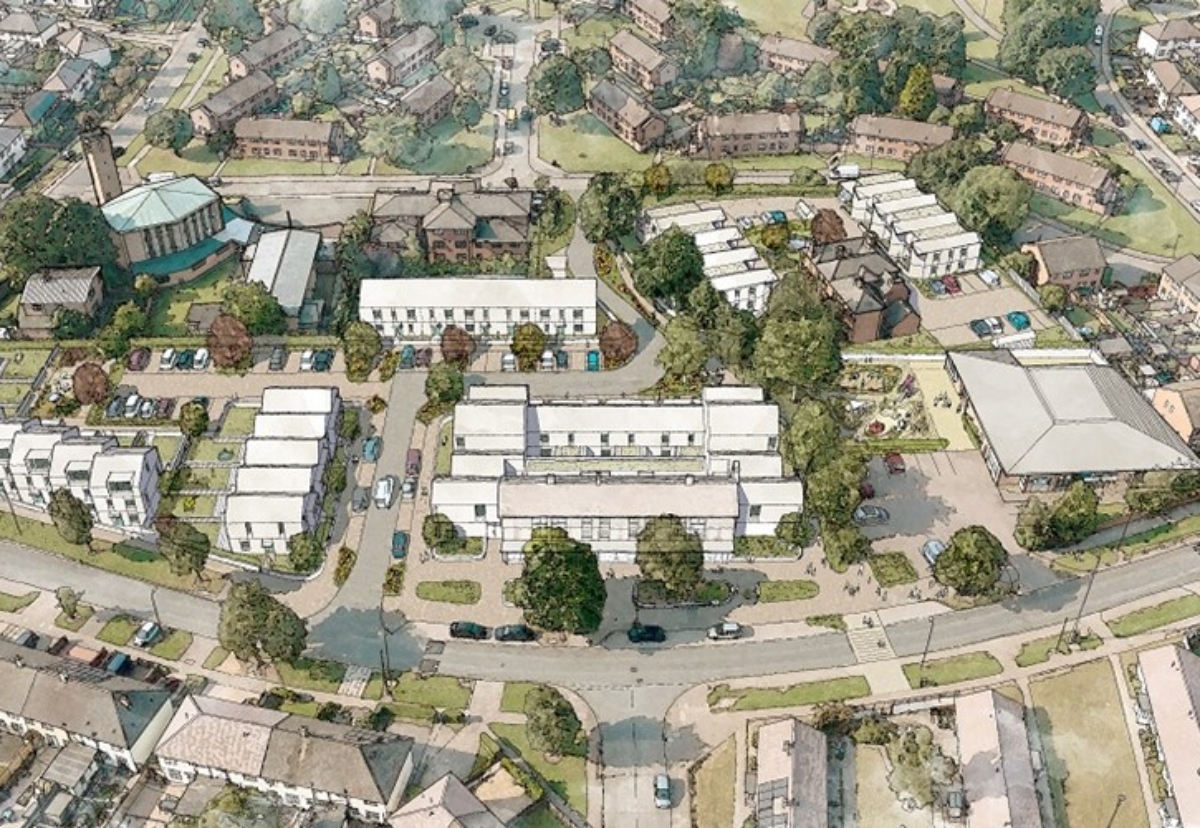
Key facts
| Item | Current position |
|---|---|
| Project | Stocking Farm Estate Redevelopment |
| Location | Stocking Farm, north-west Leicester |
| Main postcode district | LE4 |
| Local authority | Leicester City Council |
| Delivery partner | Clegg Construction |
| Project value | GBP18.8 million |
| Site size | About 3.34 acres to 3.5 acres, depending on source wording |
| New homes | 50 energy-efficient family council homes |
| Supported living | 22 supported living apartments, including six in the locally listed farmhouse |
| Existing homes | Five existing council maisonettes to be improved |
| Community works | New community facilities, landscaping, outdoor space, footpath improvements and sustainable drainage |
| Current phase | Construction partner appointed; designs to be finalised before works |
| Construction window | Construction expected to begin by winter 2026 |
| First homes | Expected by mid-2028 |
| Latest checked | 15 July 2026 |
What is being delivered
The latest public material describes a mixed housing and community regeneration scheme. The main elements are:
- 50 new energy-efficient family council homes;
- redevelopment of the locally listed 19th-century Stocking Farm farmhouse to provide six supported living apartments;
- a further 16 supported living apartments in the grounds;
- improvement of five existing council maisonettes;
- new community facilities;
- major landscaping for community outdoor space;
- improved footpaths;
- sustainable drainage;
- space for wildlife;
- a link road connecting Marwood Road to Packwood Road;
- improved pedestrian links between the new homes and local shops.
Earlier project material also described a new public green space, children's play space, landscaping, wildlife areas and local-shop/public-footpath improvements. The Local Government Association case study said the outline masterplan aimed to create a new residential heart for Stocking Farm and encourage pedestrian and cycle movement through the estate.
Planning and delivery status
The project is best described as construction partner appointed, with final design and pre-construction work ahead.
The scheme has been in development for several years. The LGA case study records that Land Release Funding was awarded in 2021 to help address abnormal costs, demolition and site levelling, with Leicester City Council matching this with capital funding to unlock the site.
Plans were then submitted for planning approval in 2022. At that stage, public material described 50 energy-efficient homes, insulation, air-source heat pumps, supported living accommodation in the farmhouse, a new public green space, play space and local movement improvements.
The latest delivery milestone came in July 2026, when Leicester City Council selected Clegg Construction as delivery partner for the GBP18.8 million redevelopment. Designs are expected to be finalised over the following months, with construction expected to start by winter 2026 and first homes complete by mid-2028.
Timeline and planning history
| Date | Milestone | Why it matters |
|---|---|---|
| 2021 | Land Release Funding of GBP490,195 awarded | Helped address demolition, levelling and abnormal costs on a difficult council-owned site |
| 2021 | LGA case study described the strategic regeneration challenge | Identified the estate site as underused and in need of council intervention |
| 2022 | Planning-stage proposals reported publicly | Set out the plan for 50 energy-efficient homes, supported living, public green space and movement improvements |
| 2024 to 2025 | Leicester City Council continued project development and procurement preparation | The scheme moved from concept and planning-stage reporting toward delivery procurement |
| June 2026 | Main contractor award information appeared in procurement data | Signalled that the council had selected a delivery route for the scheme |
| July 2026 | Clegg Construction appointed as delivery partner | Current major milestone, moving the project into final design and pre-construction phase |
| Coming months after July 2026 | Designs to be finalised | The next step before site works begin |
| Winter 2026 | Construction expected to begin | Main physical delivery is expected to start |
| Mid-2028 | First homes expected to be complete | Current public delivery target for the first homes |
Why Stocking Farm matters for Leicester
Stocking Farm matters because it is a neighbourhood-scale estate regeneration project, not a city-centre landmark. Its value is in addressing a local site that has been underused, physically tired and difficult to bring forward through normal market delivery.
The project can support Leicester by:
- adding new council family homes in an established residential area;
- providing supported living apartments in and around a locally listed farmhouse;
- improving existing council maisonettes;
- replacing underused estate land with clearer residential and community uses;
- improving local walking links between homes, shops and community spaces;
- creating better outdoor space and landscaping;
- supporting low-carbon housing through modern methods, insulation, renewable technologies and sustainable drainage.
The project is also notable because public sources describe extensive community involvement. Earlier work included resident newsletters, surveys and a school "House of the Future" competition judged by George Clarke.
Local property market context
ONS local housing data for Leicester shows an average house price of GBP241,000 in April 2026, up 2.9% from April 2025. Average private rents in Leicester were GBP944 per month in May 2026, up 3.1% year on year.
Those figures are citywide and should not be read as Stocking Farm-specific values. Stocking Farm is a local LE4 estate context, and this scheme is largely council-led affordable and supported housing rather than open-market private development.
For landlords and investors, the practical interpretation is cautious. The project may improve immediate neighbourhood quality and perception around the estate if delivery is strong, but it should not be treated as a direct price-growth forecast. The strongest evidence to monitor will be completion of homes, public-realm quality, community facility use and how well the new links connect to shops and surrounding streets.
Rental and housing impact
Housing impact is meaningful in local public-sector terms because 50 new family council homes and 22 supported living apartments are proposed. This contributes to affordable and supported housing supply in Leicester.
Rental impact is qualitative. The scheme may improve local liveability and estate perception, but the direct rental-market effect is not modelled because the homes are not primarily private rental supply and the relevant impact will depend on delivery, management, maintenance and wider LE4 market conditions.
Risks and watchpoints
| Watchpoint | Why it matters | Current risk level |
|---|---|---|
| Final design | The detailed layout and landscape design will shape how the site works day to day | Medium |
| Construction start | Winter 2026 is the next main programme test | Medium |
| Farmhouse conversion | Retaining and adapting the locally listed farmhouse adds complexity | Medium |
| Supported living delivery | Specialist accommodation needs good design, management and services | Medium |
| Community facilities | Local benefit depends on whether facilities are useful and well managed | Medium |
| Movement links | Marwood Road, Packwood Road and pedestrian connections matter for estate integration | Medium |
| Long-term maintenance | Landscaping and public space need ongoing maintenance after completion | Medium |
What to watch next
- Final design updates from Leicester City Council and Clegg Construction.
- Planning-condition discharge and any detailed reserved or technical submissions.
- Start-on-site confirmation in winter 2026.
- Construction phasing and disruption management for existing residents.
- Details of the supported living operator or management arrangements.
- Final community facility offer.
- Completion of the first homes by mid-2028.
- Whether the public realm, footpaths and link road improve day-to-day movement around the estate.