
Key facts
| Item | Current position |
|---|---|
| Project | St Ann's East and Broxtowe/Cinderhill Pride in Place Programme |
| Location | St Ann's East, Broxtowe and Cinderhill, Nottingham |
| Main postcode districts | NG3 and NG8 |
| Programme type | Community-led neighbourhood regeneration |
| Funding | Up to GBP20 million for each selected neighbourhood over 10 years |
| Funding model | GBP2 million per year for 10 years, subject to programme rules and plan approval |
| Lead public body locally | Nottingham City Council |
| National department | Ministry of Housing, Communities and Local Government |
| Current phase | Neighbourhood Board formation and plan development |
| Board deadline | Nottingham City Council states board membership is due to be finalised by 17 July 2026 |
| Delivery period | 2025/26 to 2035/36, subject to confirmed local plans |
| Latest checked | 15 July 2026 |
What is being delivered
The current confirmed delivery item is the funding programme itself, not a fixed list of construction works. Nottingham City Council says the selected communities will identify priorities, establish a Neighbourhood Board, develop a Pride in Place plan and then implement projects chosen with local residents.
Likely workstreams to monitor include:
- improvements to local public spaces, streets, parks and green areas;
- local high street and neighbourhood-centre improvements;
- support for community facilities and local assets;
- safety, cleanliness and anti-social-behaviour projects where residents prioritise them;
- youth, skills, cultural or community-capacity projects;
- local infrastructure that supports everyday neighbourhood life.
The distinction matters. A conventional regeneration scheme can usually be judged through planning drawings, phasing and developer commitments. Pride in Place should be judged through governance, community priorities, annual spending decisions and visible local project delivery.
Planning and delivery status
The programme is best described as funded in principle and moving through local governance formation.
Nottingham City Council's programme page states that St Ann's East and Cinderhill and Broxtowe have been selected by government. The council also says the next steps include identifying priorities, establishing neighbourhood boards, developing a Pride in Place plan and then implementing projects.
The deadline for finalising board membership is listed as 17 July 2026. That makes board formation and the content of the local plans the next major evidence point. Until those plans are published, the programme's effect on property demand, local amenities or the streetscape remains qualitative.
Timeline and programme history
| Date | Milestone | Why it matters |
|---|---|---|
| 25 September 2025 | EMCCA reported that St Ann's East and Broxtowe/Cinderhill were among East Midlands areas set to receive up to GBP20 million each over 10 years | Confirmed the two Nottingham neighbourhoods were part of the national Pride in Place funding announcement |
| 2025/26 | Programme period begins | Marks the start of the expected 10-year funding window, subject to local plan and governance requirements |
| 9 March 2026 | GOV.UK updated the Pride in Place Phase 2 methodology note | Sets out the national approach for selecting additional disadvantaged neighbourhoods and the role of need-based methodology |
| 2026 | Nottingham City Council published local programme guidance and boundary maps | Defines the local process and proposed areas for St Ann's East and Broxtowe/Cinderhill |
| 17 July 2026 | Deadline listed by Nottingham City Council for finalising neighbourhood board membership | The first near-term governance milestone before detailed local plans can be agreed |
| 2026 onward | Neighbourhood boards co-develop Pride in Place plans with communities | The plans should identify priority projects and spending direction |
| 2026 to 2036 | Local projects expected to be implemented across the programme period | Delivery impact will depend on which projects are selected, funded and maintained |
Area geography
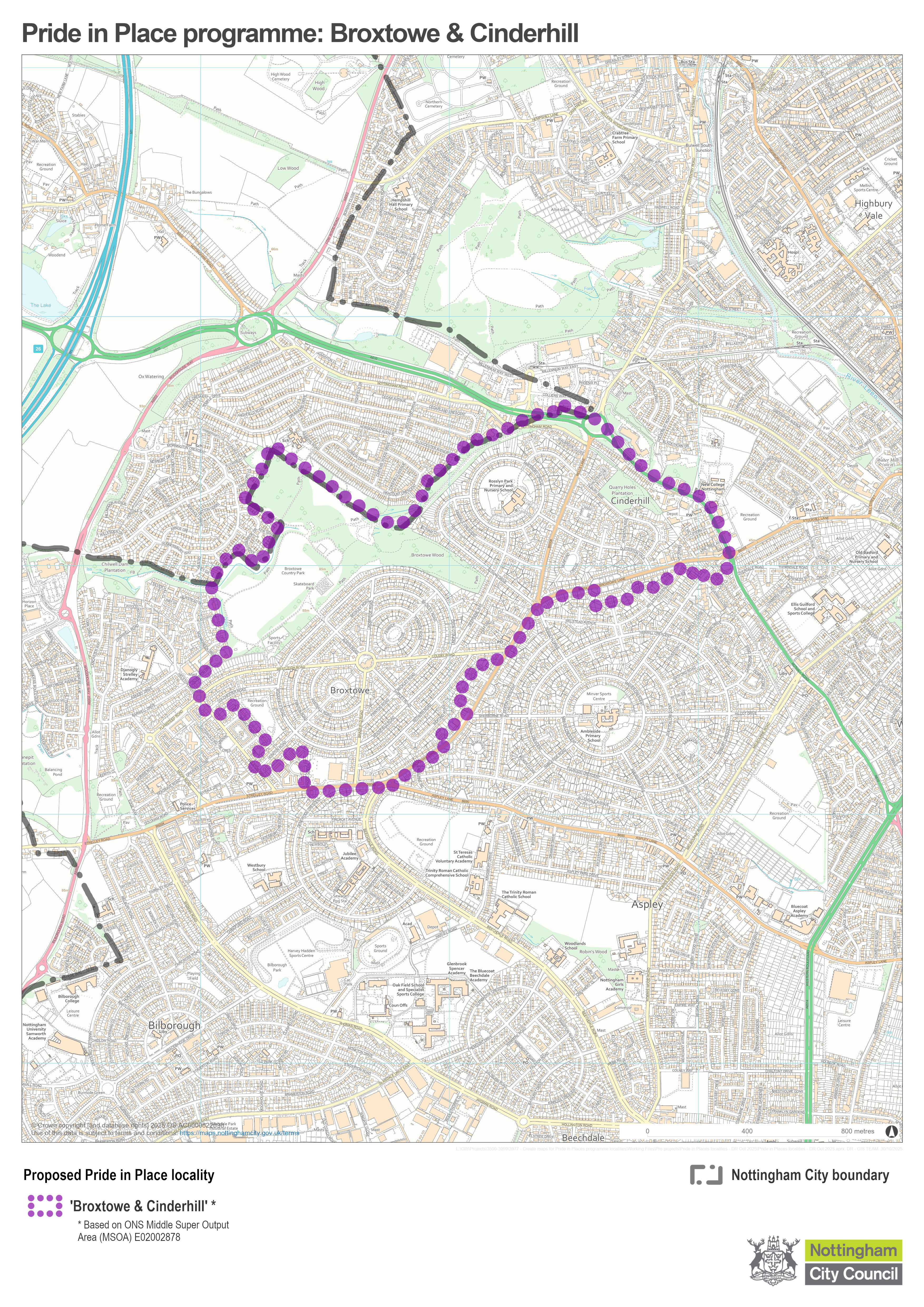
Nottingham City Council has published proposed locality maps for both selected neighbourhoods. These are important because the funding does not cover all of Nottingham or even all of St Ann's, Broxtowe or Cinderhill in a loose estate-agent sense. It applies to defined neighbourhood areas.
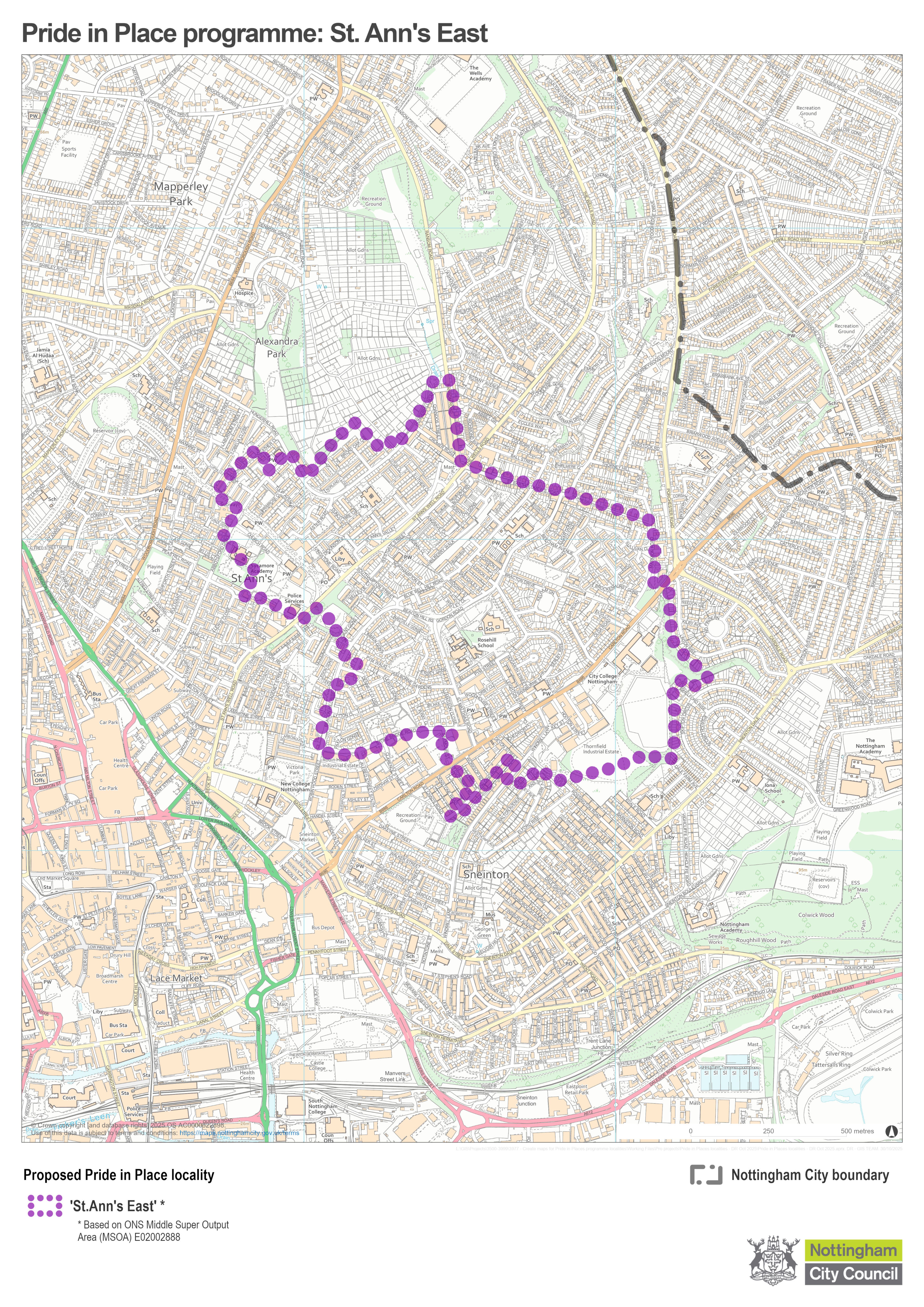
St Ann's East is close to Nottingham city centre and sits broadly within the NG3 market area. Broxtowe and Cinderhill sit further north-west, overlapping the NG8 market area and local neighbourhoods around Broxtowe, Cinderhill and nearby Aspley/Bilborough connections.
Why this matters for Nottingham
The programme matters because it targets everyday neighbourhood conditions rather than headline skyline development. If delivered well, the benefits could include better local public spaces, more usable community assets, stronger resident involvement and improvements to the feel of streets and local centres.
For Nottingham, this type of funding can complement larger city-centre and transport-led regeneration by focusing on residential neighbourhoods where public confidence, local services and the condition of communal spaces strongly affect quality of life.
The potential benefits are:
- clearer local governance through neighbourhood boards;
- long-term funding certainty rather than one-off grant spending;
- resident-led project selection;
- better maintenance and improvement of local assets;
- support for local high streets and community facilities;
- possible improvement in neighbourhood perception if projects are visible and well maintained.
The risk is that flexible funding can become hard to judge if project lists, delivery dates and outcomes are not published clearly. For a property reader, the programme should be monitored through published plans, annual spending, completed works and resident feedback.
Local property market context
ONS local housing data for Nottingham shows an average house price of GBP193,000 in April 2026, broadly unchanged from April 2025. Average private rents in Nottingham were GBP1,006 per month in May 2026, up 3.1% year on year.
Those figures are citywide. They should not be read as St Ann's East, Broxtowe or Cinderhill-specific values. The Pride in Place programme may improve local amenity and confidence over time, but it does not currently provide enough evidence to model a direct effect on local prices or rents.
For landlords and investors, the cautious reading is:
- the funding is meaningful because it is long-term and community-led;
- the delivery scope is still being shaped;
- property impact is qualitative until local projects are selected, delivered and maintained;
- the most relevant evidence will be changes to public realm, community facilities, safety, local high streets and resident satisfaction.
Rental and housing impact
Rental impact is qualitative at this stage. The programme is not currently described as adding a fixed number of homes, so it should not be treated as a housing-supply scheme.
The most plausible housing-market effects would be indirect. Better public spaces, safer local routes, improved community facilities and stronger local centres can support neighbourhood confidence, but only if the improvements are visible, sustained and relevant to residents' day-to-day lives.
The programme should therefore be monitored as a liveability and amenity intervention rather than a direct housebuilding pipeline.
Risks and watchpoints
| Watchpoint | Why it matters | Current risk level |
|---|---|---|
| Board membership | Local governance will shape priorities and public trust | Medium |
| Published Pride in Place plans | The plans will turn broad funding into actual project lists | Medium |
| Annual spending transparency | Long-term programmes need clear reporting to show progress | Medium |
| Project selection | Public-realm, community or high street projects can have very different property relevance | Medium |
| Delivery capacity | Community-led plans still need procurement, management and maintenance | Medium |
| Boundary clarity | The selected areas are specific localities, not all of Nottingham | Low/medium |
| Market interpretation | The programme could be overstated if treated as a direct price-growth catalyst | Medium |
What to watch next
- Final neighbourhood board membership after the 17 July 2026 deadline.
- Publication of the St Ann's East Pride in Place plan.
- Publication of the Broxtowe/Cinderhill Pride in Place plan.
- The first year of funded projects and whether they are capital works, community programmes or both.
- Any public consultation results or resident-priority lists.
- Nottingham City Council updates on spend, procurement and delivery.
- Visible changes to public realm, high streets, local parks, community buildings and neighbourhood safety.