
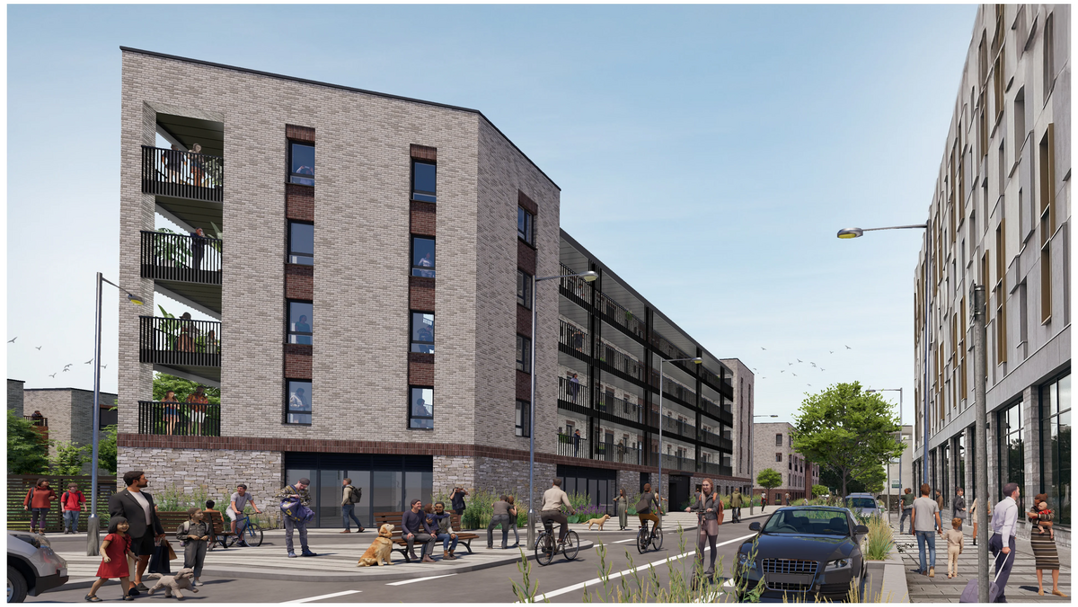
Project facts
| Item | Position |
|---|---|
| Current phase | Enabling and specialist underground-object investigations before construction progresses |
| Active delivery scale | 135 social-rent homes: 80 in phase one and 55 in a later phase |
| Planning envelope | Permission for 136 affordable homes and 628 sq m of flexible commercial space |
| Delivery window | First 80 homes estimated for early 2029; later phase timing not confirmed |
| Location/postcode | Land between Bath Street, Martin Street and Millbay Boulevard, Plymouth PL1 3LT |
| Lead parties | Plymouth Community Homes, Plymouth City Council, Homes England and Classic Builders |
| First-phase funding | £32.063 million contract sum in the March 2026 council business case |
| Confidence | High on consent and current investigation status; medium on programme timing |
| Latest checked | 16 July 2026 |
Why the Bath Street site matters
Bath Street West sits at the city-centre end of Millbay, between Union Street and the waterfront. The council's long-term objective has been to replace a fragmented mix of commercial plots, service yards and temporary parking with a residential-led route that reconnects the centre with the docks.
The wider infrastructure came first. A 2021 council business-case update traces the boulevard idea to the 2003 Mackay Plan and records construction of the widened public route between September 2019 and June 2021. That work added walking and cycling infrastructure, rain gardens, a sustainable drainage system, district-heating pipes, a new public square and utilities intended to support later development.
The housing site is therefore not the whole Millbay regeneration programme. It is one of the major development plots that the completed boulevard was designed to unlock. Its significance lies in converting that public investment into permanent homes, active ground-floor uses and a safer, more continuous route between the city centre and the waterfront.

The completed boulevard and public realm created the setting for housing-led development on adjoining plots. Source: Plymouth City Council.
Detailed project history
| Date | Milestone | Significance |
|---|---|---|
| 2003 | Mackay Plan origin | The council's Millbay Boulevard update traces the city-centre-to-waterfront route to the Mackay Plan. |
| 20 August 2018 | Infrastructure business case | The council approved the business case that enabled land, demolition and public-realm works for the boulevard. |
| September 2019 | Boulevard works began | Demolition and civil works started on the widened Bath Street route and supporting infrastructure. |
| 16 November 2020 | PCH partnership announced | A citywide delivery agreement named Bath Street West among the sites to be advanced by the council and PCH. |
| June 2021 | Millbay Boulevard completed | The council recorded the widened street, rain gardens, drainage, district-heating infrastructure and public square as complete and open. |
| 21 December 2022 | Full application received | Application 22/02109/FUL proposed 136 affordable homes and 628 sq m of flexible commercial space. |
| 30 November 2023 | Main permission issued | Plymouth City Council granted the phased scheme conditionally subject to a Section 106 agreement. |
| November 2024 | First anomaly investigated | A buried object identified during surveys was found to be a metal drain cover, according to the latest council update. |
| 7 April 2025 | Section 106 agreement published | The legal agreement supporting the 2023 permission was added to the planning record. |
| 29 September 2025 | Phase-one variation submitted | Application 25/01267/S73 sought revised plans, tenure and condition triggers for phase one. |
| 10 October 2025 | First-phase grant package announced | The council and PCH confirmed Homes England support and an initial programme of 80 social-rent homes. |
| January 2026 | Historic device made safe | A small unexploded historic device was discovered and dealt with safely during ground investigations. |
| 30 January 2026 | Phase-one variation approved | The council granted the Section 73 variation conditionally subject to a Section 106 agreement. |
| 23 March 2026 | First-phase land transfer announced | The council confirmed that land needed for the first 80 homes would be transferred to PCH. |
| 31 March 2026 | Build contract signed | PCH signed the first-phase build contract with Classic Builders. |
| 8 April 2026 | Council gap funding approved | A delegated decision approved £5.040 million for the Bath Street housing project. |
| 14 April 2026 | Construction start marked | PCH publicly marked the start of work on the first 80 social-rent homes. |
| 13 July 2026 | Further investigations commenced | Specialists began a six-to-seven-week programme to expose and assess remaining underground anomalies before construction progresses. |
Current status: start announced, investigations continuing
PCH's 14 April construction announcement records a genuine delivery milestone: the land had transferred, the build contract had been signed and the partnership formally marked work starting on site. It also identified Classic Builders as the first-phase contractor and retained an early-2029 estimate for the first 80 homes.
That announcement should not be read as proof that foundations or superstructure are now advancing. The council's 13 July 2026 site update says several buried anomalies still require specialist investigation before construction can progress. The investigation was expected to last six to seven weeks and involved carefully exposing and assessing the objects.

The Bath Street site during preparatory investigations in July 2026. Source: Plymouth City Council.
There is no official indication that the scheme has been cancelled or that its permissions have lapsed. The evidence instead shows a construction contract and delivery commitment constrained by brownfield-site investigation. Until PCH or the council confirms that piling, foundations or other substantive building work has resumed, the article should retain the more cautious enabling-and-investigation phase.
Planning consent and the revised first phase
The original full planning permission covers 136 affordable homes and 628 sq m of flexible Class E commercial floorspace. The supporting planning statement described a phased mixed-use neighbourhood with flats, houses, commercial units, communal landscaping and play space.
The approved 2023 application and the active 2026 delivery programme use slightly different totals and tenure descriptions. Original application material proposed 136 affordable homes across affordable rent, Rent to Buy and shared ownership. PCH's current delivery announcement describes 135 homes for social rent, split into 80 in phase one and 55 in a later phase.
The difference is connected to the revised first phase. Section 73 application 25/01267/S73 varied approved plans and tenure and amended the timing of several condition submissions. It was granted on 30 January 2026. The public article should therefore use 135 social-rent homes for the active delivery programme while preserving 136 affordable homes as the underlying planning envelope.
Several conditions remain important during delivery. These include land quality, archaeology, construction traffic, drainage and renewable energy, district-heating connections, landscaping, boundary treatment, external materials, ventilation and glazing. Conditional permission is a live consent, but it still requires the developer to satisfy the relevant condition details at the required stages.
Homes, commercial space and public realm
Phase one is planned to provide 80 homes for social rent, combining one- and two-bedroom flats with three-bedroom houses. The later phase is described by PCH as a further 55 social-rent homes. The first homes are intended for households using Devon Home Choice rather than for open-market sale or private letting.
The neighbourhood design includes communal gardens, children's play areas, pedestrian and cycle routes and commercial units. PCH's current material identifies 26 on-site parking spaces, including four accessible bays, electric-vehicle charging points and six drop-off bays. Cycle storage and the central location are intended to reduce reliance on private cars.
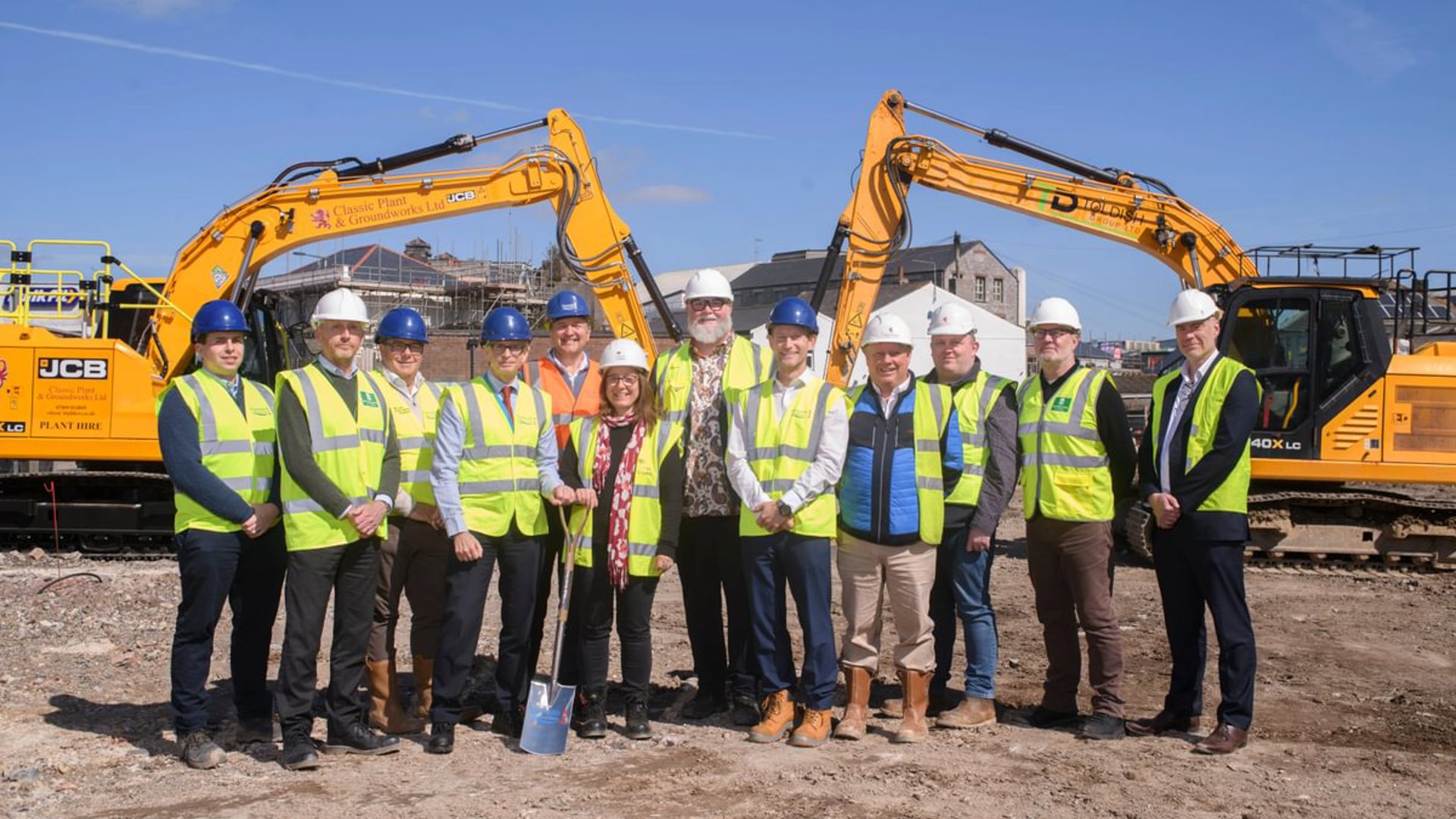
PCH, council, Homes England and contractor representatives at the April 2026 start event. Source: Plymouth Community Homes.
The scheme is also intended to make the boulevard feel inhabited rather than simply operate as a route. Ground-floor commercial space, overlooked walking routes and landscaped shared areas could add activity, but the outcome depends on those uses and public-realm elements being delivered and occupied, not only shown in visualisations.
Funding and delivery structure
Public announcements often describe the wider scheme as a £33.5 million development. The council's March 2026 capital business case gives a more specific first-phase contract sum of £32.063 million.
| First-phase source | Amount recorded in the March 2026 business case |
|---|---|
| Homes England Affordable Homes Programme grant | £14.380 million |
| Plymouth Community Homes funding | £12.643 million |
| Plymouth City Council Plan for Homes gap funding | £5.040 million |
| Total contract sum | £32.063 million |
The council had also received £1.5 million through the Land Release Fund for site preparation and enabling public-realm investment. That earlier infrastructure support should not be added casually to the phase-one contract total because it funded a different part of the regeneration sequence.
PCH is the housing developer and future landlord. Plymouth City Council assembled and transferred land and supplied gap funding. Homes England has supported land assembly and the affordable-housing grant, while Classic Builders holds the first-phase build contract. The later 55-home phase should be treated separately until its funding, contract and start date are confirmed.
Brownfield constraints and delivery risk
The Bath Street site has accommodated commercial premises, a brewery, a builder's yard, a nightclub, a garage and car parking. That history explains why land quality, archaeology, buried services and unexploded ordnance are material delivery issues rather than routine footnotes.
The current anomaly investigation is the clearest immediate watchpoint. One earlier object was a drain cover; another was a small historic device that was made safe. The identity of the remaining objects was not known when the council published its July update. The council said the site remained safe, but construction progress depends on completing the specialist assessment and any necessary disposal work.
Other programme risks include piling and substructure costs, discharge of planning conditions, construction inflation, coordination with nearby businesses and late-night venues, and delivery of future phases. The early-2029 target remains an estimate and no updated official programme has yet explained whether the July investigations affect it.
Plymouth housing and rental context
The Office for National Statistics local housing dashboard reported an average Plymouth house price of £216,000 in April 2026 and an average private rent of £994 per month in May 2026. Those figures cover the whole local-authority area and do not isolate Millbay or the PL1 postcode district.
This project is primarily relevant to affordable-housing supply, not a direct forecast for private rents or sale values. The first 80 homes are intended for social rent and would increase secure, below-market housing in the city centre if delivered. The scheme could also add residents and daily activity near Millbay Boulevard, but no reliable price, rent or rental return effect can be inferred from a project that remains in site preparation.
Property and rental effects therefore remain qualitative until completed homes, verified occupation evidence and relevant local market data are available.
Any later assessment should separate citywide market movement from project delivery. Useful evidence would include completed and occupied homes, Devon Home Choice allocations, commercial-unit take-up, public-realm completion and verified local transactions over time. Visual improvement or a construction announcement alone is not evidence of capital growth.
What happens next
The immediate step is completion of the six-to-seven-week underground-object investigation that began in the week of 13 July 2026. PCH and the council then need to confirm the outcome, any remediation and the point at which substantive construction activity resumes.
For phase one, the next measurable milestones are completion of ground preparation, foundations and superstructure, followed by fit-out, external works, certification and allocation of the 80 social-rent homes. PCH's current estimate is early 2029, but that date should be reviewed when an updated construction programme is published.
The later 55-home phase remains part of the stated 135-home programme, but its funding, contract, start date and completion window are not yet confirmed in the sources reviewed. It should not be presented as under construction alongside the funded first phase.