
At a glance
| Aspect | Detail |
|---|---|
| Current phase | Framework implementation and site-level planning progress; first major permissions secured, no confirmed construction start |
| Scale | ~15 hectares; multi-landowner area (~32 owners); ambition for ~1,000 homes plus workspace and community uses |
| Delivery window | Indicative 10–15 years from framework endorsement; not a fixed programme |
| Location / postcode | St Jude’s & Lawrence Hill, Bristol BS2; both sides of River Frome between M32/Newfoundland Way and Easton Way |
| Lead parties | Bristol City Council, multiple landowners, developers including PLATFORM_ and Dandara, design teams such as AHMM and JTP |
| Confidence | High on framework status and planning decisions; moderate on delivery timing; low on unconfirmed construction dates |
| Latest checked | 15 July 2026 |
What Frome Gateway is and why it matters
Frome Gateway is best understood as a strategic regeneration framework, not a single project. The Spatial Regeneration Framework endorsed by Bristol City Council in February 2024 sets out a shared vision for how this part of the city could evolve. It is a material consideration in planning decisions, meaning it informs but does not determine whether individual applications are approved.
The area has long been characterised by light industrial uses, fragmented plots and infrastructure barriers, particularly the M32. The River Frome, much of it hidden or constrained, runs through the site. The framework seeks to reposition this corridor as a more connected, mixed-use neighbourhood with improved public access to the river.
Key ambitions include:
- Around 1,000 new homes, including affordable housing
- Workspace ranging from small maker units to larger commercial space
- Community and cultural uses
- Public realm improvements, including riverside routes and open space
- Green and blue infrastructure to enhance biodiversity and manage flood risk
Because ownership is dispersed across roughly 32 parties, change is expected to happen incrementally. The framework provides a shared structure so that individual developments contribute to wider goals such as connectivity, environmental performance and social value.
Community engagement has been a core part of the process since 2019, with ongoing consultation documented on the Frome Gateway project site. The associated community principles are intended to guide future proposals, though each scheme must still go through its own planning process.
Framework, planning and delivery timeline
The evolution of Frome Gateway reflects wider planning cycles, including pauses during the pandemic and alignment with Bristol’s Local Plan work.
| Year | Milestone |
|---|---|
| 2019 | Initial community engagement begins |
| March 2020 | Project paused |
| January 2022 | Work resumes; further analysis undertaken during 2022 |
| Late 2023 | Public consultation on the draft framework |
| February 2024 | Council Cabinet endorses Spatial Regeneration Framework as a material consideration |
| 2025 | Consultation on River Frome and Riverside Park proposals (closed 14 July 2025) |
| December 2025 | Crown Sawmills receives planning permission; Little George Street scheme resolved to grant permission |
| 30 June 2026 | New Bristol Local Plan 2045 timetable published |
| July 2026 | Framework implementation continues; no confirmed construction starts |
The framework aligns with earlier policy work, including the 2023 publication version of the Bristol Local Plan, which referenced new homes, affordable workspace and up to 500 student bedspaces in the area. However, that document is not an adopted 2026 plan, and Bristol has since moved into a new Local Plan 2045 process.
This evolving policy context is important. The framework provides direction, but future planning decisions will also reflect updated city-wide policies, viability considerations and site-specific constraints.
First major approved sites
Two schemes reached significant planning milestones in December 2025. These represent early tests of the framework’s principles at a site level.
Little George Street
The Little George Street scheme proposes around 360 student rooms alongside public riverside gardens, a new walkway and dedicated community space for Albaseera Bristol Masjid. It is promoted by Dandara with JTP as architect.
The Planning Committee resolved to grant permission in December 2025. Public-facing materials describe this as an approval, but as with all schemes, progression to construction depends on completing planning conditions, agreements and funding arrangements.
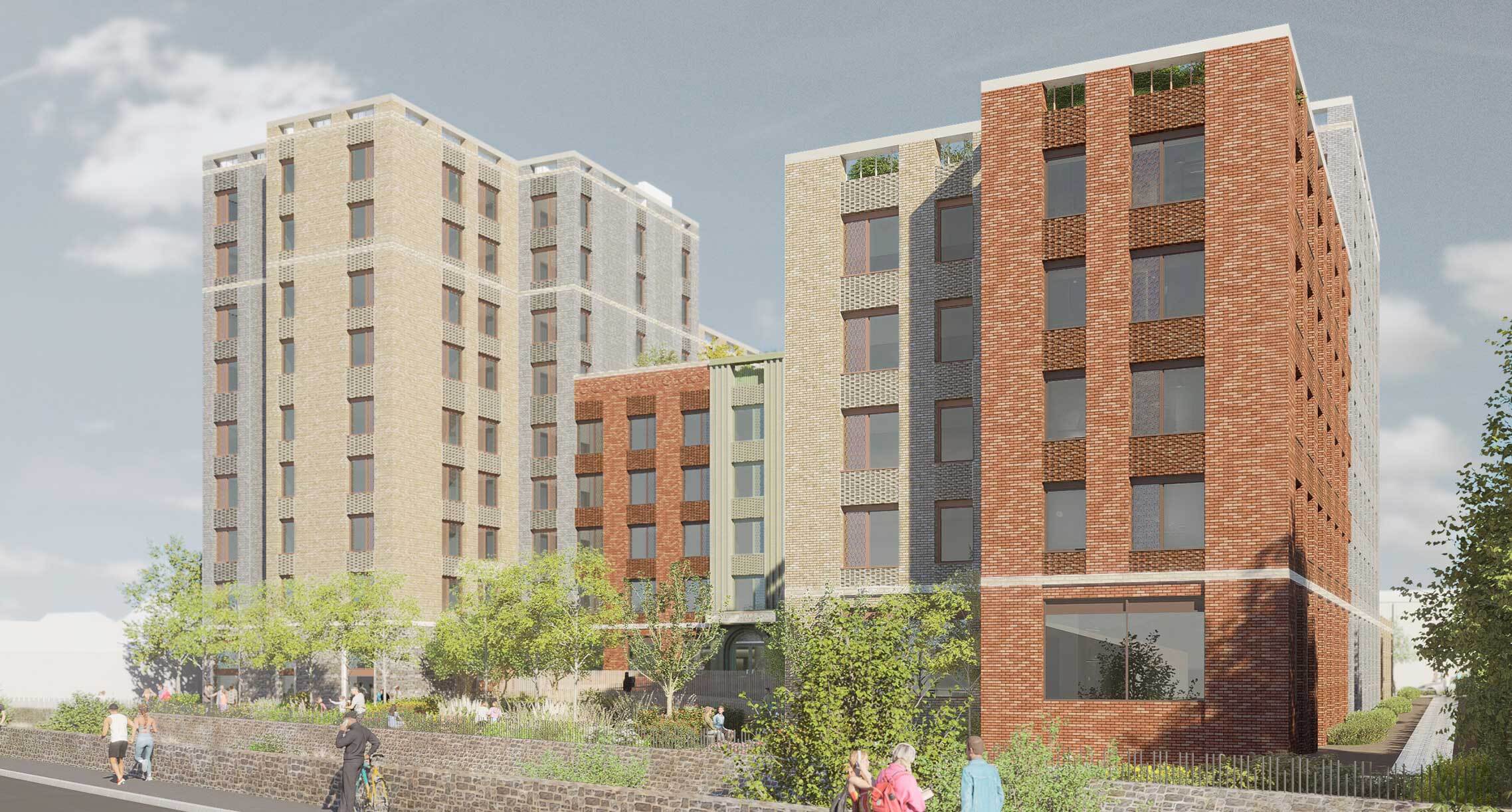
Alternative illustrative view of the Little George Street proposals. Source: Little George Street project website.
The scheme reflects several framework themes:
- Opening up access to the River Frome
- Providing publicly accessible green space
- Integrating community facilities alongside residential uses
It also raises broader questions about the balance between student accommodation and conventional housing, a recurring theme across the wider regeneration area.
Crown Sawmills / Scaddings Timber Yard
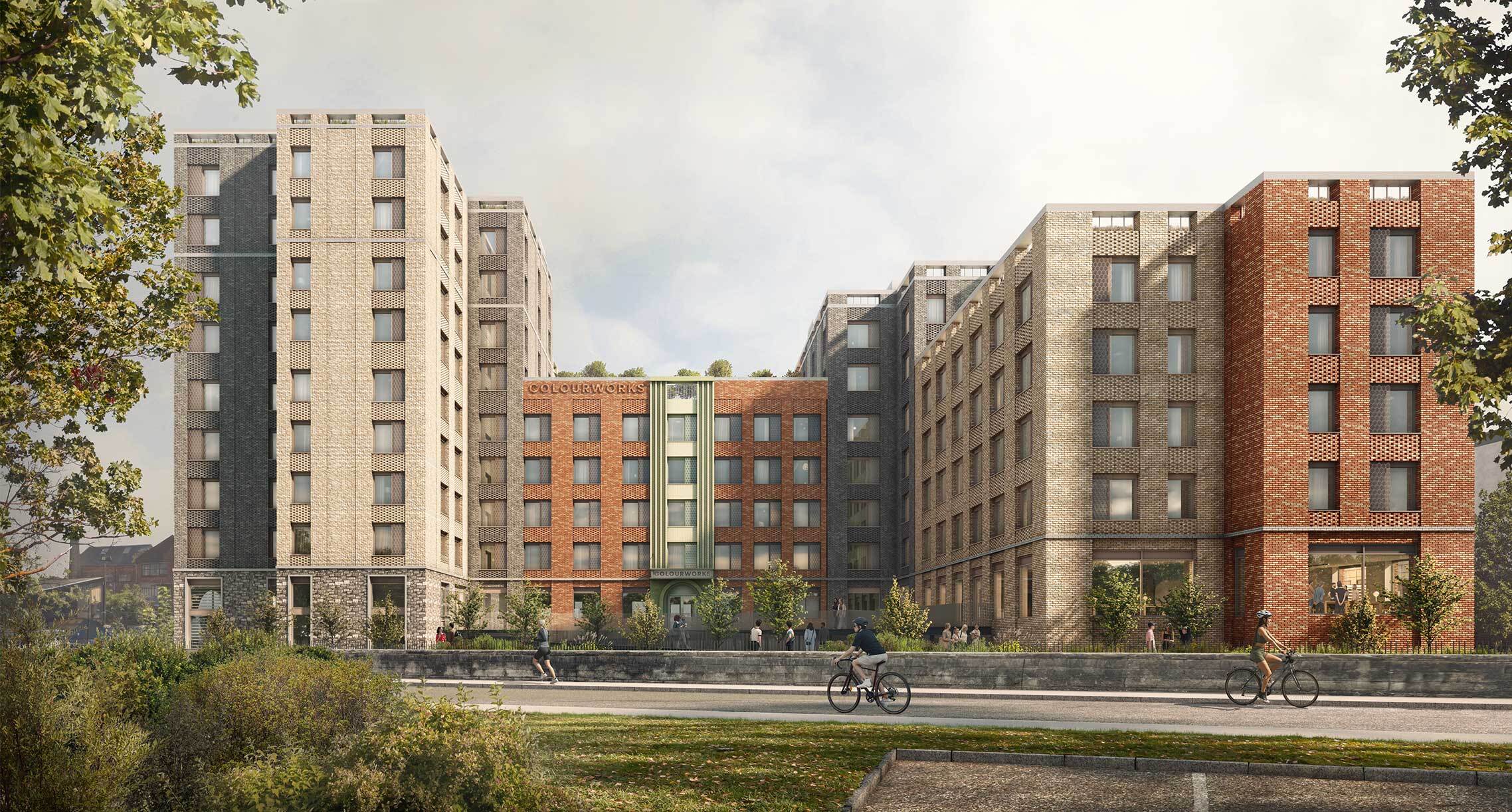
At the Crown Sawmills site, a proposal led by PLATFORM_ with AHMM as architect received full planning permission in December 2025. The scheme includes:
- 352 build-to-rent homes
- Community space and café
- Commercial and maker space
- Public realm and roof terraces
- Cycle storage and supporting infrastructure
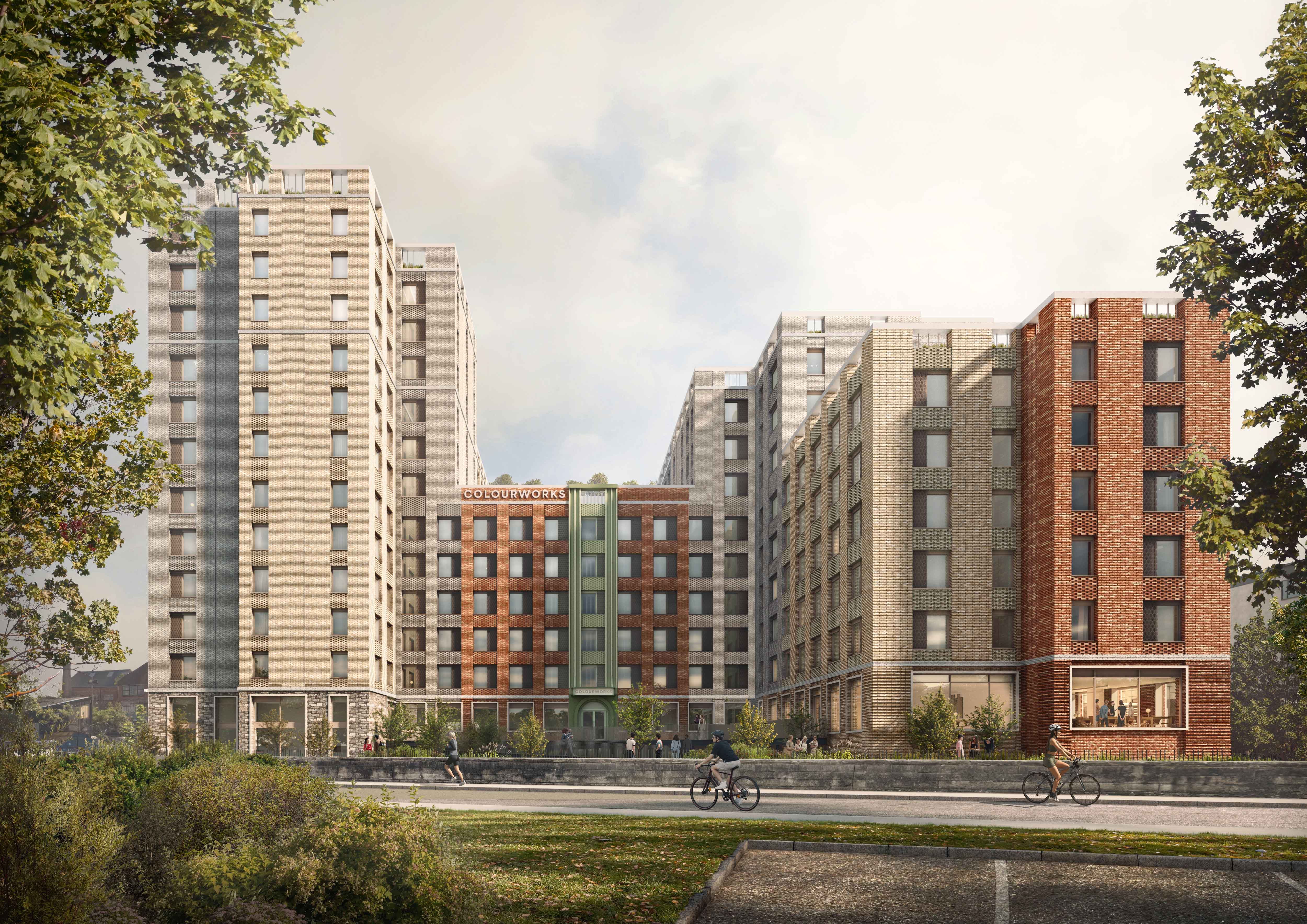
Building heights range from approximately 6 to 20 storeys. AHMM described it as the first major housing proposal in the area to receive permission.

Approved Crown Sawmills redevelopment concept. Source: AHMM project announcement.
Despite permission being granted, there is no confirmed construction start. Delivery will depend on detailed design, conditions, funding and wider market context.
Together, these two schemes demonstrate how the framework can translate into site-specific proposals, while also highlighting that regeneration will proceed incrementally rather than through a single coordinated build phase.
Homes, student accommodation and affordable housing
The framework’s headline ambition of around 1,000 homes spans a mix of tenures and building types. This includes:
- Conventional residential units, including build-to-rent
- Affordable housing, subject to viability and policy requirements
- Student accommodation, referenced in earlier policy work
The Crown Sawmills scheme contributes build-to-rent homes, while Little George Street focuses on student housing. This mix illustrates the diversity of uses anticipated across the area.

Further visualisation of the Crown Sawmills scheme. Source: AHMM project announcement.
Affordable housing delivery remains a key objective but also a recognised challenge. Outcomes will depend on:
- Individual site viability
- Planning obligations negotiated through applications
- Wider policy changes under the emerging Local Plan
The inclusion of student accommodation introduces additional complexity. While it can reduce pressure on traditional housing stock, it may also affect the balance of uses within the neighbourhood. The framework itself does not prescribe exact proportions, leaving decisions to future applications and policy guidance.
River Frome, Riverside Park, flood risk and biodiversity
The River Frome is central to the identity of the area, yet much of it is currently constrained or inaccessible. The framework places strong emphasis on restoring and enhancing the river corridor.
Proposals explored through consultation include:
- A continuous Riverside Park
- Improved flood resilience
- Habitat creation and biodiversity gains
- Public access via walking and cycling routes
A dedicated consultation on these ideas was listed by Bristol City Council and closed on 14 July 2025. At this stage, these remain proposals, not confirmed construction projects.
Flood risk is a critical factor. Development near the river must address:
- Existing flood zones
- Climate change impacts
- Surface water management
This adds technical complexity and may influence the phasing and design of future schemes. It also reinforces the importance of coordinated infrastructure rather than isolated site-by-site solutions.
Workspace, community facilities and local economy
Frome Gateway is not solely a residential project. The framework emphasises the retention and evolution of employment uses, particularly:
- Affordable workspace for small businesses and makers
- Flexible commercial units
- Community and cultural facilities
Schemes such as Crown Sawmills incorporate maker space and commercial units alongside housing. This mixed-use approach aims to support local economic activity while accommodating growth.
However, regeneration also raises concerns about business displacement. Existing industrial and small-scale enterprises may face pressure from rising land values or redevelopment. Managing this transition is a key challenge, and outcomes will depend on:
- Planning policies around affordable workspace
- Phasing strategies
- Engagement with existing occupiers
Community facilities, including the dedicated space proposed at Little George Street, highlight the importance of embedding social infrastructure within new developments.
Walking, cycling, public transport and connections
Improving connectivity is a core objective of the framework. The area is currently constrained by major roads and fragmented routes, particularly around the M32 corridor.
Proposed improvements include:
- New and enhanced walking and cycling routes
- Better links across the River Frome
- Integration with wider city networks
- Improved access to nearby neighbourhoods such as Easton and the city centre
These are largely aspirational at this stage. While individual developments may deliver sections of route or public realm, a fully connected network will require coordination across multiple sites and funding streams.
Public transport considerations include proximity to existing bus routes and the wider urban transport network. However, no specific new transport infrastructure is confirmed as part of the framework itself.
Housing and rental-market context
City-wide data provides context for the potential significance of regeneration in inner Bristol. According to the Office for National Statistics Bristol dataset, the average house price in Bristol was around £354,000 in April 2026, with modest annual growth. Average private rents were approximately £1,883 per month in May 2026, reflecting stronger annual increases.
These figures are Bristol-wide averages, not specific to St Jude’s or BS2. They provide context rather than evidence of localised change linked to Frome Gateway.
At this stage:
- No completed development is in occupation within the framework area
- No direct rental or price impacts can be attributed to the regeneration
- Any housing or rental-market effects remain qualitative and uncertain
This discussion is not investment advice, and there is no basis for forecasts or guaranteed uplift claims linked to the project.
Risks and watchpoints
Several factors will influence how Frome Gateway progresses:
Multiple land ownership With around 32 landowners, coordination is inherently complex. Delivery depends on aligning different timelines, priorities and financial positions.
Flood risk and environmental constraints Development near the River Frome must address flood risk, which may affect design, cost and sequencing.
Infrastructure and connectivity Achieving the framework’s ambitions for walking, cycling and public realm requires coordinated infrastructure investment.
Affordable housing delivery Viability pressures may affect how much affordable housing is delivered on individual sites.
Balance of uses The mix between conventional housing, build-to-rent and student accommodation remains an open question.
Business displacement Existing industrial and small-scale businesses may be displaced without careful planning and mitigation.
Policy transition The move towards the Local Plan 2045 introduces uncertainty as policies evolve.
Funding and market conditions Economic factors will influence when and how schemes move from permission to construction.
These risks do not prevent delivery, but they underline why the framework is a long-term, adaptive process rather than a fixed programme.
What happens next
The next phase of Frome Gateway is likely to focus on implementation through individual sites. Key developments to watch include:
- Progression of approved schemes through planning conditions and detailed design
- Submission of further planning applications by other landowners
- Development of detailed proposals for Riverside Park and river enhancements
- Alignment with the emerging Local Plan 2045
- Identification of funding and delivery mechanisms for infrastructure
Crucially, construction timelines remain unconfirmed. The presence of planning permission or committee resolution does not guarantee immediate delivery.
Over time, the success of Frome Gateway will depend on how effectively the framework translates into coordinated, high-quality development that balances housing, employment, environment and community needs.