
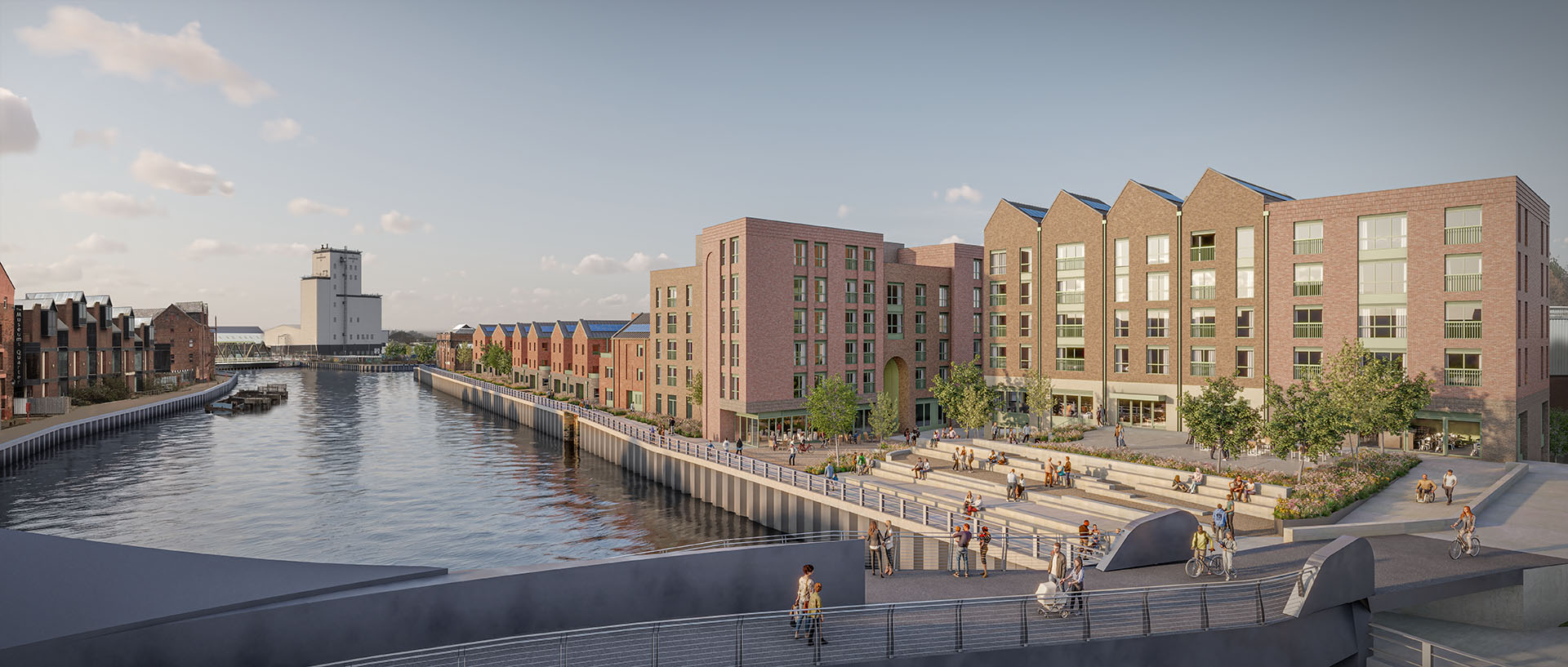
Project snapshot
| Item | Evidence-led position |
|---|---|
| Project | East Bank Urban Village |
| City | Kingston upon Hull |
| Location | East bank of the River Hull, opposite Hull Old Town |
| Public sponsor | Hull City Council |
| Development partner | ECF, the partnership between Homes England, Legal & General and Muse |
| Design team | CJCT Studios referenced in project imagery/design material |
| Overall homes | Up to 850 homes |
| Phase One | 37 townhouses and 78 apartments, all affordable |
| Later phases | More than 700 build-to-rent and affordable apartments |
| Funding | £9.875m / £9.8m Levelling Up Partnership funding for enabling works and infrastructure |
| Planning status | Hybrid planning application submitted April 2026 |
| Delivery horizon | Phased over four stages; Phase One construction anticipated from 2027, final completion around 2040 in project material |
| Investor reading | Strong waterfront placemaking signal, but still early in planning/delivery cycle |
Location and strategic context
East Bank sits immediately across the River Hull from the Old Town, near the Fruit Market, The Deep, Scale Lane Bridge and Drypool Basin. It has a strong location but has long been underused, fragmented and disconnected from the most active parts of Hull's visitor and city-centre economy.
The regeneration logic is to make the river work harder as a place to live, walk, cycle and spend time. If the scheme succeeds, East Bank could extend the appeal of the Old Town and Fruit Market across the water, while helping Hull City Council meet its city-centre housing ambition.
What is proposed or delivered
The submitted hybrid application includes detailed designs for Phase One and outline plans for the wider neighbourhood. Phase One would establish the core of the new neighbourhood with 37 townhouses and 78 apartments across two buildings. All of those homes are intended to be affordable.
The first phase also includes the eastern landing for Scale Lane Bridge and a connection to Trinity Buoy Shed, a local heritage building that forms part of the long-term neighbourhood vision.
Later phases would deliver more than 700 build-to-rent and affordable apartments, plus shops, cafes, commercial spaces, amenities, new green spaces, a revitalised Drypool Basin area, reinstated riverside walkway and active travel routes.
Partners, public bodies and funding
Hull City Council is the public-sector lead. ECF is the development partner, bringing together Homes England, Legal & General and Muse. Hull City Council confirmed ECF as lead development partner at UKREiiF in 2025, with a 15-year development agreement for masterplanning, development and construction.
The scheme is supported by £9.875m of Levelling Up Partnership funding. Hull Council and Invest Hull describe this as supporting enabling works and early infrastructure delivery. That helps de-risk early work, but does not mean every later phase is fully funded and contracted.
Planning and governance status
The key current status is that the hybrid planning application has been submitted. Phase One is the detailed part of the application, while subsequent phases are coming forward in outline. Planning approval is still a key gateway.
The project has already gone through community conversations in September and October 2025, with feedback shaping the masterplan. The official project website describes a phased approach over several years, with Phase One construction anticipated in 2027 and final Phase Four completion anticipated in 2040.
Timeline
| Date / period | Milestone |
|---|---|
| 2024/2025 | Hull City Council selects/announces ECF as preferred/lead development partner |
| May 2025 | ECF confirmed as lead development partner at UKREiiF |
| September-October 2025 | Community conversations inform the masterplan |
| April 2026 | Hybrid planning application submitted for Phase One and wider neighbourhood |
| 2027 | Phase One construction anticipated, subject to planning and delivery steps |
| 2030s | Later phases expected to bring build-to-rent and affordable apartments forward |
| 2040 | Project material anticipates final Phase Four completion |
Property investor section
East Bank has several characteristics investors tend to watch: waterfront land, proximity to the Old Town and Fruit Market, a large public-sector regeneration partnership, affordable-housing-led first phase, and a long-term pipeline of build-to-rent homes.
The positive case is that East Bank could turn a forgotten riverside edge into an extension of Hull's city-centre living market. Better links over Scale Lane Bridge, a reinstated river walkway, revived heritage assets and new public spaces would all strengthen the everyday appeal of the location.
The cautious case is timing and delivery. Phase One is still subject to the planning process, and the wider 850-home vision stretches across multiple phases through to around 2040. Investors should monitor planning approval, funding, construction starts, tenure mix, service charges, flood/water management, public-realm maintenance and actual rental/sales evidence as homes complete.
Rental impact is qualitative and should not be read as a price or rent forecast. A sensible investment view is to treat East Bank as long-term optionality, not as a reason to overpay for weak assets today.
Risks and watch points
- Planning risk: the application has been submitted, but approval and conditions still matter.
- Long phasing: the scheme is expected to run over many years and market cycles.
- Funding: Levelling Up Partnership money supports enabling works, not all phases.
- Flood and water management: the scheme must work with Hull's Living With Water principles and sustainable drainage.
- Absorption: build-to-rent and affordable homes need sustained demand.
- Connectivity: the regeneration value depends on Scale Lane Bridge, riverside routes and links to the Fruit Market and Old Town.
- Heritage reuse: Trinity Buoy Shed and other heritage assets need viable, active uses.