

Report Snapshot
| Item | Detail |
|---|---|
| Project name | Wythenshawe Civic Regeneration / Wythenshawe Town Centre Regeneration |
| City | Manchester |
| Area | Wythenshawe Civic / Wythenshawe Town Centre |
| Lead authority | Manchester City Council |
| Delivery partner | Muse, appointed August 2024 |
| Housing partner | Wythenshawe Community Housing Group |
| Long-term value | More than £500m |
| Public kick-start funding | £20m UK Government Levelling Up funding + £11.9m Manchester City Council funding |
| Programme length | 10–15 years |
| Homes target | Up to around 2,000 homes over the wider programme |
| First housing phase | 422 social-rent homes approved by March 2026 |
| Civic components | Culture Hub, Food Hall, public square, workspace, public realm, shopfront/public-space improvements |
| Current status | Civic works underway; Culture Hub under construction; first residential phase approved |
| Investor profile | Long-term regeneration play, family rental/owner-occupier uplift, local retail/service opportunity |
Strategic Purpose of the Project
The regeneration is designed to reposition Wythenshawe Civic as a proper town centre again, rather than just a declining shopping precinct. Manchester City Council’s stated aims are to bring empty and under-used buildings back into use, improve public spaces, create a stronger shopping and events environment, deliver new homes, and create jobs. manchester.gov.uk
The wider Wythenshawe Town Centre Vision frames the project as a multi-phase regeneration lasting 10–15 years, with the Civic area forming the first phase. The Council’s vision includes new public space, better public realm, a Culture Hub, Food Hall, workspaces and up to 2,000 homes over the longer programme. Wythenshawe Town Centre
This matters because Wythenshawe has historically had strong population and employment anchors, including proximity to Manchester Airport, but the Civic Centre itself has not matched the potential of the area. The regeneration is therefore trying to convert Wythenshawe from a functional local centre into a more attractive, liveable and investable district centre.
Location Context
Wythenshawe sits in south Manchester and benefits from a strategic location between Manchester city centre, Manchester Airport and the wider south Manchester residential market. Wythenshawe Town Centre has a Metrolink stop on the Airport Line, with services connecting towards Manchester city centre and Manchester Airport. Wikipedia
Manchester Airport is a major nearby economic driver. The airport reported a record 32 million passengers in 2025, and its long-running Terminal 2 transformation programme is a major infrastructure investment in the wider south Manchester economy. mediacentre.manchesterairport.co.uk
For a regeneration tracker, this gives the Wythenshawe Civic project a stronger investment case than a purely isolated neighbourhood scheme. It is not just about fixing a shopping centre; it sits within a wider employment, transport and airport-economy corridor.
What Is Being Delivered
Culture Hub
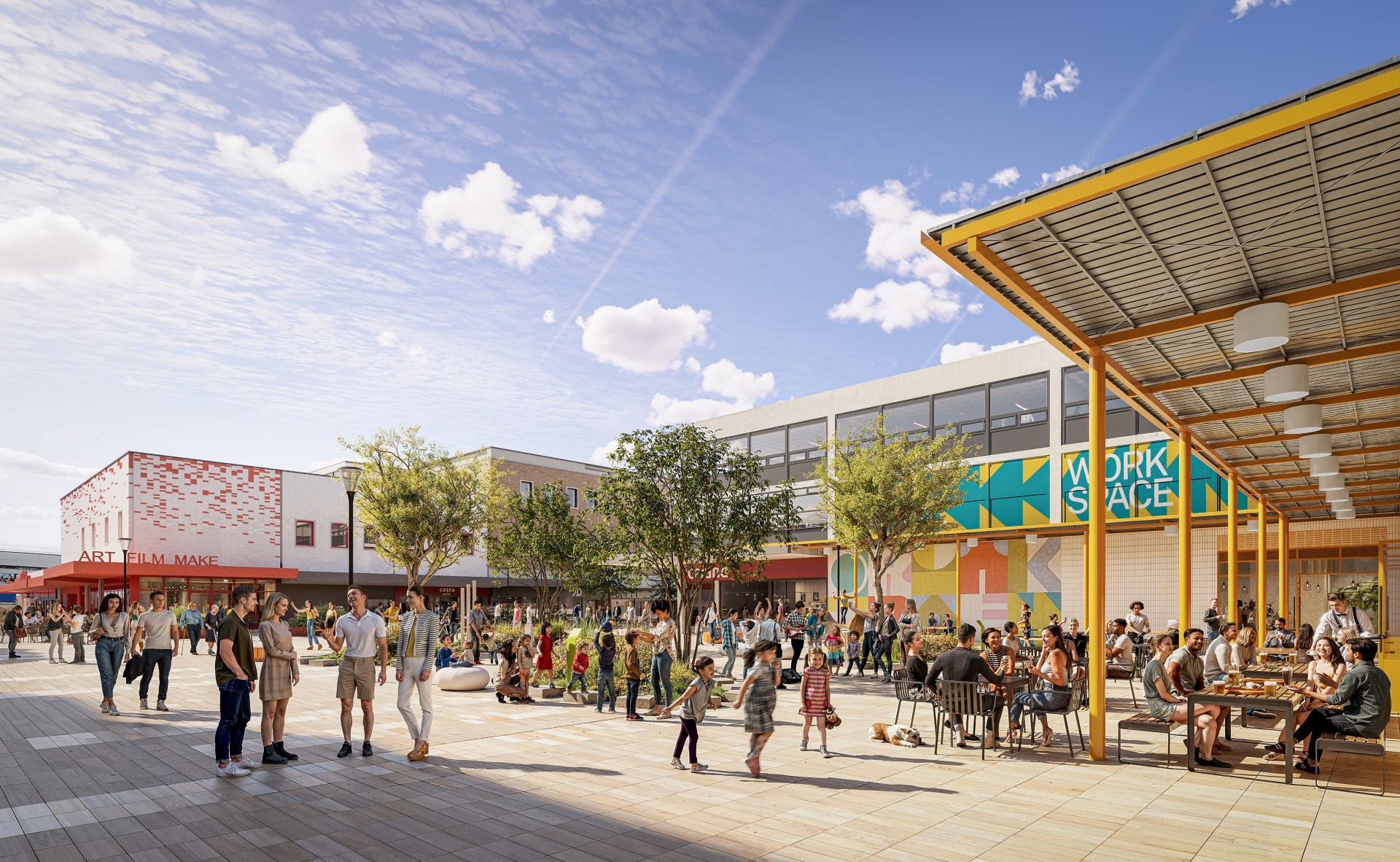
The Culture Hub is one of the flagship public-facing elements. It is planned for the former Co-op store and is intended to provide arts, creative, cultural and community space. The Council’s plans describe ground-floor social/eating and drinking space, flexible community and creative studios, workshop and exhibition spaces, and performance/cinema provision. Wythenshawe Town Centre
This is important because town-centre regeneration usually fails when it only focuses on housing. The Culture Hub is intended to give Wythenshawe Civic a reason to be used outside standard shopping hours.
Food Hall
A new Food Hall is planned in units next to the former Peacocks store, with a link to the new public square. The concept is to bring in independent and local food vendors and support evening and weekend activity. A planning application for the Food Hall was submitted in February 2026, and the wider Civic works are expected to complete in 2027. Muse
For investors, the Food Hall is worth tracking closely because successful food and beverage anchors can change footfall patterns, evening economy, rental tone and tenant demand around a district centre.
Public Square and Public Realm
The project includes a new larger public square, improved paving, planting, greener streets and more attractive spaces around Civic. The Council’s vision places the new square around the area where The Birtles meets Hale Top. Wythenshawe Town Centre
This is not cosmetic. Public realm is often the difference between regeneration that simply builds units and regeneration that changes perception. If delivered well, the square can become the new “front door” of Wythenshawe Civic.
Workspace and Enterprise Space
The regeneration also includes plans to reuse vacant or underused office space for modern workspace, start-ups and local businesses. This is intended to increase daytime footfall and create local employment space rather than making the centre purely residential. Wythenshawe Town Centre
Residential Development
The wider vision is for up to around 2,000 homes over 10–15 years. The first major housing phase is being delivered by Wythenshawe Community Housing Group, Muse and Manchester City Council, with 422 social-rent homes approved by March 2026. Wythenshawe Town Centre
The first phase includes:
| Site | Homes | Key details |
|---|---|---|
| Brotherton House | 216 | Includes later-living, extra-care and townhouse provision |
| C2 site | 81 | One and two-bed apartments with ground-floor retail |
| Alpha House | 125 | One and two-bed apartments, including wheelchair-accessible homes |
| Total | 422 | All first-phase homes approved as social rent |
The first phase being social rent is important. It supports local housing need and de-risks delivery, but it means private investors should not assume immediate private sales evidence from these first plots.
Sustainability and Social Value
The regeneration has several sustainability ambitions. Muse’s appointment announcement refers to new net-zero carbon commercial, community and cultural space and a wider ambition for a positive energy district. manchester.gov.uk
Early consultation materials also referred to decarbonisation measures, solar PV, green public spaces and “sponge park” concepts to improve biodiversity and public realm resilience. manchester.gov.uk
The first residential phase is also positioned as energy-efficient social housing, with affordable homes designed to support local residents and different life stages. Wythenshawe Town Centre
Current Status as of July 2026
The latest verified position is that the project is now in active delivery.
By December 2025, Manchester City Council announced that the former Peacocks store had begun demolition, marking the start of approximately £32m of Civic works funded by the £20m Levelling Up grant and £11.9m Council contribution. Muse
By January 2026, work had started on the Culture Hub, with completion expected in 2027. manchester.gov.uk
By February 2026, the Food Hall planning application had been submitted. Muse
By March 2026, all 422 first-phase social-rent homes had received planning approval, with Manchester City Council describing the Culture Hub and Food Hall as now under construction. manchester.gov.uk
Wythenshawe Community Housing Group’s project information describes the overall programme as likely to take 10–15 years, with works likely to start on site in summer 2026 and the final timeline still being developed. Wythenshawe Community Housing Group
Full Project Timeline: Start to Today
| Date / Period | Milestone | Why it matters |
|---|---|---|
| 1960s–1970s | Wythenshawe Civic developed as a post-war town centre / shopping centre environment | Creates the baseline: an ageing civic/shopping centre requiring modernisation. |
| 2022 | Manchester City Council completed acquisition of Wythenshawe town centre from St Modwen | This gave the Council control of the asset and made a coordinated regeneration strategy possible. |
| August 2022 | Council had submitted a £20m Levelling Up Fund bid | Early funding strategy formed around Culture Hub, Food Hall, employment space and public realm. |
| November 2022 | Public consultation sessions held, with consultation closing on 25 November 2022 | First major public engagement stage on the Civic regeneration proposals. |
| January 2023 | Wythenshawe Civic Centre Development Framework reported to Manchester City Council Executive | The project moved from early vision into formal development framework and governance. |
| 2023 | Council approved wider Development Framework masterplan | This provided the strategic framework for future investment and regeneration. |
| October 2023 | Procurement began to find a private-sector delivery partner | Start of the process that later led to Muse being appointed. |
| November 2023 | £20m Levelling Up funding confirmed for Wythenshawe Civic | Public funding de-risked the first Civic phase. |
| January–February 2024 | Culture Hub consultation opened | Specific consultation on the former Co-op building and cultural/community uses. |
| August 2024 | Muse appointed as delivery and investment partner | Major delivery milestone; Muse brought in for the 10–15 year programme. |
| February 2025 | Culture Hub planning application submitted, according to the Council’s vision timeline | Project moved into formal planning for a key anchor asset. Wythenshawe Town Centre |
| April 2025 | Community conversation launched on early proposals and neighbourhood priorities | Further engagement on homes, community uses and public-realm changes. Muse |
| 2025 | Early public programme anticipated Civic works beginning during 2025 | The public-facing programme started to move from planning to delivery. Wythenshawe Town Centre |
| December 2025 | Three planning applications submitted for 422 affordable/social-rent homes | First major housing phase entered planning. Muse |
| December 2025 | Demolition of the former Peacocks store began; £32m Civic works commenced | Visible start of physical regeneration works. Muse |
| January 2026 | Work started on the Culture Hub | The project moved into construction on a flagship community/cultural asset. |
| February 2026 | Food Hall planning application submitted | Another key town-centre anchor advanced. Muse |
| March 2026 | 297 homes at Brotherton House and C2 approved | First tranche of residential approvals secured. Wythenshawe Community Housing Group |
| March 2026 | Alpha House approved, bringing first phase to 422 approved social-rent homes | Full first residential phase approved. |
| July 2026 | Latest verified position: Civic works underway, Culture Hub progressing, first 422 homes approved, wider 10–15 year programme still to be delivered | The project is active but still early in its long-term delivery cycle. |
Property Investor Analysis
Investor Summary
Wythenshawe Civic is a regeneration-led value play, not a prime-market investment. The opportunity is based on the gap between Wythenshawe’s existing perception and what the area could become if the Civic regeneration is delivered well.
The investment case is strongest for investors who understand:
- Family housing demand
- Long-term regeneration uplift
- Transport-linked suburbs
- Airport and employment-driven rental demand
- Local retail and service demand
- The difference between social-impact regeneration and private-sales-led regeneration
This is not the same as buying into Manchester city centre. Wythenshawe is more suburban, more family-oriented and more affordability-driven.
Residential Market Indicators
Rightmove’s sold-price data shows Wythenshawe had an average sold price of around £262,784 over the last year, with semis averaging around £279,920, terraces around £255,405, and flats around £175,915. Rightmove also reports that overall prices were down 3% on the previous year but up 5% on the 2023 peak. Rightmove
For wider Manchester, the ONS reported an average house price of £247,000 in April 2026 and an average private rent of £1,352 per month in May 2026. ONS also reported Manchester monthly rents by bedroom size: one-bed £989, two-bed £1,216, three-bed £1,410 and four-bed-plus £1,989. Office for National Statistics
Using these figures only as a rough guide, a three-bed family property around the Wythenshawe average sold price, rented at the wider Manchester three-bed average, would imply a simple gross rental return of around 6.4% before costs. This is not a substitute for street-level rental evidence, but it shows why investors may start paying more attention to the area as regeneration moves forward.
What Type of Property Investor Could Benefit?
Family buy-to-let investors
The strongest residential angle is likely to be houses rather than speculative flats. Wythenshawe has a family-housing profile, and the regeneration should improve local amenities, public space and perception.
Long-term capital growth investors
The regeneration programme is 10–15 years, so the best fit is an investor prepared to hold through several phases: Civic improvements first, then residential delivery, then later private/affordable mixed-tenure phases.
Local commercial investors and operators
The Food Hall, Culture Hub, public square and workspace provision could create opportunities for cafés, convenience retail, health, beauty, childcare, fitness, community services and local independent food operators.
Social-impact and affordable-housing aligned investors
The first wave is social rent, and the wider programme includes affordable rent, shared ownership and homes for sale. WCHG describes the intended tenure mix as including social rent, affordable rent, shared ownership and homes for sale. Wythenshawe Community Housing Group
Investor Opportunities
| Opportunity | Why it matters |
|---|---|
| Early-stage regeneration position | Physical works have started, but the wider market may not fully price in the 10–15 year change yet. |
| Transport connectivity | Metrolink access to Manchester city centre and the airport supports commuter and employment-led demand. |
| Public-sector commitment | Council ownership, Levelling Up funding and Muse appointment reduce “paper project” risk. |
| First phase approved | 422 approved homes show the residential programme is moving from concept to delivery. |
| Amenity uplift | Culture Hub, Food Hall, public square and workspace can improve local desirability. |
| Family housing stock | Terraces and semis may benefit more directly than flats from improved town-centre amenities. |
| Airport corridor | Manchester Airport growth supports the wider south Manchester economy. |
Investor Risks
| Risk | Investor impact |
|---|---|
| Long delivery period | A 10–15 year programme means benefits may arrive slowly. |
| First phase is social rent | Positive for housing need, but it does not immediately create private-sale comparables. |
| Programme slippage | Earlier public timelines indicated some openings in 2026, while later updates point to 2027 for key Civic spaces. |
| Funding and construction risk | Inflation, contractor costs and public-sector budgets can affect phasing. |
| Local affordability | New food and leisure uses must match local spending power to succeed. |
| Perception lag | Even after works complete, market perception may take years to change. |
| Buy-to-let tax and rates | Investor returns remain sensitive to mortgage rates, tax treatment and compliance costs. |
| Micro-location risk | Streets close to Civic may perform differently from wider Wythenshawe. |
Investor Watchlist
Property investors should track the following:
- Opening date of the Culture Hub
Completion is expected in 2027, so confirmation of programme and operator details will be important.
- Food Hall planning and tenant announcements
The Food Hall could materially affect evening footfall if the operator mix is strong.
- Start on site for the 422 homes
Planning approval is not the same as completed homes. Construction start, delivery phasing and handover dates are key.
- Future private-sale phases
The first phase is social rent. Investors should watch when homes for sale and shared ownership phases are brought forward.
- Retail occupancy and void rates
Regeneration success should show up in reduced vacancy, stronger tenant mix and better footfall.
- Public realm completion
The new square and streetscape improvements are central to changing perception.
- Rental evidence in M22 / M23
Use actual local comparables rather than relying only on Manchester-wide rent averages.
- Transport and airport growth
Airport-linked employment and Metrolink reliability are key demand drivers.
Planning and Delivery References to Track
These references are useful for a regeneration-tracking product because they allow users to follow public planning progress:
| Component | Planning / reference detail |
|---|---|
| Culture Hub | Planning reference reported as 142287/VO/2025 in local development coverage. Place North West |
| Food Hall | Planning reference reported as 145125/FO/2026. Place North West |
| Alpha House | Planning reference reported as 144655/FO/2025. Place North West |
| Brotherton House / C2 | Approved as part of the first 297-home tranche in March 2026. Wythenshawe Community Housing Group |
Regeneration Impact Assessment
Economic impact
The scheme should increase construction activity, support local jobs, create workspace, improve local retail footfall and strengthen the town-centre economy. The strongest impact is likely to come once the Culture Hub, Food Hall and public square are all open and trading.
Housing impact
The first 422 homes are all social rent, which is positive for local housing need. It also creates population density around the centre, but investors should remember that social-rent delivery does not directly create private sales evidence.
Public realm impact
The new square, planting and improved Civic environment are central to changing the area’s image. This is one of the most important non-financial parts of the project.
Social impact
The project has a clear social-regeneration angle: affordable housing, later-living provision, cultural space, community space and local enterprise. This makes it more resilient politically than a purely private residential-led scheme.
Investment impact
The biggest potential investment upside is not immediate. It is the gradual re-rating of Wythenshawe Civic as a better-served, better-connected, more active district centre.
Image Placement Guide for the Report
For the final regeneration tracker page, the best layout would be:
| Report section | Suggested image |
|---|---|
| Hero banner | Masterplan or aerial CGI of Wythenshawe Civic |
| Project vision | CGI of new public realm / public square |
| Residential phase | Site plan or model showing first homes |
| Timeline section | Before/current image of Civic shopping centre |
| Investor section | Map-style image showing Civic, Metrolink, Manchester Airport and surrounding housing |
| Delivery status | Construction/demolition image of former Peacocks / Culture Hub works |
The strongest visual narrative is: old Civic centre → masterplan → public square → new homes → investor map.
Overall Conclusion
Wythenshawe Civic Regeneration is a credible, live Manchester regeneration project with public funding, Council ownership, a major delivery partner, approved first-phase housing and visible construction progress.
The project should be tracked as a major south Manchester district-centre regeneration programme, not just a housing scheme. The most important components are the Culture Hub, Food Hall, public square, workspace and first 422 social-rent homes. Together, these create the conditions for long-term place improvement.
For property investors, the area offers a potential long-term uplift story, especially for family housing and local commercial uses. However, this is not a short-term speculative project. The best investor approach is to monitor delivery milestones, buy carefully by micro-location, avoid overpaying for the regeneration story too early, and focus on assets that will benefit directly from improved amenities, transport access and town-centre confidence.
Rental impact note
Rental impact is qualitative at this stage. Treat the rent and sales discussion as evidence-led context, not a promise of future price or rent movement.