
Project scope, trajectory and current status
Manchester City Council chose Newton Heath district centre and the Old Church Street area for a neighbourhood framework because of what it described as the area’s “huge potential”. The consultation page defined the focus area as stretching along Oldham Road from just beyond the Post Office in the west to beyond Farm Foods in the east, extending south of Oldham Road along and around Old Church Street to All Saints Church and Scotland Street, and including a plot at Flash Street. The same consultation material says the framework’s initial themes were expanded community facilities, improved healthcare, new housing, safer public space, better shopping conditions, reduced congestion and better walking/cycling connectivity. 6
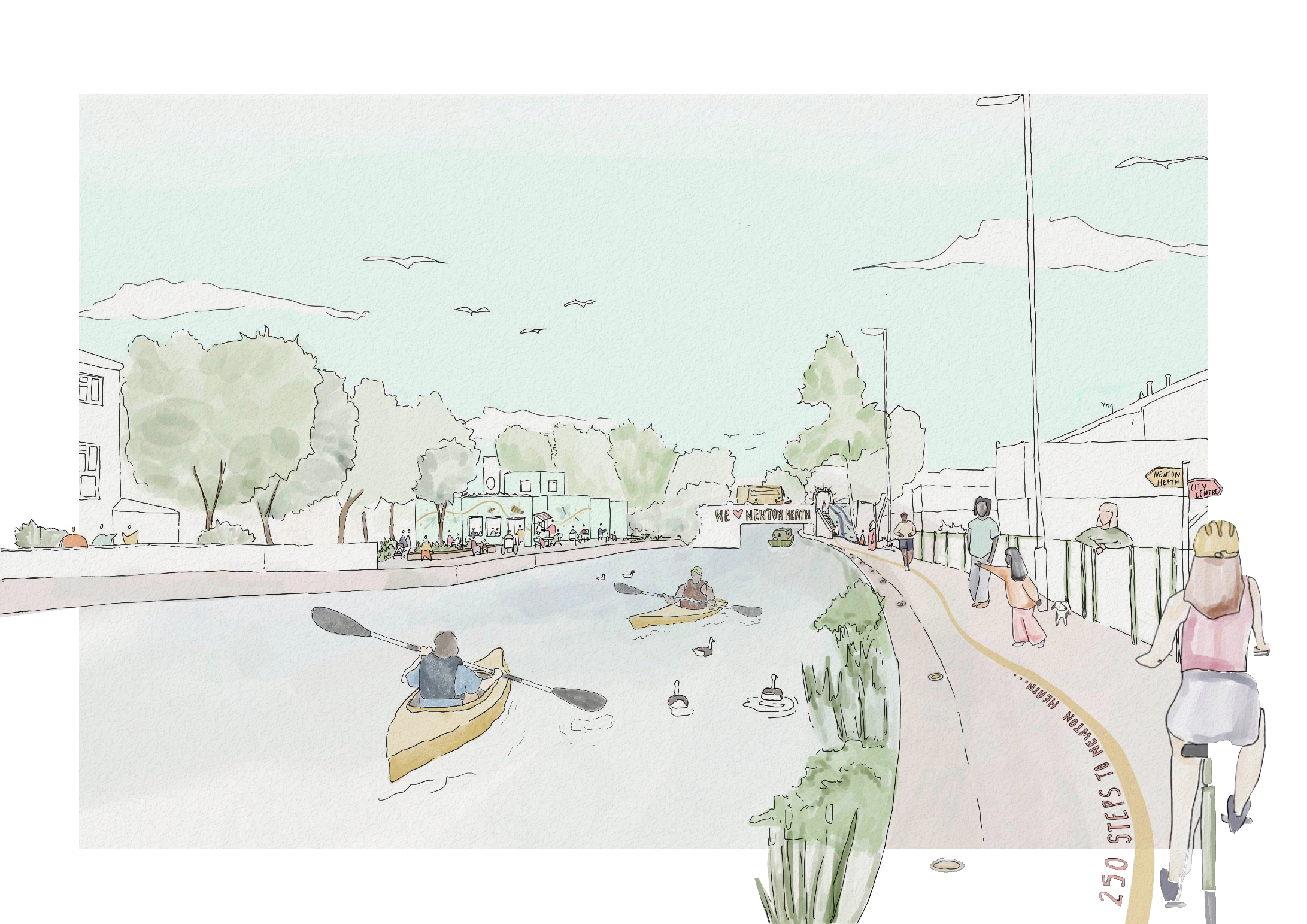
Project-area maps and diagrams are available in official Manchester City Council material. The consultation page contains both an “area of focus” plan and an illustrative streetscape image, while the consultation boards set out cluster diagrams for Old Church Street North, Millwright Street and the area’s green-space and movement network, including the “Easy Come Easy Grow” green trail concept. Those official images are the best public guide to the regeneration geography. 7
The March 2026 NDF and associated council news set out six main development clusters: Oldham Road West; Old Church Street North; Millwright Street; Old Church Street South; Holyoak Street / Rothwell Street / Silk Mill; and Flash Street. The framework also proposes a new central square branded “Silk Square”, canal-corridor upgrades, All Saints area improvements and signalled/pedestrian crossing changes on Old Church Street. Consultation findings reported 606 responses, with very strong support for canal and square improvements, a new or expanded health centre, and an improved library on or near its existing canalside site. 8
By July 2026, the regeneration programme is best described as part strategic framework, part live delivery pipeline. The NDF itself is a long-term place-shaping document. Its most visible “current status” manifestation is that site-by-site housing delivery around the centre is already changing the area before most public-realm works inside the core centre have been fully scoped or costed in public. Manchester’s district-centre update said in late 2025 that there were already “300+ new homes in and around the district centre”, and the draft NDF said the wider local-area pipeline over the next five years amounted to 1,485 proposed homes, 52% of them affordable. 9
The timeline above combines the framework process with the surrounding development pipeline. The dates come from GMCA UKSPF records, Manchester consultation and Executive material, planning committee records and developers’ own live sales pages. 10
A concise way to understand scope is to separate the town-centre interventions from the market-shaping housing projects:
| Element | What it covers | Status | Source |
|---|---|---|---|
| District-centre NDF | Six development clusters, Silk Square, Old Church Street upgrades, canal and All Saints improvements, movement and community/health interventions | Framework stage, long-term implementation | 11 |
| Existing completed exemplar | Silk Street, 69 low-carbon social-rent homes adjacent to district centre and canal | Completed and fully occupied | 12 |
| Live affordable pipeline at Oldham Road | Earlier 139-home affordable scheme plus later 109-home affordable scheme | Earlier phase on site / later phase approved Feb 2024; public start-on-site date not clearly specified in indexed sources | 13 |
| Wider growth context | Jacksons Brickworks, Riverpark and other Newton Heath schemes that are outside or beyond the tight district-centre core but influence local demand and infrastructure | Approved / pre-delivery / enabling | 14 |
The analytical takeaway is that Newton Heath has moved beyond “vision only”, but it has not yet reached a stage where every town-centre intervention has a public programme, contractor and funding envelope. The housing-led regeneration is ahead of the civic-place programme. 15
Planning documents, approvals and policy context
The district-centre regeneration is being shaped through a stack of documents rather than one statutory masterplan. The most important are the closed 2025 public consultation and boards, the March 2026 NDF report to Executive, and planning consents on adjoining or nearby brownfield sites that already form part of the area’s regeneration momentum. The NDF itself is a council-endorsed framework document intended to coordinate investment and guide future planning rather than replace site-specific planning applications. 16
The key planning and framework documents available in public sources are as follows:
| Document or application | Main content | Status in public sources | Source |
|---|---|---|---|
| Newton Heath public consultation and boards | Establishes area boundary, themes, concept diagrams and community input process | Consultation opened Feb 2025 and later closed | 17 |
| Newton Heath District Centre NDF | Long-term neighbourhood framework for district centre regeneration | Presented to Manchester Executive on 13 March 2026 | 18 |
| One Manchester 139-home old consent | 100 apartments and 39 family houses on Oldham Road plots | Approved in 2020 | 19 |
| Application 138730/FO/2023 | Additional 109 affordable homes on land bounded by Oldham Road / Old Church Street | Approved by planning committee in Feb 2024 | 20 |
| Application 133700/FO/2022 | Jacksons Brickworks hybrid scheme: detailed phase one and outline phase two | Approved in Oct 2022 | 21 |
| Application 142464/FO/2025 | Riverpark redevelopment at former trading estate | Approved in Nov 2025 | 22 |
| Application CDN/26/0189 | Condition/discharge application tied to former Jacksons Brickworks site | Valid in Apr 2026, showing post-consent implementation activity | 23 |
The statutory policy context currently rests on Manchester’s adopted Core Strategy, updated after the adoption of Places for Everyone in March 2024. Manchester’s Local Plan page states that the local plan currently consists of the Core Strategy, Places for Everyone, the interactive proposals map and remaining UDP policies. The Core Strategy was adopted in 2012, and Manchester says it was updated in March 2024 after PfE took effect. 24
For Newton Heath, the most relevant strategic policy themes are straightforward. First, both Manchester and GM policy favour development in sustainable, previously developed locations and around centres. Second, the city’s adopted affordable-housing baseline under Core Strategy policy H8 is a 20% contribution citywide, while the emerging draft local plan raises the expectation to 30% on major schemes and says 70% of the affordable component should be social rent. Third, the draft local plan identifies Newton Heath itself as a focus for around 1,000 homes over the plan period, explicitly including Jacksons Brickworks and development around the district centre. 25
That means developers and investors need to distinguish between adopted policy and direction of travel. Today’s formal decision-making still sits within the adopted Core Strategy/PfE framework, but the city has already consulted on a draft local plan that is materially tougher on affordable housing and more explicit about growth locations and net-zero expectations. In practice, Newton Heath is therefore likely to experience policy pressure from both the current 20% rule set and the city’s emerging 30%/social-rent-forward stance. 26
Transport and placemaking policy also matter. Greater Manchester’s Transport Strategy 2040, carried into the Local Transport Plan refresh, seeks sustainable connectivity and a “Right Mix” reduction in car dependency, while Manchester’s own strategic documents tie housing, neighbourhoods, climate and transport together. This policy language aligns closely with the NDF’s focus on safer crossings, walking/cycling links, congestion management and canal improvements rather than road-widening-led regeneration. 27
Stakeholders, funding and delivery model
The stakeholder map is unusually important here because Newton Heath is being regenerated through coordinated public stewardship plus multiple delivery vehicles, not through a single master developer. Manchester City Council is the lead place-shaping authority. GMCA matters because of strategic planning, devolved transport, brownfield and UKSPF routes. TfGM is the relevant transport body because Newton Heath and Moston is on the Metrolink network and Oldham Road is a major bus corridor. Registered providers and their developer partners are central because most visible housing delivery to date is affordable-led. Community groups matter because the framework was explicitly built through consultation and because some greening/community interventions reference local initiatives by name. 28
| Stakeholder | Role in regeneration | Evidence |
|---|---|---|
| Manchester City Council | Commissioned the NDF, ran consultation, presented framework to Executive, leads district-centre programme, owns or has disposed of key land for affordable housing elsewhere in the city | 29 |
| Greater Manchester Combined Authority | Supported NDF development through Manchester’s UKSPF programme; adopted Places for Everyone; oversees regional transport and housing strategy context | 30 |
| TfGM | Operates Metrolink and Bee Network bus information relevant to Newton Heath and Moston stop and local bus corridors | 31 |
| One Manchester | Affordable-housing developer/registered provider delivering the Oldham Road schemes | 32 |
| Your Housing Group | Promoter and expected lead delivery partner for Jacksons Brickworks | 33 |
| Great Places / Kellen Homes / Plumlife | Promoters and sales route for Riverpark, a major nearby housing scheme likely to reinforce district-centre demand | 34 |
| Community groups and local residents | 606 consultation responses; local businesses and residents engaged through drop-ins; the NDF references “Easy Come Easy Grow” in its greening concept | 35 |
| Library and adult education partners | Newton Heath Library already acts as a community venue, advice point and adult-learning location, making it a live social-infrastructure stakeholder rather than a passive asset | 36 |
The funding picture is real but incomplete. The NDF consultation page states that the framework project was funded through the UK Shared Prosperity Fund, and GMCA records from June 2023 explicitly list development of the Newton Heath Neighbourhood Development Framework within Manchester’s UKSPF-backed proposal set. Manchester also says Newton Heath will benefit from part of Pride in Place funding because it sits inside the Clayton Vale area selected for £20 million over ten years. However, the council has not publicly itemised Newton Heath district centre’s exact share of that £20 million in the indexed sources reviewed here. 37
| Funding source | Use | Publicly specified amount? | Source |
|---|---|---|---|
| UK Shared Prosperity Fund | Funded NDF preparation/consultation | Unspecified for Newton Heath in indexed sources | 38 |
| Pride in Place | Long-term neighbourhood investment; Newton Heath sits within Clayton Vale programme area | £20m over ten years for the programme area, not itemised by Newton Heath share | 39 |
| Section 106 on 138730/FO/2023 | Environmental improvements, place-making and linkages to district centre | £110,000 | 40 |
| GMCA Brownfield Land Fund | Supported Jacksons Brickworks according to YHG annual report | Amount unspecified in indexed source | 41 |
| Government / affordable-housing subsidy routes | Supports affordable housing at schemes such as Riverpark and wider council affordable-housing land programme | Scheme-level amounts largely unspecified in reviewed Newton Heath sources | 42 |
Analytically, that means delivery risk is concentrated less in whether some money exists and more in whether enough different pots can be assembled at the right time. The NDF needs town-centre public-realm cash, health capital, library/community investment and brownfield-housing finance to align. Housing is already moving because it can be financed and phased site by site. Civic and street-scene transformation usually takes longer because it depends on public capital and cross-agency coordination. 43
Place impacts across transport, housing, economy and environment
Transport and infrastructure. Newton Heath and Moston has a Metrolink stop on the Rochdale/Oldham side of the network and sits on an established Oldham Road public-transport corridor. TfGM also shows several local or corridor bus routes serving or passing through the area, including the 83, 84, 171, 711 and 724. The significance for regeneration is that Newton Heath already has transit access; the NDF is therefore focused on improving the quality of local movement rather than adding major new transit infrastructure. Publicly indexed NDF material proposes upgraded crossings, signalled junctions, wayfinding, better pedestrian links to Millwright Street, canal-towpath improvements and easier cycling/walking connections, but it does not set out a new tram extension or new station proposal. 44
Housing. Housing is the largest quantifiable component of regeneration. The NDF explicitly positions new homes as central to viability and neighbourhood renewal, with significant emphasis on social rent and affordable housing. Within the core NDF, the six clusters envisage infill housing, homes above a new health facility, larger long-term redevelopment at Millwright Street, mixed-use redevelopment at Old Church Street South, canalside conversions/infill near the Silk Mill and new townhouses at Flash Street. The wider local-area pipeline in the draft NDF is 1,485 homes over five years, with 52% affordable. The live schemes around that framework are substantial: Silk Street delivered 69 social-rent low-carbon homes; the earlier One Manchester phase delivered/plans 139 affordable homes; the later One Manchester consent adds 109 affordable homes; Riverpark was approved for 498 dwellings including 214 affordable homes; and Jacksons Brickworks was approved for more than 700 homes with mixed tenures including affordable rent and shared ownership. 45
| Housing component | Homes | Tenure and notes | Source |
|---|---|---|---|
| NDF wider local pipeline | 1,485 | 52% affordable across local-area pipeline | 46 |
| Silk Street | 69 | All social rent; low-carbon / zero-and-low-carbon homes; complete and occupied | 47 |
| One Manchester early phase | 139 | 100 apartments for social rent and 39 houses for affordable rent | 48 |
| One Manchester later phase 138730/FO/2023 | 109 | 81 social-rent flats and 28 affordable-rent houses; three wheelchair-accessible flats | 49 |
| Riverpark | 498 | 214 affordable homes: 139 social rent, 75 shared ownership | 50 |
| Jacksons Brickworks | 716 to 730 in sources | Hybrid scheme; phase one 378 homes plus hub/park, phase two 338 homes plus school; mixed tenures including affordable rent, shared ownership, social rent, private rent and open market | 51 |
The tenure story is especially important. Newton Heath is not being regenerated primarily through luxury for-sale apartments. The delivery pattern is dominated by social rent, affordable rent, shared ownership and, in strategic wording, some owner-occupation, private rent and specialist housing such as extra care/independent living. That is socially progressive and consistent with Manchester’s housing strategy, but it also means pure private capital will often be entering a market whose price setting is being shaped by affordable housing and public-sector priorities rather than by speculative private-sale comparables alone. 52
Commercial and retail impacts. Newton Heath’s high street is described in the draft NDF as being “primarily retail and food & beverage”, while consultation feedback showed the strongest improvement request was for a more diverse retail and service offer. The NDF’s commercial strategy is therefore incremental rather than transformational: upgrade the street scene, improve signage, crossings, shopfronts and public space, and use new housing and community footfall to support local businesses. Nearby district-centre evidence shows the council tracks these centres through regular surveys, and one later planning document confirms Newton Heath District Centre had a 2024 district centre survey basis. But a Newton Heath-specific vacancy-rate figure was not surfaced in the indexed sources reviewed here, so that figure remains unspecified. 53
The likely commercial effect is therefore twofold. In the short term, public-realm and safety improvements should help defend existing convenience retail, takeaways and services on Old Church Street. In the medium term, housing delivery around the centre should improve local spending power and daily footfall, but the evidence does not point to Newton Heath becoming a large-format destination retail location. Even Jacksons Brickworks only adds a community hub with 6,600 sq ft of commercial floorspace in phase one, which is locally useful but not a district-wide retail reset. 54
Public realm, green space, heritage and conservation. The public-realm offer is one of the framework’s strongest features. Official plans propose Silk Square as a central gathering/events space, Millwright Green as a more structured green heart, canal-towpath and bridge/access improvements, All Saints area enhancements, more planting, play features and better street furniture. Heritage is a real constraint and an opportunity: Historic England lists Newton Silk Mill as Grade II and the Church of All Saints as Grade II, with separate Grade II listing for the railings and gateways to the churchyard. The NDF and council minutes explicitly identify these as heritage assets capable of strengthening identity. However, heritage sensitivity also affects design, view-lines, massing and materials around the centre and along Old Church Street/Holyoak Street. Reviewed official sources emphasise listed assets; they do not surface a separate Newton Heath district-centre conservation-area programme. 55
Environmental and sustainability measures. Manchester’s corporate and citywide climate framework sets a zero-carbon city target for 2038, and the council’s 2025–30 climate plan says this trajectory remains the reference point. At local-project level, the clearest evidence is Silk Street, which Manchester presents as a low-carbon social-rent demonstrator and which partner project pages describe as zero-and-low-carbon housing. Citywide, Manchester says it has built hundreds of low-carbon affordable homes using technologies such as solar panels, batteries, EV chargers and heat pumps, and Silk Street is used in official material as an example of best practice informing later projects. Jacksons Brickworks committee material also said the development would be climate resilient and energy efficient with renewable technology, while the NDF’s own sustainability content emphasises active travel, green links, greener public space and canal enhancements. 56
Social impacts. Regeneration here is being cast as social infrastructure as much as physical construction. The NDF states that employment opportunities and skill development should arise through local labour, apprenticeships and work placements. The 109-home affordable scheme specifically secured a local labour agreement, and the district-centre update to scrutiny says that jobs and skills benefits in district-centre regeneration generally flow through construction supply chains and local recruitment mechanisms. Newton Heath Library already offers job advice, youth activity and community use, and a 2026 libraries update says the library has been remodelled to create a new meeting room and interview/advice room. Adult education is also present through MAES provision at Newton Heath Library. 57
The key analytical point is that Newton Heath’s model is community-retention regeneration rather than displacement-led gentrification planning. The promise being made is not “replace the centre”; it is “upgrade the centre, add homes, improve health and library provision, and make the existing neighbourhood safer and more attractive.” Whether that promise is kept will depend on delivery quality, tenure balance and how much of the public-realm programme actually gets built. 58
Risks, constraints and objections
The first major risk is delivery fragmentation. The NDF intentionally coordinates multiple sites, but that also means different timelines, ownership positions, design constraints and funding routes. Where large affordable-housing schemes are led by different housing providers and public-realm projects depend on public capital, there is a real risk that residential delivery will outpace the high-street, square, canal and civic upgrades that are meant to make the centre feel transformed. The public sources strongly support that reading because the housing pipeline is detailed and live, while district-centre public-realm budgets remain much less explicit. 59
The second risk is site abnormality and brownfield complexity. Jacksons Brickworks is the clearest example: council and planning sources repeatedly refer to contamination legacy from its former use as brickworks and landfill, and a remediation application was needed before redevelopment proposals advanced. Brownfield conditions increase cost, delay and programme uncertainty in ways that matter directly for viability and phasing. In Newton Heath, this is not theoretical; it is already evidenced on a flagship site. 60
The third risk is highways and movement tension. Consultation showed strong appetite for safer crossings and traffic management, but views on pedestrianisation of Old Church Street were mixed. That is a classic district-centre regeneration fault line: what improves pedestrian quality of place can also be seen as reducing convenience, loading access or traffic capacity. Because Newton Heath is an active local centre rather than a blank-slate redevelopment zone, this tension should be expected at detailed design stage. 61
The fourth risk is local political and resident scrutiny. The February 2024 109-home scheme drew six objections, and both ward councillors named in the committee record objected. The public committee summary does not expose every objection in detail in the snippet, but objections existed despite the scheme being 100% affordable, showing that “affordable” is not by itself enough to eliminate local concerns around form, traffic, parking, design or site relationships. Jacksons Brickworks also faced enough concern to be pushed back in September 2022 over issues including school safety. 62
The fifth risk is heritage and townscape sensitivity. Nearby listed assets such as All Saints Church and Newton Silk Mill strengthen placemaking but also constrain development envelopes, façade treatment and visual impact. The 2024 planning committee pack for the 109-home scheme explicitly noted proximity to Newton Silk Mill and another historic mill building. This is manageable, but it reduces the freedom to pursue aggressive density or generic repeat-product design in the most sensitive parts of the framework area. 63
The sixth risk is retail-market realism. Consultation found demand for more diverse shops and services, but publicly indexed evidence does not show a published retail-viability model proving that Old Church Street can quickly absorb higher-order retail or leisure uses. The likely near-term outcome is stronger convenience, better services, cleaner public realm and improved local trading conditions, not a dramatic wholesale tenant remix. Investors assuming a rapid “high street re-rate” would be leaning ahead of the evidence. 64
Property market evidence and investor implications
Newton Heath’s residential market is still relatively low-entry by Greater Manchester urban standards. ONS says the average house price in Manchester local authority was £247,000 in April 2026 on a provisional basis. By contrast, Rightmove’s Newton Heath area data puts the local average at about £204,894 over the last year, with terraced homes averaging £211,580, semis £235,500 and flats £85,770. Zoopla’s sold-price summary for Newton Heath is lower, at £185,629 over the last 12 months, which is a reminder that portal methodologies and geographies differ. Either way, Newton Heath remains cheaper than Failsworth and substantially cheaper than Miles Platting in the current data reviewed. 65
| Area | Average sold price | Recent trend in source | Source |
|---|---|---|---|
| Newton Heath | £204,894 on Rightmove; £185,629 on Zoopla | Rightmove says up 19% year on year; Zoopla methodology lower | 66 |
| M40 postcode | £232,964 | Rightmove says up 9% year on year | 67 |
| Moston | £220,110 | Rightmove says up 13% year on year | 68 |
| Failsworth | £244,799 | Rightmove says up 8% year on year | 69 |
| Miles Platting | £283,928 | Rightmove says down 6% year on year | 70 |
| Manchester local authority | £247,000 | ONS, April 2026 provisional | 71 |
That relative-value position is one of Newton Heath’s most investable characteristics. It suggests the district still trades at a discount despite proximity to the city centre, Metrolink access and a very visible regeneration narrative. The discount alone is not enough to justify investment, but a discount plus transit access plus public-sector-led housing and place investment is often how neighbourhoods begin to reprice in a durable way. 72
Current rental evidence is thinner and more volatile because portal listings are snapshot-based, but the direction is useful. Rightmove currently shows a one-bed flat in Ivy Graham Close at £850 pcm and a two-bed semi on Oakley Close at £1,100 pcm. Using recent average sold-price data, that implies rough gross rental returns of about 11.9% for a one-bed flat against Newton Heath’s average flat price and about 5.6% for a two-bed semi against the Newton Heath average semi price. These are indicative screens, not underwritten investment rental returns: they use asking rents, average sold prices and broad area data rather than achieved rents, EPC-adjusted costs, service charge assumptions or voids. 73
| Asset screen | Rent benchmark | Price benchmark | Indicative gross rental return | Comment | Source |
|---|---|---|---|---|---|
| One-bed flat | £850 pcm | £85,770 average Newton Heath flat price | c.11.9% | High headline rental return, but this segment usually carries greater letting, management and liquidity risk | 74 |
| Two-bed semi | £1,100 pcm | £235,500 average Newton Heath semi price | c.5.6% | More conservative family-housing screen; likely closer to institutional comfort | 75 |
Investor opportunities. The most attractive strategies in Newton Heath are likely to be: family housing and low-rise PRS; shared-ownership or affordable-housing partnership models; selective acquisition of brownfield or edge-of-centre plots that fit the NDF’s low-rise/mid-rise logic; and active management of neighbourhood-serving retail or mixed-use assets on or just off Old Church Street where environmental improvements may support tenancy quality over time. The least persuasive strategy is speculative high-density private-sale product pitched as a city-centre extension. The local evidence base points much more strongly toward affordability-led and community-serving growth. 52
Expected rental returns. A sensible expectation range is that mainstream family-rental product in Newton Heath screens in the mid-5% to mid-6% gross range on current broad evidence, while some lower-capital-value flat stock or older conversions may screen much higher but with correspondingly more operating risk. For mixed-use or retail assets, publicly indexed rental evidence is too thin to support a robust local rental return estimate, so that remains unspecified. 76
Planning and permitting considerations. Any investor or developer needs to price in: the NDF as a clear but non-self-executing framework; adopted affordable-housing policy at 20% and emerging city policy pressure toward 30%; heritage sensitivity near All Saints and the Silk Mill; likely demand for local labour/social value packages; and brownfield abnormal-cost risk on some sites. In Newton Heath, the planning question is not merely “will housing be supported?” Housing clearly will be. The sharper question is “what type, at what tenure mix, with what public benefit and with what townscape response?” 77
Comparable local case studies. Silk Street is the best completed example of what the council wants Newton Heath regeneration to feel like: brownfield reuse, social rent, canal-edge reconnection and low-carbon design. The One Manchester schemes are the best examples of affordable-housing-led intensification adjacent to the centre. Riverpark is the clearest sign that larger institutions/developers see Newton Heath as scalable enough for a 498-home regeneration proposition with 43% affordable housing and a planned shared-ownership release from early 2027. Jacksons Brickworks is the longer-burn strategic comparator: a large difficult site with school, park, community hub and multi-tenure housing, but with contamination and phasing complexity. Together they suggest a market where patient capital aligned to policy priorities has a much better chance than short-hold speculative capital. 78
The investor judgement, therefore, is balanced. Newton Heath offers a credible regeneration discount, strong public-sector intent, proven affordable-housing delivery and improving quality-of-place prospects. The main reasons to be cautious are that public-realm implementation is still less concrete than the residential pipeline, the area remains politically and socially sensitive, and the town-centre uplift story will probably be gradual rather than explosive. For long-term residential, affordable or mixed-tenure capital, that can still be attractive. For short-cycle speculative retail or high-rise private sale, it is less compelling. 79
Overall assessment
Newton Heath District Centre Regeneration is a serious, credible and policy-backed neighbourhood renewal programme, but it is still in the stage where strategy and surrounding housing momentum are more advanced than the detailed delivery of every civic intervention. Official sources make clear that Manchester wants Old Church Street to become a stronger, safer, greener local centre with a new square, better health and library provision, better walking/cycling connections and a substantial affordable-housing offer. They also make clear that the wider Newton Heath area has already attracted enough affordable-housing and brownfield-development activity to change local expectations. 80
The regeneration model is distinctive. It is not based on landmark towers, luxury housing or a single private-sector master developer. It is based on the public sector using framework planning, grant assembly, district-centre investment and partnerships with housing associations and delivery partners to upgrade an existing working neighbourhood. That gives the programme social legitimacy and a stronger affordability case, but it can also make delivery slower and more administratively complex than a single-scheme regeneration. 81
On the evidence available as of July 2026, the most robust conclusion is this: Newton Heath is no longer just “an area with potential”; it is becoming a regeneration market with real delivered stock, a sizeable approved pipeline and a clear policy narrative. What remains uncertain is the speed and completeness with which the district-centre public-realm, health and community pieces can catch up with the housing story. That uncertainty should not be ignored, but it does not negate the regeneration case. It defines the investment and planning discipline required to participate in it successfully. 82
Rental impact note
Rental impact is qualitative at this stage. Treat the rent and sales discussion as evidence-led context, not a promise of future price or rent movement.