
Programme scale and structure
The Development Framework sets out a roughly 25-year transformation of brownfield land on the eastern side of Bristol city centre. Public partners state ambitions for 10,000 homes and a GBP1.6 billion annual boost to the city economy, although these are programme-level objectives rather than consented delivery totals or guaranteed outcomes.
The regeneration area includes several linked locations:
- Bristol Temple Meads and the Southern Gateway, where station access, interchange facilities and walking and cycling routes are being improved.
- Temple Meads West, which is moving towards a developer-led outline planning application.
- The University of Bristol Temple Quarter Enterprise Campus, together with nearby land at Temple Island and Silverthorne Lane.
- St Philip's Marsh, the largest long-term masterplanning area and an important source of potential housing and employment space.
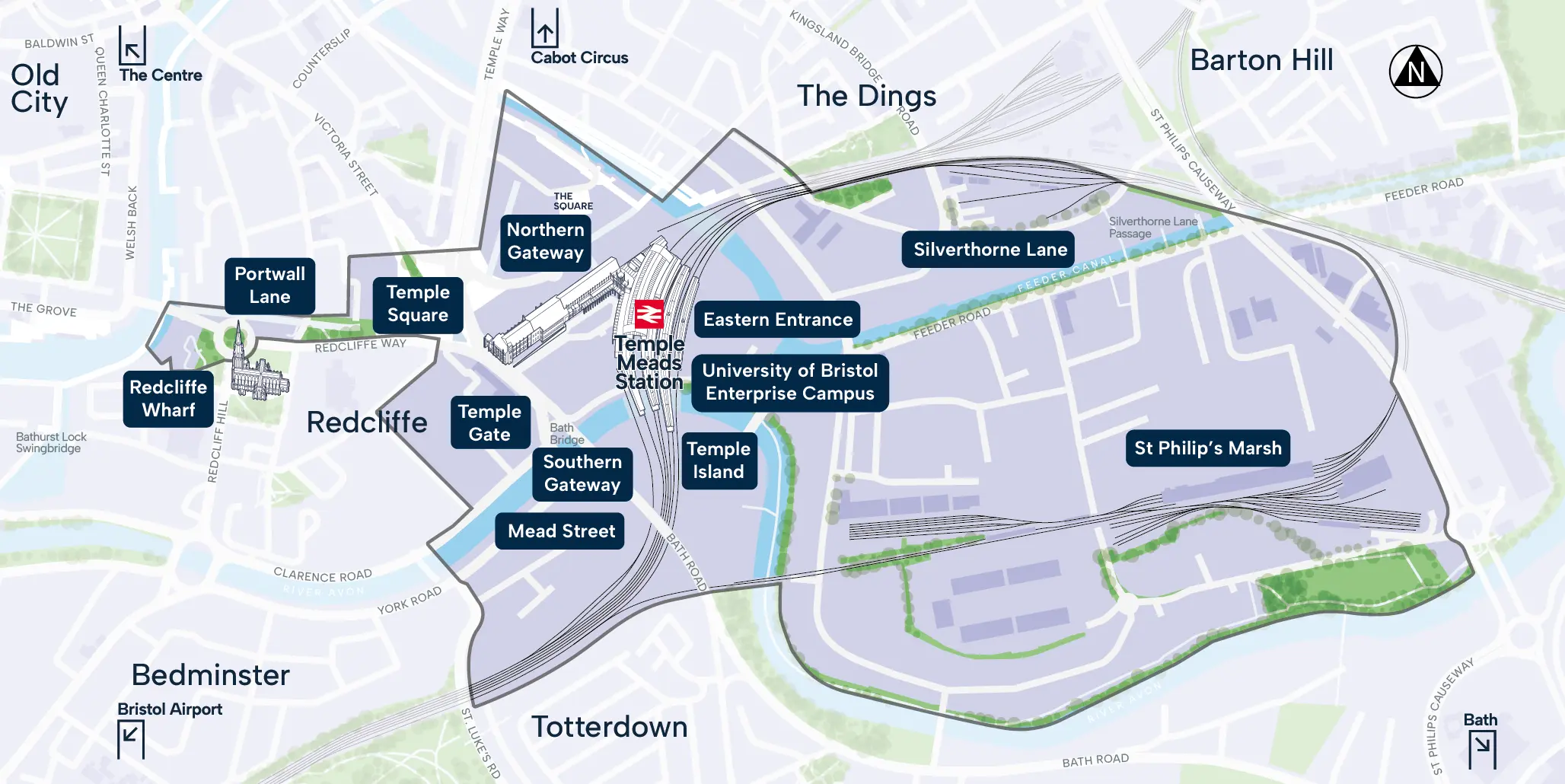
The wider programme contains several development areas, each with its own planning and delivery sequence.
Current phase
At the 15 July 2026 research cut-off, Bristol Temple Quarter was in active delivery, planning and consultation.
The programme's strategic framework was endorsed in 2023, while Bristol Temple Quarter LLP was incorporated in 2024 by Homes England, Bristol City Council and the West of England Combined Authority. Completed enabling work includes the new Eastern Entrance to Bristol Temple Meads, which finished in September 2024.
In January 2026, Bristol Temple Quarter LLP named Muse as preferred development partner for Temple Meads West and St Philip's Marsh. Muse is expected to prepare an outline planning application for Temple Meads West, with submission anticipated in early 2027, while also supporting the longer-term proposals for St Philip's Marsh.
The immediate planning focus is St Philip's Marsh. A draft planning document was published in January 2026, followed by a masterplan consultation running from 16 June to 28 July 2026. The outcome will help shape more detailed proposals for land use, movement, public space and future development across the area.

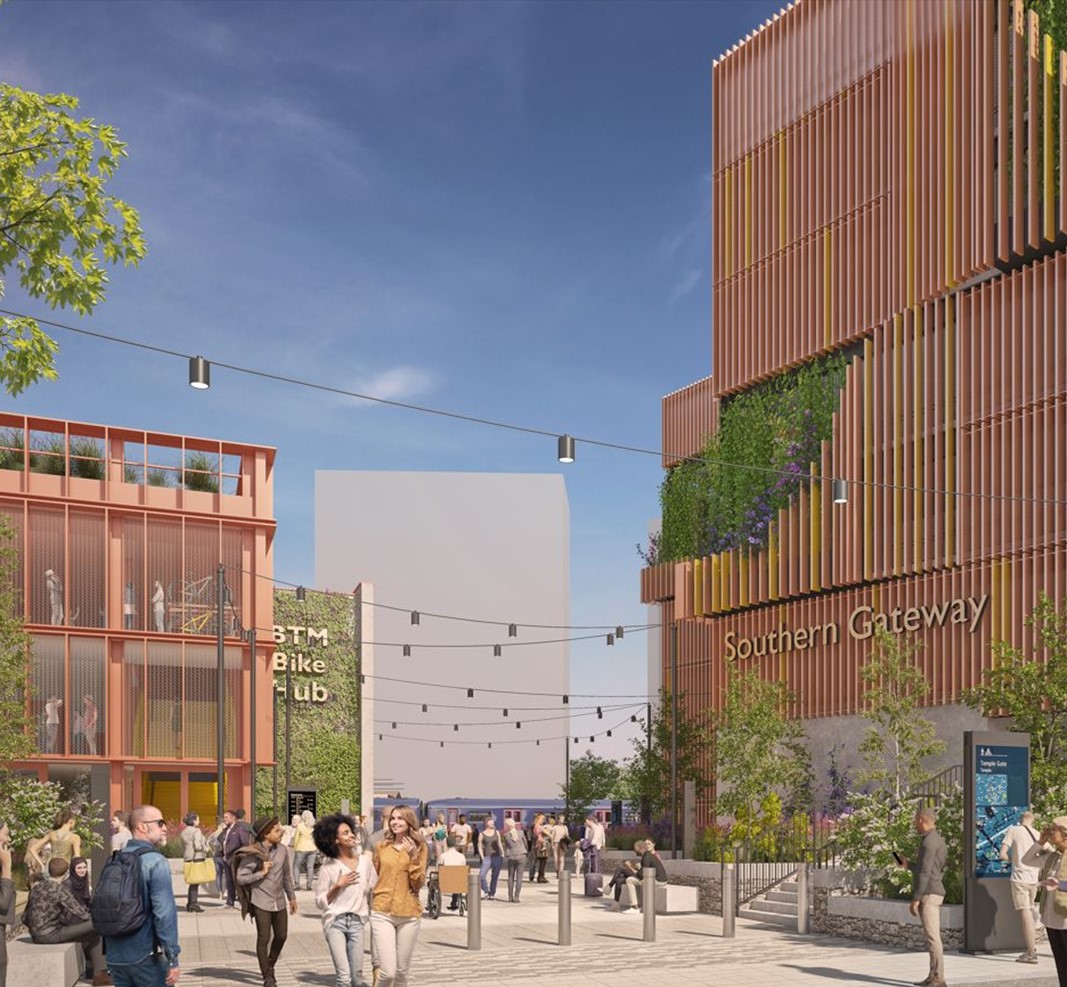
An illustrative view of St Philip's Marsh, where the detailed masterplan remains under consultation.
Planning and delivery timeline
The programme history shows how the current regeneration builds on the station's long-established role as Bristol's eastern rail gateway.
| Date | Milestone |
|---|---|
| 1840 | Brunel's original Bristol Temple Meads station opened. |
| 2012 | The Temple Quarter Enterprise Zone was established around Temple Meads. |
| September 2017 | The Temple Quarter Strategic Board met for the first time, bringing programme partners and stakeholders together. |
| February 2021 | Temple Quarter partners signed a Memorandum of Understanding committing them to work more closely together. |
| June 2022 | The programme received GBP94.7 million from central government to support station improvements, new homes and commercial space. |
| April 2023 | The University of Bristol broke ground on the main building for its new Enterprise Campus at Cattle Market Road. |
| May 2023 | Bristol City Council endorsed the Bristol Temple Quarter Development Framework following public consultation. |
| March 2024 | Bristol Temple Quarter LLP was incorporated by Homes England, Bristol City Council and the West of England Combined Authority. |
| September 2024 | Work on the additional Eastern Entrance to Bristol Temple Meads was completed. |
| February 2025 | The search began for a private-sector development partner. |
| July 2025 | A planning application was submitted for the Southern Gateway transport hub. |
| November 2025 | Bristol City Council resolved to grant planning permission for the Southern Gateway. |
| January 2026 | Muse Places Ltd was selected as preferred development partner for Temple Meads West and St Philip's Marsh. |
| January 2026 | Draft planning guidance was published for St Philip's Marsh. |
| 16 June to 28 July 2026 | Bristol City Council and Bristol Temple Quarter LLP consulted on the St Philip's Marsh masterplan. |
Published next milestones remain prospective. The University of Bristol campus is expected to open in September 2026, while Muse's outline planning application for Temple Meads West is anticipated in early 2027.
Transport, station access and public realm
Transport infrastructure is one of the clearest signs of progress because it enables later development and improves access between the station, university campus and surrounding neighbourhoods.
The additional Eastern Entrance at Bristol Temple Meads has been completed, providing a direct connection towards the university campus. The university also identifies upgraded sustainable travel connections and a new harbour walkway as parts of the wider campus and connectivity programme.
The Southern Gateway proposal includes a multi-storey car park, cycle hub, bus stops and improvements for walking and cycling. Space is also intended to be protected for a possible future mass-transit system.
The November 2025 approval announcement anticipated that Southern Gateway works would begin in mid-2026. A confirmed construction start was not established at the research cut-off, so commencement and the detailed delivery programme remain points to monitor.
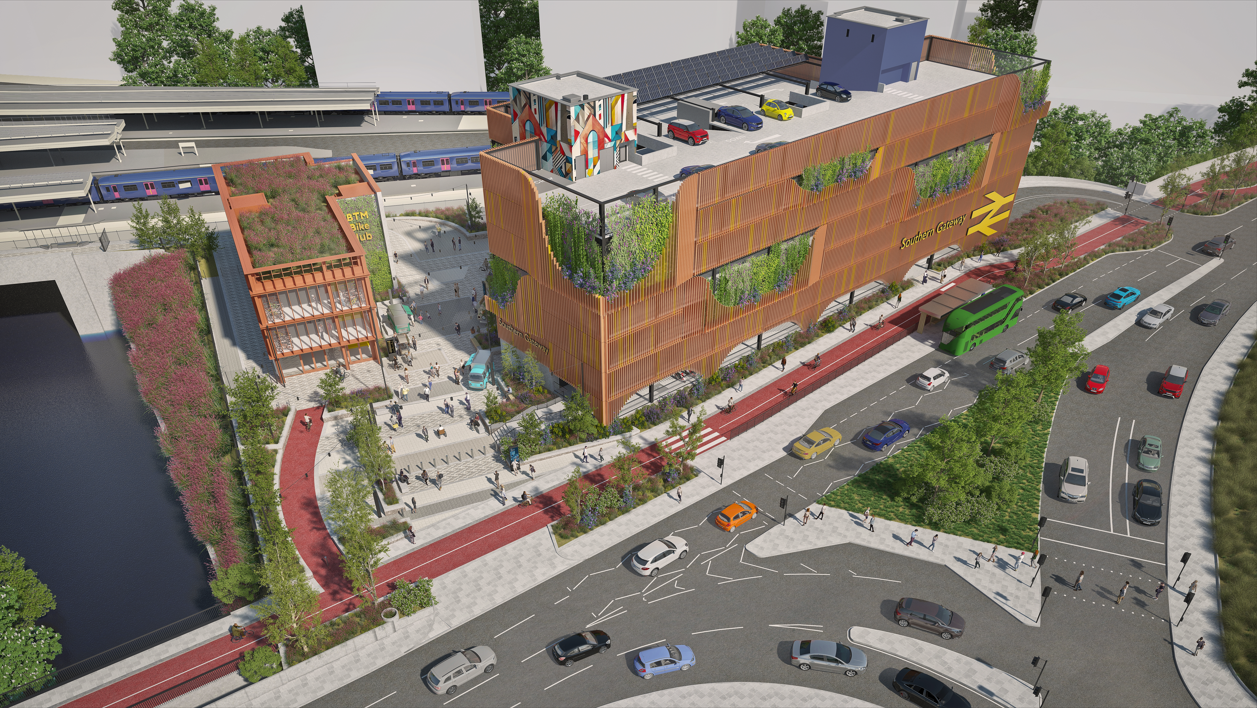
An illustrative overview of the Southern Gateway, including new interchange and active-travel facilities.
University campus and economic context
The University of Bristol Temple Quarter Enterprise Campus is one of the programme's most advanced major developments. The university describes it as a publicly accessible campus intended to connect teaching, research, enterprise and the wider city.
Its location beside Temple Meads, together with the Eastern Entrance and harbour walkway, is intended to make the campus more accessible by rail, walking and cycling. The opening is expected in September 2026, but that date remains a published expectation rather than a completed milestone.
Across the wider regeneration area, public partners have set an ambition for 22,000 jobs and a GBP1.6 billion annual contribution to the Bristol economy. The more meaningful test will be whether the campus, station works and development partnership lead to sustained occupier demand, business activity, skills links and everyday public use across the district.
Housing and rental context
Temple Quarter has a long-term ambition for 10,000 homes, but those homes will require multiple masterplans, planning applications and construction phases. The figure should not be interpreted as a single consented housing scheme or an immediate addition to Bristol's supply.
Rental impact remains qualitative at this stage. Any local effects will depend on the timing, scale and mix of homes actually delivered rather than the programme's headline ambitions alone.
Temple Meads West and St Philip's Marsh are particularly important to future residential capacity. However, the number, density, tenure and timing of homes, and the eventual affordable housing provision, will depend on detailed applications, infrastructure requirements and viability work.
The latest ONS housing data for Bristol provides a city-wide baseline:
- The average Bristol house price was GBP339,000 in April 2026, an annual increase of 0.7%.
- The average private rent was GBP1,391 a month in May 2026, up 5.4% from GBP1,320 a year earlier.
These figures cover Bristol as a whole. They do not demonstrate that Temple Quarter has caused a particular movement in house prices or rents, and they should not be used to predict future investment returns. Any local property effects will depend on the timing, scale and mix of homes actually delivered, as well as wider economic and housing-market conditions.
Risks and watchpoints
Planning and phasing
The programme is spread across several sites and will be delivered through separate planning processes. Progress in one area does not mean that all 10,000 homes or associated commercial development are committed or close to construction.
St Philip's Marsh masterplan
The 2026 consultation is an important step, but further planning work will be required before individual development plots can proceed. Changes resulting from consultation, technical studies and viability testing could affect land use, density and delivery timing.
Temple Meads West application
Muse's anticipated early-2027 outline application will provide a clearer view of the proposed development mix and phasing. Until it is submitted and assessed, the scale and timing of delivery remain provisional.
Infrastructure sequencing
The Eastern Entrance has been completed, while the Southern Gateway and other station improvements are still moving through delivery. The sequencing of transport, access and public-realm works will influence how quickly surrounding sites can be brought forward.
Housing mix and affordability
The headline housing ambition does not yet establish the tenure mix or affordable housing outcome for each development area. These details will emerge through later planning applications and viability assessments.
Economic integration
The campus, improved station access and new development could create stronger links between education, employment and the city centre. The practical measure of success will be whether these areas attract long-term activity and remain connected to surrounding communities rather than functioning as isolated development plots.
What happens next
The immediate milestone is the close of the St Philip's Marsh masterplan consultation on 28 July 2026. The responses and subsequent planning work should provide more detail on the area's proposed layout, development capacity and infrastructure requirements.
The University of Bristol's campus is expected to open in September 2026, alongside continuing work on connections between the campus, station and harbour.
For Temple Meads West, Muse is expected to develop and submit an outline planning application in early 2027. That application should offer a more reliable basis for assessing land uses, housing numbers, phasing and infrastructure than the programme-wide ambitions alone.
Across the wider Temple Quarter, the main indicators to follow are confirmed construction starts, detailed planning submissions, affordable housing commitments, transport delivery and evidence that completed infrastructure is supporting active, mixed-use neighbourhoods.