
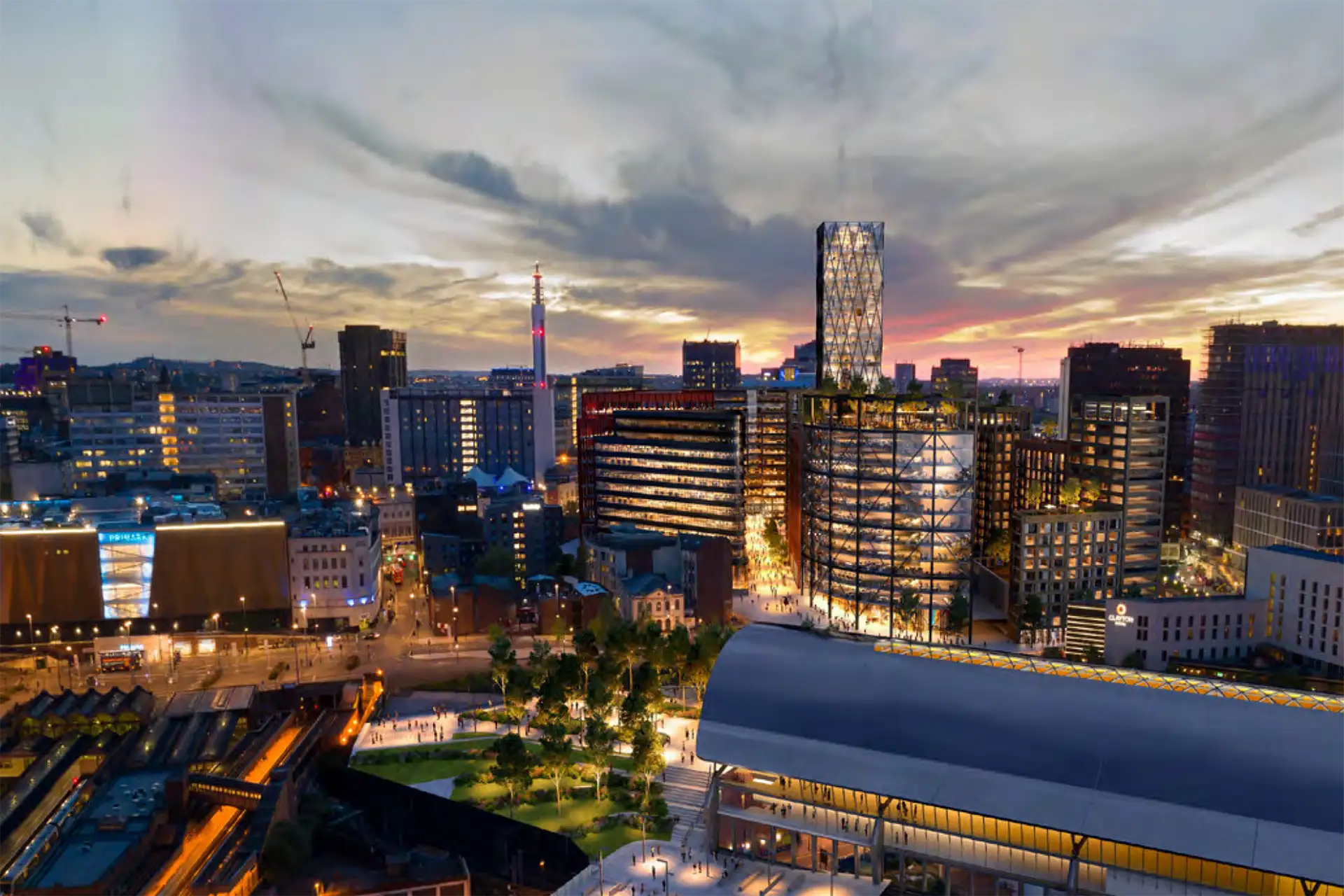
Project snapshot
| Item | Detail |
|---|---|
| Project name | Birmingham Central Heart Prospectus |
| Location | Birmingham city centre, between HS2 Curzon Street, Birmingham New Street, Bullring, Moor Street, Colmore Business District and the retail core |
| Project type | City-centre investment prospectus / growth-zone regeneration framework |
| Launch | Launched at MIPIM in March 2026 |
| Lead public bodies | Birmingham City Council, Invest West Midlands / West Midlands Growth Company, West Midlands Combined Authority |
| Strategic sites | Martineau Galleries, Martineau Place, Cherry Street, Cannon Street, Union Street, Carrs Lane, City Arcade and 42 High Street |
| Headline development capacity | 4m+ sq ft / 400,000 sq m+ commercial space |
| Housing ambition | Up to 5,000 homes |
| Employment ambition | Up to 8,000 jobs |
| Public realm ambition | More than 7 hectares of new or improved public realm |
| Land-use mix | Homes, offices, mixed-use workspace, retail, leisure, hospitality, hotel, public realm, active-travel routes and green spaces |
| Strategic role | Reconnect Birmingham’s retail core, commercial core, HS2 gateway and Eastside / Digbeth growth corridor |
| Governance context | Sits within the wider Central Birmingham Framework 2045 and the emerging Central Heart Growth Zone; also relevant to the Birmingham East Mayoral Development Corporation area |
| Planning status | Prospectus-level framework. Individual sites require separate planning permissions, reserved matters, landowner agreements and funding / development partner decisions |
| Current delivery status | Investment-market and site-planning stage; some sites have planning history, while others remain emerging opportunities |
| Main investor relevance | City-centre residential supply, employment growth, transport connectivity, public realm, mixed-use densification and micro-location uplift |
| Main caveat | Capacity figures are not delivered totals; specific schemes may change through design, viability, consultation and planning |
Snapshot sources: Invest West Midlands, West Midlands Growth Company, Birmingham Chamber, Gensler, Hammerson and Birmingham planning records.
Location and strategic context
A central-core regeneration opportunity
Central Heart focuses on a highly strategic but fragmented part of Birmingham city centre. The eight sites sit between the established retail core, the office core, the Bullring, Moor Street, New Street and the future HS2 Curzon Street station. Invest West Midlands describes the proposition as a gateway between Birmingham’s historic business districts and the new HS2 station at Curzon Street.
The area has significant strengths: high footfall, central transport access, retail and leisure anchors, proximity to Colmore Business District, links to Eastside and Digbeth, and adjacency to Birmingham’s largest infrastructure project at Curzon Street. Its challenge is that some sites remain under-used, retail-led, service-led or disconnected by highways, inward-facing shopping blocks and weak pedestrian routes.
The prospectus responds to a broader shift in UK city centres. Gensler, which worked on the Central Heart vision, frames the project around the need for city centres to evolve beyond retail-led models toward mixed-use neighbourhoods with homes, workplaces, public spaces and active travel. Gensler
Connection to HS2, Metro and Birmingham’s eastward growth
Central Heart’s strategic logic is closely tied to transport and eastward city-centre expansion. HS2 Curzon Street is under construction and is intended to create a major new arrival point for Birmingham, with public squares, green spaces, cycle parking, pedestrian links and a tram stop beneath the station. HS2
The first phase of the Birmingham Eastside Metro Extension opened to Millennium Point on Easter Sunday 2026. The wider 1.7 km route is intended to connect Bull Street to High Street Deritend, serve Curzon Street and Digbeth, and link into Birmingham’s wider tram network. Midland Metro Alliance
A key caution is timing. The UK Government’s May 2026 HS2 reset states that first trains between Old Oak Common and Birmingham Curzon Street are now expected in the 2036–2039 period, with the full scheme later. That means the HS2-related value proposition is long-term rather than immediate.
Relationship with BEMDC and the Central Birmingham Framework
Central Heart is one of the city-centre growth projects referenced within the wider Birmingham East regeneration agenda. WMCA describes the Birmingham East Mayoral Development Corporation as including major projects such as the Sports Quarter, Birmingham Knowledge Quarter, HS2 Curzon Street and adjoining Central Heart, Smithfield and Digbeth. West Midlands Combined Authority
BEMDC was legally established in 2026 under the Localism Act model. It is intended to help join up planning, land, investment and infrastructure powers, although the detailed transfer and operation of functions should continue to be tracked.
Central Heart also aligns with the Central Birmingham Framework 2045, which sets out a long-term direction for central Birmingham’s growth, public realm, movement, housing and economic development. In practical terms, Central Heart is the more market-facing investment proposition; the Central Birmingham Framework provides wider strategic policy context.
What is being delivered
Central Heart is not a single development site. It is a coordinated prospectus for eight strategic opportunities, many of which are expected to be delivered by different landowners, developers and investors.
Programme-level outputs
| Output category | Prospectus ambition |
|---|---|
| Homes | Up to 5,000 homes |
| Jobs | Up to 8,000 jobs |
| Commercial space | 4m+ sq ft / 400,000 sq m+ |
| Public realm | More than 7 hectares of new or improved public space |
| Strategic sites | Eight sites |
| Main design themes | Greener streets, linear green routes, better pedestrian and cycling connections, mixed-use redevelopment, active frontages and stronger links to HS2 / Eastside |
These figures are taken from the Central Heart prospectus and launch material. They should be read as development-capacity estimates and investment ambitions rather than confirmed planning permissions.
Strategic sites
| Site | Prospectus / public-domain proposition | Current status and caveats |
|---|---|---|
| Martineau Galleries | Large mixed-use redevelopment between the retail core and Curzon Street, including homes, workspace, hotel, retail / leisure, public square and boulevard-style links toward HS2 | Has planning history and reserved-matters approval. Hammerson describes a 7.5-acre site with up to 1,300 homes, 140,000 sq m workspace, hotel, restaurants and cafés. Other summaries describe broader commercial floorspace differently, so figures should be checked against live planning documents. |
| Martineau Place | Major redevelopment / intensification of the existing shopping-centre block | Latest reporting in June 2026 says Henley Investment Management and Sixth Street are consulting on proposals for up to 1,500 homes plus office / retail space, with an outline application expected later in 2026. Prospectus summaries have referred to higher housing capacity, so the live scheme appears to be evolving. |
| Cherry Street | Redevelopment around the former Rackhams / House of Fraser area, with homes, offices and improved public realm | Construction media summaries of the prospectus refer to around 600 flats and 14,000 sq m offices. This should be treated as indicative until confirmed through planning. Construction Enquirer |
| Cannon Street | Reuse / conversion opportunity above ground-floor retail, close to the tram network | Prospectus summaries refer to around 50 homes above refurbished workspace and retail. Site-specific planning status needs checking before investment underwriting. Construction Enquirer |
| Union Street | Large commercial-led redevelopment opportunity, with possible hotel, student, co-living and retail elements | Prospectus summaries refer to up to 200,000 sq m commercial space and optional complementary uses. This appears to be an opportunity-stage site rather than a fully consented scheme. Construction Enquirer |
| Carrs Lane | Residential-led mixed-use opportunity near HS2 / Eastside, with public-square potential | Prospectus summaries refer to around 480 flats above a reimagined church building and new public space. Treat as indicative until detailed planning documents are published. Construction Enquirer |
| City Arcade | Heritage-led restoration / reuse of the Grade II arcade, reconnecting routes toward Great Western Arcade and Cherry Street | Smaller-scale commercial and public-realm / route improvement opportunity. Heritage condition, viability and conservation requirements will matter. Construction Enquirer |
| 42 High Street | Gateway redevelopment linking the HS2 route into the city centre, with homes and ground-floor commercial space | Prospectus summaries refer to around 750 homes plus ground-floor commercial. Treat as opportunity-stage unless and until detailed planning is confirmed. Construction Enquirer |
Homes
The headline housing ambition is up to 5,000 homes across the eight sites. This is significant because Central Heart would bring residential density into the most central part of Birmingham, rather than focusing growth only on fringe locations such as Digbeth, Eastside, Jewellery Quarter or Southside.
Likely tenure mixes have not been confirmed across all sites. Based on comparable central Birmingham schemes, the pipeline could include a mix of build-to-rent, private-sale apartments, affordable housing, student accommodation, co-living and possibly hotel / aparthotel elements. That mix should not be assumed; each site will require its own planning application, viability assessment, affordable-housing position and management strategy.
Offices and commercial space
The prospectus identifies 4m+ sq ft / 400,000 sq m+ commercial space. This could include offices, workspace, retail, hospitality, leisure, hotel and other commercial uses, depending on each site’s design and planning route.
The office proposition is supported by Birmingham’s prime office market. JLL reported Birmingham prime office rents at £52 per sq ft in Q1 2026, with overall vacancy at 9.9% and Grade A vacancy at 4.6%. That supports the case for high-quality central workspace, but it also means secondary space and speculative schemes need careful demand testing. JLL
Public realm and green infrastructure
Central Heart is explicitly framed around new public space and greener routes. Invest West Midlands and West Midlands Growth Company identify more than 7 hectares of new or improved public realm, including new green routes, improved public spaces and stronger pedestrian links across the city core.
Gensler describes the vision as including linear urban green spaces, new active-travel routes and public spaces intended to make the city centre greener and more walkable. The Chamber of Commerce also reported the ambition to double green space in the area and create safer walking and cycling links.
The key investor caveat is maintenance. High-quality public realm can improve lettability and place perception, but only if long-term management, cleaning, landscaping, security and stewardship arrangements are funded and enforced.
Infrastructure and movement
Central Heart’s movement strategy is built around:
- better pedestrian connections between Colmore, Bullring, Moor Street, New Street, Curzon Street and Digbeth;
- safer cycling and walking routes;
- integration with Metro routes;
- better legibility between retail, commercial and transport zones;
- new public spaces and green corridors.
The transport context is strong but long-term. The Eastside Metro phase to Millennium Point is open, while further route sections toward Curzon Street and Digbeth remain critical. HS2 Curzon Street is under construction, but the 2026 reset pushes first passenger services into the 2036–2039 period.
Key partners, landowners, developers, public bodies and funding
Public-sector and regional partners
| Partner | Role |
|---|---|
| Birmingham City Council | Lead city authority, planning authority, public-realm and city-centre strategy partner; helped develop the prospectus with landowners and partners |
| Invest West Midlands / West Midlands Growth Company | Investment promotion and market-facing prospectus platform |
| West Midlands Combined Authority | Regional strategic partner; relevant through transport, BEMDC and investment coordination |
| Birmingham East Mayoral Development Corporation | New statutory regeneration vehicle relevant to Central Heart’s wider delivery environment |
| Transport for West Midlands / Midland Metro Alliance | Delivery and coordination of Metro infrastructure affecting Eastside, Curzon and Digbeth connectivity |
| HS2 Ltd / Department for Transport | Delivery and policy bodies for Curzon Street and HS2 programme |
| Business Improvement Districts | Local place-management, business engagement and footfall / public-realm partners |
West Midlands Growth Company states that the prospectus was developed with Birmingham City Council, major landowners, developers, BIDs and regional partners. West Midlands Growth Company
Landowners, developers and advisers
| Organisation | Role / relevance |
|---|---|
| Gensler | Design / vision partner for the Central Heart prospectus |
| Sphere Group | Development / advisory partner involved in the Central Heart launch and landowner / development partnership |
| Hammerson / Martineau Galleries Limited Partnership | Promoter / landowner-developer interest for Martineau Galleries |
| Henley Investment Management and Sixth Street | Reported owners / promoters for Martineau Place proposals as of 2026 |
| Other private landowners | Central Heart covers multiple blocks, some with separate owners and existing occupiers |
| Local developers and institutional investors | Expected to be needed for delivery, forward funding, build-to-rent, workspace and mixed-use phases |
Gensler says it worked with Birmingham City Council, Sphere Group and the landowner / developer partnership on the prospectus vision. Gensler
Funding position
There is no evidence in the public sources reviewed of a single ring-fenced public funding pot that will deliver all Central Heart sites. The prospectus is primarily an investment and development-partner proposition.
Funding and delivery are likely to combine:
- private development equity and debt;
- institutional forward funding for residential / build-to-rent;
- commercial development funding;
- public-sector public-realm and transport investment where applicable;
- Metro and HS2 infrastructure funding;
- BEMDC / WMCA / council support where statutory powers or funding routes apply;
- potential government-backed finance streams, subject to eligibility.
The Chamber of Commerce reported that Birmingham City Council, WMCA and government-backed finance institutions are seeking to link projects with funding streams, but specific site-level funding packages are not yet fully public. Greater Birmingham Chambers of Commerce
Planning, governance status and current delivery status
Planning status
Central Heart is a prospectus and growth-zone proposition, not a single planning permission. Each of the eight sites requires its own planning route. Some sites have advanced planning history, while others appear to remain at opportunity, design, consultation or pre-application stage.
| Site / workstream | Planning / governance position |
|---|---|
| Central Heart overall | Prospectus launched March 2026; no single overarching planning consent |
| Martineau Galleries | Reserved-matters application 2023/03036/PA approved subject to conditions in December 2023, pursuant to outline permission 2019/05900/PA |
| Martineau Place | Latest reporting refers to pre-application / consultation activity in 2026 and an outline application expected later in the year |
| Cherry Street | Prospectus-level opportunity; detailed current planning position should be checked plot by plot |
| Cannon Street | Prospectus-level reuse / conversion opportunity; site-specific permissions to be confirmed |
| Union Street | Prospectus-level major redevelopment opportunity; not treated here as consented |
| Carrs Lane | Prospectus-level residential / mixed-use opportunity; planning to be confirmed |
| City Arcade | Heritage-led restoration / reuse opportunity; conservation and listed-building issues likely relevant |
| 42 High Street | Prospectus-level redevelopment opportunity; planning to be confirmed |
| BEMDC | Statutory corporation established in May 2026, but practical planning-function transfer and operating arrangements should be tracked |
| Transport interface | Eastside Metro partly open; HS2 Curzon Street under construction; longer-term HS2 passenger services now expected later under the 2026 reset |
Planning source basis: Birmingham planning portal, Invest West Midlands, WMCA, Midland Metro Alliance, HS2 and 2026 local development reporting.
Current delivery status
The most accurate current description is:
Central Heart is at investment-prospectus / site-pipeline stage, with some advanced sites but no complete area-wide build-out. Martineau Galleries has the clearest planning history; Martineau Place is actively moving through a new 2026 consultation / pre-application process; several other sites are best treated as opportunity-stage until detailed planning documents are published.
The surrounding enabling context is more advanced: HS2 Curzon Street is under construction, Eastside Metro has partly opened, and BEMDC has been legally established. However, the full Central Heart transformation remains a multi-year, phased programme dependent on landowner decisions, planning, infrastructure, funding, occupier demand and residential market absorption.
Full timeline: earliest planning / announcement through today
| Date / period | Milestone | Why it matters |
|---|---|---|
| 2019 | Martineau Galleries outline planning framework progressed for a large mixed-use redevelopment of the former Martineau Galleries / Dale End area | Established one of the largest constituent development opportunities now inside Central Heart |
| January 2020 | Birmingham planning committee resolved to approve the Martineau Galleries masterplan, according to project reporting | Early major planning milestone for the eastern gateway element of the Central Heart area |
| 2021 | Construction began on the Birmingham Eastside Metro Extension | Important transport-enabling context for Eastside, Curzon Street, Digbeth and Central Heart connectivity |
| May 2023 | Reserved-matters application for Martineau Galleries registered | Showed the scheme moving beyond outline concept into detailed site matters |
| December 2023 | Martineau Galleries reserved-matters approval issued subject to conditions | Provides the clearest advanced planning status among the eight sites |
| May 2024 | Birmingham City Council published the Central Birmingham Framework 2045 | Set the wider long-term strategy for central Birmingham’s growth, public realm, housing and movement |
| 2025 | HS2 Curzon Street foundation works completed | Confirms physical progress on the major transport anchor east of Central Heart |
| March 2026 | Central Heart prospectus launched at MIPIM | Formal market-facing launch of the eight-site investment opportunity |
| March 2026 | Central Heart presented as part of Birmingham’s wider growth-zone and investment strategy, linked to HS2, Metro, Central Birmingham Framework 2045 and BEMDC proposals | Established the prospectus within the city’s broader governance and infrastructure context |
| 14 April 2026 | Birmingham East Mayoral Development Corporation Establishment Order laid before Parliament | Statutory governance milestone relevant to Central Heart’s wider delivery environment |
| Easter Sunday 2026 | First phase of Eastside Metro Extension opened to Millennium Point | First operational Metro delivery in the wider Curzon / Eastside corridor |
| 11 May 2026 | BEMDC Establishment Order came into force | BEMDC legally established |
| May 2026 | BEMDC launched to investors at UKREiiF | Reinforced Central Heart’s role within a larger east Birmingham / city-centre investment corridor |
| June 2026 | HS2 began installing major beams for Curzon Street station platforms | Confirms ongoing construction progress at Curzon Street |
| June 2026 | Public reporting said Martineau Place owners were preparing consultation on redevelopment proposals | Indicates active scheme evolution at one of the eight Central Heart sites |
| 7 July 2026 | Current status: prospectus live; planning / delivery varies by site; full build-out not yet secured | Investors should track individual planning applications and funding rather than treating the prospectus as a single consented scheme |
| July 2026 onward | Martineau Place consultation and future outline application expected | Important next planning milestone for the shopping-centre block |
| 2036–2039 | Government’s 2026 HS2 reset expects first Old Oak Common–Birmingham Curzon Street services in this period | Reinforces that HS2-driven uplift is a long-term rather than immediate factor |
Timeline sources: Invest West Midlands, Birmingham planning records, WMCA, HS2, Midland Metro Alliance, GOV.UK / DfT and local planning reporting.
Property investor view
Investment relevance
Central Heart is one of Birmingham’s most important city-centre regeneration propositions because it targets the actual core of the city, not only fringe neighbourhoods. Its potential impact comes from:
- adding homes in the city centre;
- increasing high-quality workspace and mixed-use floorspace;
- improving public realm and walking routes;
- strengthening links to HS2 Curzon Street, Metro, Colmore, Bullring, New Street, Moor Street, Eastside and Digbeth;
- repositioning under-used retail and office blocks for a post-retail-dominant city-centre economy.
For residential investors, the strongest relevance is likely to be in central apartments and professionally managed rental stock near Martineau, Dale End, High Street, Moor Street, Corporation Street, Bullring, Colmore fringe, Eastside and Digbeth.
However, investors should not treat the prospectus as guaranteed uplift. It is a long-term development pipeline, and individual returns will depend on purchase price, building quality, service charges, leasehold terms, financing costs, construction competition, tenant demand and the timing of actual delivery.
Rental demand
Birmingham has a large rental base supported by universities, professional services, financial services, healthcare, public-sector employment, graduate retention, hospitality and cultural activity. Central Heart could add to this by increasing the number of homes close to the city’s main transport, retail and office nodes.
ONS data shows Birmingham’s average private rent at £1,088 per month in May 2026, up 3.3% year-on-year. Average rents were £821 for one-bedroom homes, £993 for two-bedroom homes and £910 for flats and maisonettes. These are local-authority averages, not Central Heart-specific rents. Office for National Statistics
Deloitte’s 2026 Birmingham Crane Survey reported a strong city-centre residential pipeline, with 4,594 homes completed in 2025 and 6,822 homes under construction. It also reported that build-to-rent accounted for 55% of homes under construction, reflecting ongoing demand for professionally managed urban rental accommodation but also signalling supply competition. Deloitte
Capital growth potential
Central Heart has credible long-term placemaking drivers: central location, public realm, transport connectivity, mixed-use redevelopment, stronger links to Curzon Street and the potential to replace tired or under-used assets with higher-value uses.
But capital growth should not be promised. ONS reported Birmingham’s average house price at £236,000 in April 2026, up 0.7% year-on-year. Flats and maisonettes averaged £147,000 and were down 2.6% year-on-year. That matters because much of the Central Heart residential opportunity is likely to be apartment-led. Office for National Statistics
A cautious investor case would focus on:
- buying at a price supported by today’s comparable evidence;
- favouring buildings with strong management and controlled service charges;
- checking EWS1 / building-safety status;
- avoiding over-reliance on future HS2 uplift given the revised delivery timescale;
- tracking actual achieved rents rather than asking rents;
- assessing whether new supply could dilute rent growth in the short and medium term.
Micro-location strengths
| Micro-location | Strengths |
|---|---|
| Martineau / Dale End | Direct link between the retail core and Curzon Street; large redevelopment capacity; potential for homes, workspace and hotel |
| Martineau Place / Corporation Street | Very central; tram and retail proximity; major intensification potential |
| Cherry Street / Cannon Street | Close to Colmore, Great Western Arcade, retail core and established city-centre employment |
| Union Street / High Street | Strong footfall and transport access; potential for dense mixed-use redevelopment |
| Carrs Lane / Moor Street fringe | Close to Moor Street, Bullring, Eastside and Curzon; strong gateway potential |
| City Arcade | Heritage-led placemaking and small-scale commercial potential |
| 42 High Street | Gateway role between HS2 / Eastside and the central retail core |
Micro-location risks
The same centrality that makes Central Heart attractive also creates risks:
- construction disruption could be prolonged across multiple sites;
- high-density schemes may increase service-charge and management costs;
- retail displacement could temporarily weaken footfall in some blocks;
- nightlife, hotels, deliveries and city-centre traffic may create noise or management issues;
- older buildings may carry hidden maintenance, asbestos, fire-safety or conversion risks;
- new-build apartment supply could create competition for tenants;
- some benefits depend on HS2 / Metro timelines and public-realm delivery.
Tenant demand
Likely tenant groups include:
| Tenant group | Why Central Heart may appeal |
|---|---|
| Young professionals | Walkability to Colmore, retail core, New Street, Moor Street and future Curzon |
| Graduate renters | Central access to employment, universities, nightlife and transport |
| Corporate renters | Short commute to business districts and national rail links |
| Students / postgraduates | Central access to Aston, BCU, University College Birmingham and transport |
| Hospitality / retail workers | More homes close to city-centre employment |
| Creative and tech workers | Links toward Digbeth, Eastside, Knowledge Quarter and city-centre coworking |
| Downsizers / lifestyle renters | Potential appeal of managed central apartments near amenities |
Short-let and serviced-apartment strategies should be treated cautiously. Central location and event demand may look attractive, but investors must check lease covenants, building management rules, planning use, mortgage terms, insurance and any future local short-let regulation.
Transport and employment drivers
The strongest drivers to track are:
- Eastside Metro — first phase now open to Millennium Point, with further Curzon / Digbeth links still important.
Midland Metro Alliance
- HS2 Curzon Street — under construction, but passenger-service timing now extends into the 2036–2039 period.
- Colmore and professional services — proximity to Birmingham’s established office core remains a major strength.
- Prime office demand — JLL reported tight Grade A vacancy in Q1 2026, which supports demand for high-quality space but not necessarily for all secondary stock.
JLL
- Retail-to-mixed-use shift — Central Heart’s success depends on replacing under-performing retail and office assets with active, viable mixed-use schemes.
- BEMDC coordination — the new statutory body may help coordinate land, infrastructure and planning, but operational details need to be proven.
What investors should track
- Site-by-site planning applications — especially Martineau Place, Union Street, 42 High Street and Cherry Street.
- Martineau Galleries phasing — whether reserved-matters approvals convert into construction and pre-lets / funding.
- Martineau Place consultation and outline application — scale, height, tenure, public realm, affordable housing and viability.
- BEMDC powers and governance — planning powers, board structure, delivery plan, CIL / Section 106 treatment and land-assembly approach.
- HS2 and Metro milestones — distinguish between operational Metro, under-construction station works and long-term HS2 services.
- Residential supply absorption — monitor build-to-rent, co-living, student and private-sale supply across the city core.
- Achieved rents — compare actual lettings, voids and incentives, not just advertised rents.
- Service charges and building safety — central high-rise and mixed-use buildings can carry high running costs.
- Public-realm maintenance — green routes and squares need long-term stewardship.
- Ground-floor activation — retail, hospitality and leisure occupancy will determine whether the area feels like a neighbourhood rather than a construction corridor.
Risks and watch points
| Risk / watch point | Why it matters | Current assessment |
|---|---|---|
| Prospectus-stage uncertainty | Central Heart is not one consented scheme | High: site-specific permissions still matter |
| Landownership complexity | Eight sites involve different owners, leases, occupiers and development economics | High |
| Planning risk | Height, massing, heritage, daylight, transport, affordable housing and public realm will be scrutinised | Medium/high |
| Funding and viability | High-rise residential, office and mixed-use schemes are sensitive to build costs and interest rates | High |
| HS2 timing | Curzon Street is under construction, but full passenger benefits are long-term | Medium/high |
| Metro phasing | Eastside Metro is partly open, but further links remain important | Medium |
| Residential supply competition | Birmingham has a large city-centre pipeline | Medium/high |
| Flat-market performance | ONS shows flats / maisonettes underperformed the wider Birmingham market in April 2026 | Medium/high |
| Service-charge inflation | High-density mixed-use buildings can be costly to manage | High for net rental returns |
| Retail displacement | Redevelopment may disrupt existing footfall and trading before benefits arrive | Medium |
| Public-realm delivery | The 7 ha+ public-realm ambition must be funded, built and maintained | Medium/high |
| Heritage constraints | City Arcade and older buildings require careful restoration and viable reuse | Medium |
| Overpricing regeneration uplift | Buyers may pay too much for future benefits before delivery is de-risked | High |
| BEMDC governance | New statutory body may help, but practical powers and interfaces remain important to track | Medium/high |
| Market-cycle risk | Office, residential and retail markets can all change before phased schemes complete | Medium/high |
Rental impact note
Rental impact is qualitative and should be treated as directional only. It depends on delivery timing, the final mix of uses, local supply, affordability, employment conditions and wider market cycles; it is not a guarantee of future rents or capital growth.