
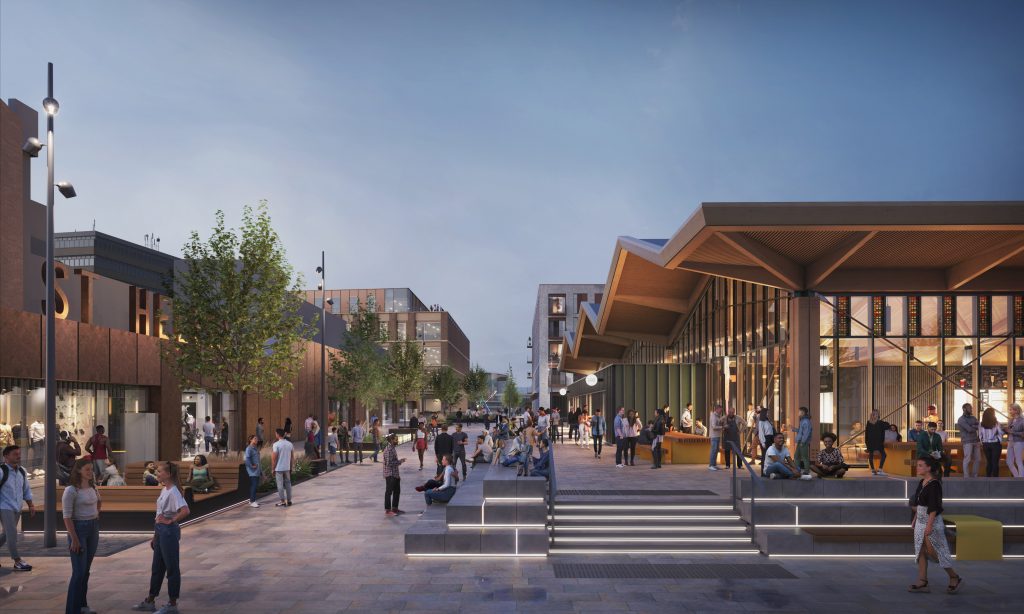
The St Helens Town Centre Transformation is a comprehensive, 24-acre regeneration programme currently under construction in the heart of the WA10 postcode district. Delivered through a strategic, 20-year partnership between St Helens Borough Council and the English Cities Fund (ECF), a joint venture comprising Homes England, Legal & General, and Muse, the project has successfully transitioned from a conceptual masterplan into a fully funded, actively progressing construction site. With main contractor VINCI Building mobilised on site since early 2025 to conduct enabling works and the main construction phase advancing through 2026, the core execution risk has shifted away from planning and land assembly toward commercial absorption and phased delivery timetables leading up to an expected practical completion of Phase 1 around 2028.
My central analytical judgement is that this scheme represents one of the most credible, publicly backed civic resets currently underway in the Liverpool City Region. The strategic positioning is exceptionally strong: the local authority achieved Compulsory Purchase Order (CPO) powers in late 2023, successfully relocated legacy retail tenants, fully demolished the obsolete Hardshaw Shopping Centre, and secured a complex funding stack exceeding £120 million for the first phase. This includes a decisive £69.7 million commitment from the council's own capital programme, backed by substantial grants including the Towns Fund, the One Public Estate Brownfield Land Release Fund, and £32 million from the Liverpool City Region Combined Authority for transport infrastructure.
The headline delivery for Phase 1A includes 64 new highly sustainable homes (56 apartments and 8 townhouses), a 120-bedroom Hampton by Hilton hotel, a modern 29-stall Market Hall, approximately 4,266 sq ft of new retail space, and a state-of-the-art multi-modal Transport Interchange. These assets are stitched together by high-quality public realm designed to deliver a Biodiversity Net Gain of over 1,000%.
For the housing market, the introduction of 64 new homes is modest in volume but highly significant in qualitative terms. Built to stringent energy-efficiency standards mirroring Passivhaus criteria, these units are designed to act as a proof-of-concept for high-specification town-centre living in St Helens. While they will not flood the broader WA10 market with oversupply, they will likely test the upper valuation ceiling in the urban core. For investors, the most critical takeaway is that the scheme is an infrastructure-first, publicly de-risked regeneration effort. The focus should not be on rapid, speculative value inflation, but rather on how a fundamentally improved civic core, enhanced active travel, and new hospitality anchors might sustainably elevate tenant demand and long-term asset resilience across the immediate town-centre micro-market.
Project overview
The St Helens Town Centre Transformation sits at the geographic and economic core of the borough. The fundamental spatial strategy is driven by the removal of the Hardshaw Shopping Centre, a tired legacy retail asset that previously acted as a physical barrier between the town's primary transport nodes and its historic civic squares. By erasing this 115,000 sq ft structure, the masterplan aims to re-stitch the urban fabric, prioritising pedestrian movement, active travel sightlines, and public open space.
The delivery vehicle is as important as the physical architecture. The project is led by ECF (formerly the English Cities Fund), which recently doubled its operational capacity to £400 million following equal equity injections from its three institutional partners: Muse, Legal & General, and Homes England. ECF's model focuses on area-wide, long-term regeneration, typically taking on complex brownfield sites that require significant upfront capital, bespoke public-private partnerships, and patient execution. Their involvement introduces a level of institutional credibility and financial resilience that fundamentally separates this project from speculative, single-developer proposals. ECF's track record includes large-scale, delivered transformations such as St Paul's Square in Liverpool and the Salford Central masterplan (including the Passivhaus-certified Greenhaus development). This demonstrates a proven ability to sustain momentum across multiple economic cycles.
The current public scope of the transformation is heavily weighted toward Phase 1A, which serves as the catalytic first move. The framework intentionally pivots away from traditional high-street retail dependency, acknowledging that regional town centres can no longer survive purely as shopping destinations. Instead, it anchors the town centre with hospitality (the Hilton hotel), experiential leisure and independent commerce (the Market Hall), upgraded connectivity (the Transport Interchange), and modern residential capacity.
Furthermore, the physical regeneration works in tandem with the town's heritage assets. The masterplan includes the eventual refurbishment of the former M&S building for new retail frontages and ties into parallel council-led initiatives, such as the extensive external and internal restoration of the historic Gamble Building. This landmark is being repositioned as a cultural and community hub following £1.2 million in external repairs and ongoing internal enabling works, ensuring that the new-build elements are grounded in the borough's historical identity.
Official scheme details and delivery timeline
The specific deliverables for the 24-acre masterplan have evolved slightly as the project navigated the planning process, but the current consented metrics for Phase 1A, as confirmed by official council and ECF releases in late 2025 and early 2026, represent the most defensible baseline for property analysis.
Phase 1A and 1B Component Breakdown
| Component | Official Consented Details (Phase 1A & 1B) |
|---|---|
| Residential (Phase 1A) | 64 homes comprising 56 apartments and 8 townhouses. Characterised by perforated decorative panels reflecting local architectural heritage and designed to create a car-free, safe pedestrian environment. |
| Hospitality (Phase 1A) | 120-bedroom hotel, publicly confirmed to be operated by the globally recognised brand, Hampton by Hilton. Designed across five storeys. |
| Market Hall (Phase 1A) | A modern facility featuring exposed structural timber to reduce embodied carbon. Designed for approximately 29 stalls, including food, beverage, artisan retail, and a performance area. |
| Commercial / Retail (Phase 1A) | 4,266 sq ft of modern-format retail space integrated within the footprint. (Note: Earlier 2023 documentation suggested 11,000 sq ft, but the late-2025 reserved matters approvals specify the 4,266 sq ft figure). |
| Transport Hub (Phase 1A) | A new multi-modal Transport Interchange replacing the obsolete bus station. Features 11 stands (up from 9), enclosed temperature-controlled concourses, a travel centre, and active travel (cycle) storage. |
| Public Realm (Phase 1A) | Extensive pedestrianisation (including Bickerstaffe Street), new civic squares, rain gardens, and integrated play spaces. Targets a Biodiversity Net Gain of >1,000%. |
| Future Commercial (Phase 1B) | A 75,000 sq ft Grade A office building spanning five floors with a rooftop terrace, alongside the reimagining of the existing M&S building into new retail space. |
The sustainability credentials of the new buildings are a structural feature of the scheme, not merely an aesthetic addition. The residential units are designed to meet Energy Use Intensity (EUI) performance levels equivalent to Passivhaus standards, guided by specialist environmental consultant Hilson Moran. The use of "green steel" in the transport interchange, which is produced by converting recycled scrap metal and results in 60-75% lower carbon emissions than traditional blast furnace steel, and sustainably sourced timber framing in the commercial spaces aligns the project directly with St Helens Council’s declared Climate Emergency and ambition to achieve net-zero carbon by 2040.
Indicative Delivery Sequence
The physical delivery logic follows a classic infrastructure-first approach: secure the land, remediate the site, install the transport links, and then build the vertical structures. Unforeseen variables can alter timings, but the current operational pathway is clearly defined.
| Development Phase | Key Milestones and Status | Timeframe |
|---|---|---|
| Strategic Planning | Masterplan Development Framework adopted; Hybrid Planning Application approved. | 2022 - 2023 |
| Site Assembly | Compulsory Purchase Order (CPO) powers obtained; final third-party interests acquired. | Late 2023 |
| Enabling Works | Final retail tenants relocated to Church Square; Hardshaw Centre vacated and soft strip begins; temporary bus hub opens on Chalon Way West. | 2024 |
| Demolition & Approvals | Main demolition of Hardshaw Centre completed; Reserved Matters planning consent granted; VINCI Building confirmed as main contractor. | 2025 |
| Active Construction | Main construction phase live. Hall Street temporary closures implemented for drainage. Interchange steelwork and substructure foundations progress. | Early to Mid 2026 |
| Practical Completion | Targeted completion of Phase 1A residential, hotel, Market Hall, and Transport Interchange (subject to standard construction risk profiles). | 2028 |
Planning, infrastructure and transport context
The legal and planning framework underpinning the transformation is exceptionally robust, differentiating this project from speculative land promotions. By establishing an adopted Masterplan Development Framework in February 2022, the council de-risked subsequent applications by setting clear, mutually agreed parameters for massing, use classes, and public realm integration. A Hybrid Planning Application was approved in September 2022, granting detailed consent for demolition and outline consent for the vertical builds. Crucially, the detailed Reserved Matters application for Phase 1 was formally granted in late 2025, clearing the final major planning hurdle and allowing vertical construction to commence.
Equally important to the planning sequence was the successful execution of Compulsory Purchase Order (CPO) powers. The vesting and acquisition of final third-party interests, such as the former Heron Foods unit within the Hardshaw Centre, was resolved and approved for disturbance payments by the council. Site assembly is often the most fatal risk to large-scale municipal regeneration; resolving the CPO fully empowered ECF and VINCI to execute the build phase without the threat of holdout land disputes stalling the timeline.
Transport infrastructure acts as the functional anchor for the entire project. The new £32 million Transport Interchange is not a secondary feature; it is positioned as the primary catalyst for footfall and civic integration. In St Helens, official data cited by the development partnership indicates that three times as many people commute by bus than by rail. By expanding capacity from 9 to 11 bus stands and creating a climate-controlled, highly accessible environment seamlessly linked to the central rail station, the project addresses the core logistical weakness of the old town centre.
The strategy is clear: direct passenger movement out of a modern, safe transport hub and route them directly past the new retail units, the Market Hall, and the hotel, thereby sustaining the commercial viability of these new assets. Liverpool City Region Mayor Steve Rotheram has additionally noted that St Helens will be the first borough to benefit from the region's franchised bus network. Integrating publicly owned hydrogen buses and regulated fares directly into this new hub will structurally lower the barrier to entry for consumers visiting the town centre from the wider metropolitan area.
Local economy implications
The economic narrative for St Helens Town Centre is shifting fundamentally from retail volume to civic experience and service retention. The Hardshaw Centre, like many enclosed shopping malls built in previous decades, suffered from structural vacancy and changing consumer habits. Replacing it with a mixed-use landscape limits the local economy's exposure to volatile high-street retail trends and diversifies the civic offering.
During the construction phase, the economic injection is tangible. VINCI Building’s contract is heavily weighted toward local supply chain utilisation and job creation, aligning with the council's Inclusive Growth Strategy. Official project documentation estimates that Phase 1 will support approximately 485 new jobs and generate an annual Gross Value Added (GVA) of £23.2 million once fully operational.
The 120-bed Hampton by Hilton hotel is a particularly important economic lever. According to consultation feedback, local and international businesses operating in the borough highlighted a severe shortage of high-quality corporate accommodation for extended stays. Securing a globally recognised hospitality brand provides a reliable baseline of overnight visitors. This directly supports the adjacent Market Hall and local evening economy, a segment that the previous town centre configuration struggled to capture due to a lack of safe, high-quality dwell spaces.
Furthermore, Phase 1 is designed to support the broader ecosystem of small-to-medium enterprises (SMEs). The 29-stall Market Hall provides relatively low-barrier-to-entry space for independent food, beverage, and artisan operators. By fostering a localized incubator environment rather than relying exclusively on national retail chains, the local authority retains a greater share of economic multiplier effects within the borough. This is augmented by "meanwhile uses" such as the Steel Life Chalon Way project, which uses upcycled shipping containers to provide interim business start-up and leisure space, ensuring economic momentum is not lost during the heavy construction years.
Housing market implications
Understanding the residential impact of this regeneration requires a cautious view of the existing St Helens baseline. Local property market evidence gathered by Belvoir in early 2026 indicates that the average property price in the WA10 postcode sits at approximately £161,000, having risen moderately from £149,000 in 2023 (an 8% rise over three years). This points to a highly accessible, relatively low-value market when compared to the broader UK or core Liverpool and Manchester city averages. While detached family homes in premium suburban pockets like Eccleston and Windle command £275,000 to £320,000, the immediate town-centre terraced stock generally transacts between £125,000 and £150,000.
The delivery of 64 new town-centre homes (56 apartments, 8 townhouses) will not fundamentally alter the macro supply-demand balance of the wider borough. However, it will unequivocally set a new pricing and quality benchmark for the immediate urban core.
These are highly specified units featuring sustainable timber frames, perforated heritage panelling, and Passivhaus-aligned energy performance. There is currently a very limited supply of equivalent Grade A residential product in WA10. Consequently, upon completion, these units should command a visible "new-build premium" over existing town-centre flats, driven by their energy efficiency, lack of required refurbishment, and immediate proximity to the new rail and bus interchanges.
For the wider WA10 housing market, the start of heavy construction in 2026 introduces an "anticipatory effect." As the physical civic squares, parkland, and hospitality venues take shape, the perceived desirability of walking-distance terraced stock is likely to firm up. My assessment is that values on the periphery of the regeneration zone will experience defensive stabilization and moderate upward pressure relative to a no-development counterfactual, simply because the amenity value and safety profile of the town centre will be vastly improved by 2028. Buyers no longer view a declining precinct; they see a heavily capitalised civic core.
Rental market implications
The rental implications for the 64 new residential units depend heavily on their final tenure mix. While the overarching ECF partnership has a mandate to deliver diverse tenures across its UK portfolio, the precise sales and lettings strategy for these specific 56 apartments and 8 townhouses (i.e., whether they will be retained as institutional Build-to-Rent, sold to owner-occupiers, or transferred to a registered provider for affordable tenures) is not exhaustively detailed in the headline planning releases reviewed.
However, assuming a portion of these enter the private rented sector (PRS), their technical specification will be the primary driver of rental demand and premium pricing. The commitment to designing homes that meet Energy Use Intensity (EUI) performance levels of a Passivhaus building means these properties will require exceptionally low operational energy usage to maintain thermal comfort. In a macro-environment highly sensitive to utility costs, homes that structurally insulate tenants against high heating bills generally experience stronger gross-to-net rent retention, lower void periods, and significantly lower arrears profiles.
From an investor standpoint, standard secondary housing stock in WA10 already offers relatively high gross percentage yields due to the low capital entry points (£125,000 - £150,000 for terraced housing). The new ECF units, if brought to the open market, will command higher capital values, likely resulting in tighter initial percentage yields. However, this is offset by superior long-term capital preservation, lower maintenance liabilities, and stronger appeal to young professional cohorts prioritising active travel and rapid rail connectivity to Liverpool and Manchester employment hubs.
If investors are looking at existing stock, the regeneration acts as a defensive moat. Upgrading the public realm and introducing a 120-bed hotel creates secondary employment and increases the pool of service-sector workers requiring local accommodation, thereby underpinning baseline rental demand in the immediate vicinity.
Supply, demographics and demand drivers
To contextualise demand, the borough of St Helens has a population of approximately 183,200, having grown by 4.5% between the 2011 and 2021 censuses. It is an area with an incrementally aging demographic profile; the median age increased from 41 to 43 over that same decade. Furthermore, the 2021 census highlighted that the proportion of residents aged 25 to 34 increased by 17.4%, while the 35 to 49 age bracket fell by 8.9%.
The town centre masterplan appears strategically designed to retain and attract these younger, economically active cohorts who might otherwise migrate out of the borough to the urban cores of Liverpool or Manchester. By introducing pedestrianised spaces, a high-quality food and beverage offering (the Market Hall), and seamless active travel linked to the rail station, the town is attempting to pivot its demographic appeal. A town centre that functions merely for daytime convenience retail struggles to attract young professionals; a town centre structured around experiential leisure, safe evening environments, and rapid transit access is much more competitive.
It is also vital to view this 64-home phase within the broader housing delivery context of the borough. St Helens is successfully demonstrating that brownfield land can be repurposed for residential capacity. For example, Liverpool-based housing association Torus recently completed the first phase of Park Grange in Thatto Heath, a £34 million development delivering 164 affordable and shared-ownership homes on brownfield land. The success of surrounding brownfield residential schemes suggests that underlying absorption capacity exists within the borough, provided the product meets modern affordability and quality standards.
The 64 units in Phase 1A of the town centre are therefore highly calibrated. Rather than flooding the market, they will test the absorption of premium, sustainable urban living within an area traditionally dominated by low-density suburban and legacy terraced housing models.
Investor watchpoints and risks
While the physical delivery of the infrastructure and Phase 1A is now heavily de-risked by contracted funding and live construction, investors conducting due diligence should monitor several medium-term execution factors that will dictate the ultimate commercial success of the regeneration.
Commercial Absorption and Curation Risk: The physical construction of the Market Hall and the 4,266 sq ft retail space is funded, but their long-term vitality depends on securing and retaining high-quality independent operators. The Market Hall model relies on a critical mass of diverse, high-footfall stalls to generate atmosphere. If the facility struggles to attract viable artisan and food-and-beverage operators post-2028, the desired "halo effect" on surrounding residential property values and the evening economy may be muted. The local authority's procurement and curation strategy over the next 24 months is a critical indicator to watch.
Phase 1B and Long-Term Office Sequencing: The masterplan includes ambitions for Phase 1B, which prominently involves delivering a 75,000 sq ft Grade A office building. The regional office market has experienced structural shifts post-pandemic, with occupiers demanding exceptional ESG credentials and flexible floorplates, but often taking less total footprint. Whether ECF and the Council push forward with speculative office development, or await a pre-let anchor tenant, will dictate the pace at which the town centre becomes a true daytime commercial employment destination.
Transport Integration and Construction Friction: The temporary closure of the old bus station and the routing of traffic via a temporary hub on Chalon Way West presents short-term disruption to local businesses and pedestrian flows. While VINCI Building has implemented phased highway works and clear diversion routes through 2026 (such as the Hall Street closures for drainage installation), extended disruption periods could temporarily impact high-street sentiment and footfall before the permanent interchange opens.
Macro-Economic Headwinds: Although the core public funding is legally committed, construction inflation and supply chain volatility remain persistent background risks for any major contractor. While the ECF partnership has the institutional financial depth to weather standard market shocks, severe macroeconomic downturns could potentially exert pressure on value engineering or extend the timeline for the delivery of later masterplan phases.
Scenario outlook and delivery impact
To quantify the potential impacts on the local WA10 property market, the following table models indicative scenarios based on the delivery of Phase 1A. This is an analytical framework based on the integration of 64 high-spec homes, a major transport hub, and a 120-bed hotel into a market with a current average baseline of £161,000. It is not an official forecast.
The scenarios assume that the infrastructure completes by 2028, and that the "spillover effect" measures the defensive value retention or moderate growth of existing peripheral terraced housing stock directly resulting from the newly created civic amenities.
| Scenario | Market Hall & Retail Absorption | Hotel Occupancy | Impact on new-build (64 units) capital values | Spillover effect on existing WA10 terraced stock by 2030 |
|---|---|---|---|---|
| Pessimistic | Slow tenant uptake; heavy reliance on local authority subsidies to maintain 29 stalls. | Struggles to attract mid-week corporate bookings; weekends reliant on unpredictable leisure footfall. | Values remain flat against build costs; yields compress as open-market sales stall. | Minimal. Existing stock values remain dictated purely by macro interest rates rather than local amenity improvements. |
| Central | Steady absorption; a mix of strong F&B anchors drives consistent daytime and early evening footfall. | Consistent corporate uptake driven by local industry, alongside strong weekend leisure usage linked to transport hub. | Establishes a clear, sustainable "premium" ceiling for WA10 apartments (10-15% above equivalent secondary stock). | Defensive stabilisation. Proximity to the new transport hub and leisure assets limits downside risk and drives moderate rental demand for terraced stock. |
| Optimistic | Rapid curation of high-quality artisans creates a regional destination effect, pulling footfall from outside the borough. | High occupancy; acts as a catalyst for further hospitality investment in Phase 1B or surrounding streets. | Rapid off-plan absorption; values dictate the viability of further dense residential phases in the masterplan. | Tangible uplift. Investors actively target peripheral streets for refurbishment, anticipating rising demand from young professionals priced out of Liverpool/Manchester. |