
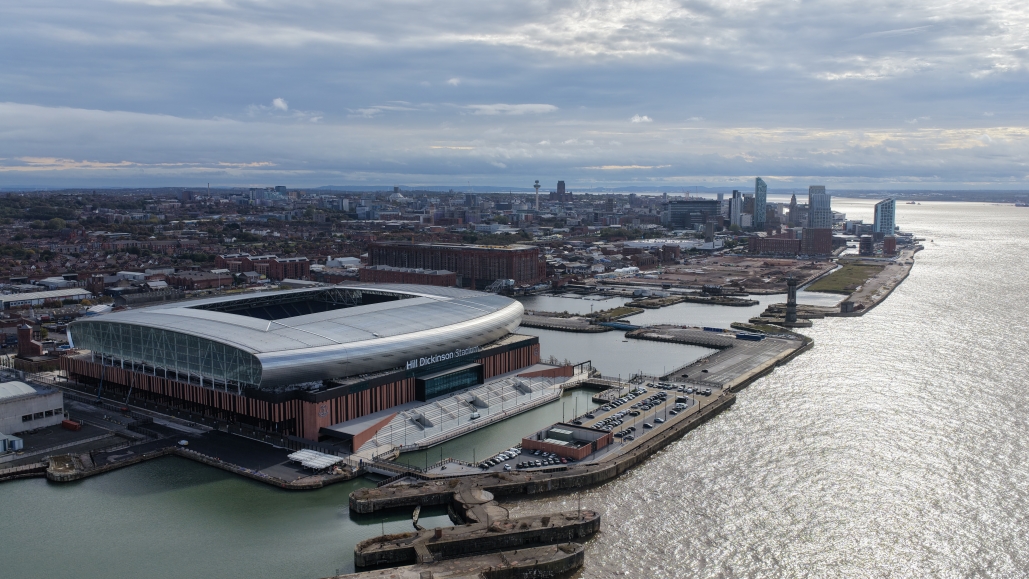
The formal agreement to establish the North Docks Mayoral Development Corporation (MDC) represents the most significant governance intervention and structural delivery shift in Liverpool’s waterfront regeneration since the 1980s. Following decisive approval by Liverpool City Council’s Cabinet in December 2025, the project is currently advancing through full business case development. A statutory public consultation is scheduled for summer 2026, positioning the MDC for formal, legal establishment by autumn 2026. This proposed statutory body is explicitly designed to accelerate the transformation of 174 hectares of predominantly brownfield land, stretching from the city centre commercial core to the newly constructed Everton Hill Dickinson Stadium at Bramley-Moore Dock.
By amalgamating previously fragmented masterplans under a unified, state-backed delivery mechanism, the combined local authority and mayoral ambition is exceptionally large in scale. The framework targets the phased delivery of up to 17,700 new homes and 5 million sq ft of commercial space over a 15-year horizon.
My central analytical judgement is that the introduction of the MDC fundamentally alters the risk profile of North Liverpool's regeneration landscape. For over a decade, ambitious visions in this area, most notably the sprawling 60-hectare Liverpool Waters scheme, have been constrained by complex land ownership, severe foundational infrastructure deficits, and the inherent viability challenges of speculative brownfield development. The MDC model directly mitigates these historic barriers by equipping the public sector with enhanced, statutory powers for land assembly (including compulsory purchase capabilities if required), accelerated planning pathways, and access to innovative financing structures. This institutional architecture transitions the northern docklands from a series of isolated private-sector aspirations into a coordinated, publicly underwritten urban extension.
The immediate delivery core of this masterplan is already live and fully funded. Within the Central Docks neighbourhood, a £56 million grant from Homes England, operating in tandem with £26 million from developer Peel Waters, is currently funding the primary enabling infrastructure and a 2.1-hectare public park. With infrastructure completion targeted for 2028, this initial phase unlocks the immediate capacity for 2,350 homes. Adjacent to this, the £1 billion King Edward Triangle project, led by Davos Property Developments and Beetham Group, is advancing a high-density cluster comprising up to 3,000 homes and a landmark 60-storey tower. Further inland, the newly drafted Pumpfields and Limekilns framework outlines the spatial capacity for an additional 7,283 homes.
For the property investor, the sheer scale of this intervention necessitates a cautious, dual-perspective analysis. At the micro-level within the prime waterfront and the L3 postcode, early phases of the park-side developments are likely to command distinct new-build premiums, supported by enhanced public realm, active travel corridors, and the stadium footfall ecosystem. However, at the macro-level, the sequential introduction of 17,700 homes represents a massive structural increase in Liverpool's housing supply. This volume of stock, delivered consistently over 15 years, is highly likely to absorb a significant proportion of the city's demographic growth. Consequently, it should act as a moderating force on broader city-wide house price inflation and rental pressure, rather than acting as a simple catalyst for unchecked capital appreciation across all local stock.
Investors must therefore exercise stringent due diligence regarding phasing, specific plot micro-locations, and developer track records. The principal execution risk is no longer the provision of primary infrastructure, which is now actively funded and underway, but rather the absorption capacity of the local market and the sequencing of vertical construction by private partners as the infrastructure completes post-2028.
2. Project overview
The North Docks Mayoral Development Corporation is a bespoke statutory vehicle created through deep, structural collaboration between Liverpool City Council and the Liverpool City Region Combined Authority. Unlike traditional planning departments, the MDC is designed to assume dedicated, overriding powers over a defined geographic zone to expedite urban renewal and commercial delivery.
2.1 The MDC boundary and geographic context
The MDC operates within a strictly defined boundary encompassing 174 hectares of predominantly brownfield land. The geography is highly strategic, acting as the critical connective tissue necessary for the city’s northern economic expansion.
The southern extent of the zone integrates directly with Liverpool's existing Commercial Business District, specifically incorporating the Pall Mall Grade A office development scheme. The northern boundary is firmly anchored by the new 52,769-capacity Everton Hill Dickinson Stadium at Bramley-Moore Dock, leveraging the stadium as a primary catalyst for regional identity and consistent visitor footfall. The River Mersey forms the continuous western edge, absorbing the waterfront expanses of the historic docklands, including the Central Docks and the Stanley Dock complex. Moving inland from the water, the eastern boundary absorbs the transitional industrial zones of the Ten Streets creative district and the Pumpfields neighbourhood, stretching toward the city centre fringe.
2.2 The rationale for a statutory corporation
The deployment of a Mayoral Development Corporation is a deliberate, targeted policy response to historic market failure. While the wider Liverpool Waters outline planning permission dates back over a decade, speculative private capital alone proved systematically insufficient to manage the immense upfront costs of remediation. Preparing 19th-century dockland infrastructure, reinforcing heritage dock walls, and establishing modern utilities across such a vast acreage carried a "brownfield penalty" that suppressed viable vertical development.
By formalising the MDC, the local state transitions from a passive planning authority to an active, interventionist co-developer. The MDC legislative framework unlocks enhanced statutory powers that standard local authorities struggle to deploy efficiently. These include streamlined, accelerated planning consent mechanisms and aggressive land assembly powers, allowing fragmented, multi-owner plots in areas like Pumpfields to be compulsorily consolidated for viable development. Furthermore, it enables the ability to ring-fence and leverage innovative financing tools against future business rates and land value uplifts generated within the zone.
Crucially, the MDC acts as a single, empowered counterparty for central government agencies. This is evidenced by the strategic alignment with the national housing agency, Homes England, which is actively co-producing the delivery framework and has already deployed substantial enabling capital into the zone via a formal Strategic Place Partnership.
2.3 Distinct from the Liverpool North New Town
It is vital for analytical clarity and investor due diligence to separate the MDC from the adjacent but functionally separate Liverpool North New Town project. While both share the broader goal of northern regeneration, they differ entirely in scope, geography, and governance mechanisms.
The North Docks MDC is a commercially focused, waterfront-oriented statutory body targeting large-scale economic output, 17,700 dense urban homes, and 5 million sq ft of commercial space. Conversely, the Liverpool North New Town is a community-focused, housing-led regeneration programme stretching further inland into established, historically deprived residential areas such as Vauxhall, Everton, Anfield, and Kirkdale. The New Town project focuses on retrofitting existing neighbourhoods, delivering affordable housing models, and addressing deep-seated socioeconomic challenges. A prime example of New Town delivery is the Vescock Street Build-to-Rent and Rent-to-Buy scheme, delivered in partnership with Torus and Aviva Investors. While the two masterplans are designed to complement each other, with the MDC driving economic output and the New Town project stabilising the residential hinterland, their delivery vehicles, planning frameworks, and investment profiles must be analysed as distinct entities.

3. Official scheme details and delivery timeline
The MDC does not start from a blank slate; rather, it supercharges, coordinates, and consolidates a portfolio of massive, pre-existing masterplans under a single delivery umbrella. The 17,700-home target is an aggregation of several distinct neighbourhoods, each currently operating on its own delivery trajectory.
3.1 Component masterplans
The scale of the North Docks regeneration requires an understanding of the individual constituent zones that make up the 174-hectare territory. The table below outlines the primary development anchors within the MDC boundary based on current official council and developer planning frameworks.
| Sub-District / Project | Delivery Status and Scale | Strategic Role within the MDC |
|---|---|---|
| Central Docks (Liverpool Waters) | Infrastructure underway. 10.5-hectare site targeting 2,350 homes and a 2.1-hectare public park. | The primary near-term residential and leisure anchor. Backed by an £82 million public-private infrastructure package to derisk vertical plot development by 2028. |
| King Edward Triangle | Masterplan phase. Targeting up to 3,000 homes, 400 hotel rooms, and 200k sq ft of offices. | A proposed high-density, skyscraper-led district bridging the waterfront and the CBD, featuring a proposed 60-storey landmark residential tower. |
| Pumpfields and Limekilns | Draft SPD phase. Identified spatial capacity for approximately 7,283 new homes. | An inland, residential-led mixed-use neighbourhood designed to replace fragmented industrial land with townhouses and apartments integrated with new civic squares. |
| Ten Streets | Active SRF phase. 125 acres of former dockland warehouse territory. | The designated cultural, tech, and creative employment district. Focuses on preserving maritime architectural heritage while encouraging diverse commercial uses. |
| Pall Mall | Planning approved / early works. Targeting 400,000 sq ft of Grade A office space. | The primary corporate employment anchor, expanding the supply of premium, centrally located workspace close to key transport hubs. |
| Stanley Dock Complex | Multi-phase delivery underway. | Ongoing conversion of colossal, heritage-listed warehouse structures into high-end residential apartments and visitor accommodation. |
Central Docks represents the most mature and derisked element of the MDC residential pipeline. The viability of this site was unlocked by a £56 million grant from Homes England, matched by £26 million from the landowner, Peel Waters. This capital is actively funding underground utilities, road networks, heritage preservation, and the creation of Central Park. Official projections state that the completion of this enabling infrastructure by 2028 will unlock £550 million in private sector vertical construction.
3.2 Indicative delivery sequence
The MDC is operating on a stated 15-year horizon. The physical delivery logic is phased logically: establish governance, fund primary infrastructure, secure developer commitments, and execute vertical construction. The following timeline outlines the most reliable current milestones based on combined authority and developer announcements.
- December 2025: Liverpool City Council Cabinet formally endorses the ambition to create the North Docks MDC.
- Spring 2026: Full business case development to outline financial, economic, and governance frameworks.
- Summer 2026: Launch of the statutory six-week public consultation on the scope and function of the MDC.
- Autumn 2026: Anticipated formal, legal establishment of the MDC following national government consent.
- 2026 - 2028: Live deployment of enabling infrastructure at Central Docks, concluding with the opening of the 2.1-hectare Central Park.
- 2027 - 2030: Detailed planning approvals secured for King Edward Triangle and Central Docks plots. Commencement of first major residential blocks and commercial spaces on fully serviced land.
- 2030 - 2040: Volume build-out phase. Sequential release of homes across Liverpool Waters, Pumpfields, and Ten Streets. Deployment of MDC land assembly powers to unlock complex, fragmented inland sites.
4. Planning, infrastructure and transport context
The planning environment governing the MDC is robust, multi-layered, and heavily directed by newly updated statutory documents. The local authority has spent the past several years laying the policy groundwork to ensure the MDC does not result in chaotic, piecemeal development that isolates communities.
4.1 Masterplanning frameworks
The overarching statutory guide is the new Liverpool Local Plan (2025-2041), which explicitly identifies Liverpool Waters, Ten Streets, and Pumpfields as the primary focus areas for significant growth to meet the city's housing targets. Beneath this Local Plan, detailed spatial parameters are governed by a network of Supplementary Planning Documents (SPDs) and Spatial Regeneration Frameworks (SRFs).
The Liverpool Waterfront Plan, commissioned in April 2024 and designed by renowned urban placemakers BDP and West 8, acts as a 25-year blueprint for six miles of the Mersey edge. This document ensures inclusive design, public access to the water, and cohesive public realm standards from Festival Gardens up to the new stadium. Similarly, the Ten Streets SRF guides the transition of the warehouse district immediately behind the docks, mandating the preservation of maritime architectural heritage while encouraging cultural venues and tech workspaces.
Crucially for investor density modeling, the Tall Buildings SPD, adopted in late 2023, provides vital policy certainty regarding height limits and sightlines. It protects Liverpool's 1,532 listed buildings while explicitly designating clusters, such as the King Edward Triangle, where ambitious skyscrapers will be actively supported by planners.
4.2 Energy and environmental infrastructure
A fundamental pillar of the MDC's long-term sustainability strategy is the Mersey Heat network. This is a major district heating system designed to provide low-carbon heat and hot water to thousands of new homes and commercial buildings across the waterfront.
The network is advancing structural plans to utilise water source heat pumps drawing directly from the River Mersey and local canal systems. This infrastructure drastically reduces the carbon footprint of the new developments, aligning with the Combined Authority's net-zero mandates and offering long-term energy cost stability for future residential and commercial tenants within the MDC zone.

4.3 Transport and connectivity
The addition of 17,700 homes and massive commercial floorspace necessitates a radical upgrade in transport capacity to prevent severe gridlock on the northern arterial routes, specifically Great Howard Street and the A565.
The MDC strategy relies heavily on integrating with the Combined Authority's broader £2 billion public transport investment pipeline. This includes leveraging the new £500 million fleet of publicly owned Merseyrail trains, providing high-capacity, electrified transit. At the micro-level, the masterplans strongly mandate active travel integration. Development proposals are required to prioritise pedestrian permeability, cycle corridors, and continuous waterfront walkways. The explicit intention is to engineer a "15-minute city" dynamic, where residents can walk or cycle safely from the Central Docks or Pumpfields directly into the Commercial Business District or the new stadium ecosystem without relying on private vehicles.

5. Local economy implications
The economic ambition of the North Docks MDC extends far beyond residential construction. It is positioned as a core component of the broader Liverpool City Region Growth Plan, a decade-long strategy aiming to expand the local economy by £10 billion and create tens of thousands of high-value jobs.
5.1 Commercial capacity and sector targeting
The provision of up to 5 million sq ft of commercial space within the MDC zone is transformative for the regional economy. Applying standard UK Employment Density Guide metrics (broadly estimating 10 to 12 sq m per office worker), a full build-out and occupation of this commercial quantum could theoretically accommodate upwards of 35,000 to 40,000 jobs. While this represents maximum physical capacity rather than guaranteed job creation, it underlines the scale of the employment district being engineered.
This space is not intended to cannibalise the existing city centre office market, but rather to capture growth in specific high-value sectors targeted by the Mayoral Combined Authority. These include Advanced Manufacturing and Life Sciences, leveraging the city's newly launched Industrial Strategy Zone and Life Sciences Innovation Zone. Furthermore, the Ten Streets framework targets the Creative and Digital sectors, expanding upon the momentum of nearby film and television production hubs to capture post-production, immersive technology, and gaming enterprises. Finally, the zone will support the administrative and strategic needs of the Port of Liverpool, a global maritime gateway managing 45% of UK trans-Atlantic trade.
5.2 Construction and supply chain economics
Over the 15-year delivery horizon, the MDC will function as one of the largest continuous construction sites in Europe. The £11 billion of planned infrastructure and development investment promoted by the Mayor at international forums will generate thousands of direct construction jobs. This sustained economic activity will provide a robust baseline of demand for local retail services, hospitality, and short-to-medium term rental accommodation for contract workers and project management staff over the coming decade.
6. Housing market implications
For property investors, parsing the housing market implications requires distinguishing between the immediate waterfront micro-market and the wider Liverpool structural context.
6.1 Current market baseline
Official baseline data indicates that Liverpool remains highly accessible compared to national averages, presenting a lower barrier to entry for investors. The Office for National Statistics reported an average house price in Liverpool of £177,000 in February 2026, representing a 3.6% annual rise. Broken down by property type, flats and maisonettes, which represent the dominant typology of the MDC zone, averaged £122,000 across the city, while terraced housing averaged £168,000.
Local property evidence from the L3 postcode (which encompasses the waterfront, the CBD, and parts of the MDC zone) shows a median price of £167,000 based on recent completed sales. However, broader market analyses frequently place the average valuation for prime, newly built city-centre L3 stock higher due to the premium weighting of modern apartments with waterfront aspects.
6.2 The dual impact of the MDC supply shock
The delivery of 17,700 homes over 15 years equates to an average completion rate of roughly 1,180 units per annum within this specific zone. To contextualise, this represents a massive, sustained injection of supply that will fundamentally alter local market dynamics.
The Micro-Market Premium: Within the immediate boundaries of Central Docks, King Edward Triangle, and the premium waterfront edge, property values are highly likely to establish a new pricing ceiling for Liverpool. The combination of newly serviced public realm, the 5-acre Central Park, sweeping river views, proximity to a £1 billion Grade A office district, and the amenity ecosystem generated by the stadium will command a clear new-build premium. Investors purchasing early phases (e.g., Central Docks immediately following post-2028 infrastructure completion) are acquiring assets at the beginning of a placemaking curve.
The Macro-Market Moderation: However, the sheer volume of supply means investors should not rely on extreme, scarcity-driven capital appreciation across the wider city. The MDC explicitly seeks to address the city's housing shortage and provide homes for a growing workforce. By meeting this demand efficiently through high-density development, the MDC will likely moderate the intense pressure on the city's existing, older stock. Therefore, while premium waterfront assets will appreciate based on their unique micro-location and quality, the broader L3 and surrounding markets will become highly competitive. Landlords will be required to maintain high property standards to attract tenants and buyers who will soon have 17,700 new choices.
6.3 Analytical scenarios for price dynamics
The table below provides a strictly analytical, scenario-based view of how the waterfront micro-market might perform relative to the wider Liverpool baseline, assuming steady vertical build-out. These scenarios rely on cautious, evidence-led projections rather than guaranteed sales forecasts.
| Scenario Focus | Market Driver | Expected Outcome on L3 Waterfront Values | Impact on Wider Liverpool Average |
|---|---|---|---|
| Short-term (2026-2028) | Infrastructure spend; masterplan anticipation; stadium completion. | Moderate uplift. Pricing reflects anticipation of place-making rather than fully realised amenities. | Negligible. Vertical supply has not yet hit the market. |
| Medium-term (2029-2035) | Central Park opens; first major residential phases occupied; commercial tenants arrive. | Establishment of a distinct "Waterfront Premium" relative to older city stock. | Moderating effect. New supply begins to absorb demographic growth, easing demand pressure on older housing. |
| Long-term (2035+) | Critical mass achieved; 10,000+ homes built; mature public transport and retail ecosystem. | Stabilisation as a premium destination. Values driven by macroeconomic cycles rather than local regeneration leaps. | Structural shift. North Docks operates as an established, high-value core, effectively shifting the city's economic centre of gravity northward. |
7. Rental market implications
The rental market in the L3 postcode is currently robust, driven by young professionals, corporate tenants, and students demanding central, amenity-rich living arrangements.
7.1 Rent baselines and current performance
According to the ONS, the average private rent in Liverpool was £893 in March 2026, representing a 6.4% annual increase. By bedroom count, the city-wide averages are £672 for one-bedroom, £819 for two-bedroom, and £941 for three-bedroom properties.
Within the L3 postcode specifically, market data indicates a distinct premium over the city average due to the concentration of modern apartments and proximity to the CBD. Sector data suggests average L3 rents sit at approximately £729 for a one-bedroom apartment and £931 for a two-bedroom apartment, with top-tier waterfront properties and newer builds commanding rates well in excess of £1,000 per month.
7.2 The professionalisation of the rental sector
A critical trend for retail investors to understand is the heavy involvement of institutional capital and the Build-to-Rent (BTR) sector in Liverpool's northern regeneration. The MDC and the adjacent Liverpool North New Town frameworks explicitly support institutional BTR delivery to ensure rapid housing deployment.
For example, the Vescock Street scheme, managed by Aviva Investors in partnership with Torus, demonstrates how deep-pocketed institutions are funding and operating dedicated rental blocks. Furthermore, Peel Waters has been actively marketing the "Central Seven" plot within Liverpool Waters as a flagship BTR opportunity.
The influx of thousands of professionally managed, amenity-rich BTR units (often featuring on-site gyms, co-working spaces, and concierge services) within the MDC zone will redefine tenant expectations. Private buy-to-let investors holding older stock in L3 will face intense competition. To maintain high occupancy and defend rental revenue streams, retail investors will need to ensure their properties offer exceptional condition, highly competitive pricing, or unique micro-locations (such as direct, unobstructed river views) that generic institutional BTR blocks may lack.
8. Supply, demographics and demand drivers
The demographic impact of the MDC is profound. Delivering 17,700 homes fundamentally alters the human geography of Liverpool, creating an entirely new civic district.
Assuming an average household size of 1.8 to 2.2 persons, typical for the high-density, apartment-led formats proposed in the King Edward Triangle and Central Docks, the MDC zone will eventually accommodate a new population of between 31,800 and 38,900 residents.
8.1 Target demographics
The physical typology of the housing, which is predominantly 1- and 2-bedroom apartments with some townhouses integrated into the Pumpfields area, strongly dictates the future demographic profile. The zone is structurally engineered to attract young professionals, drawn by active travel links to the CBD, high-grade office space, and waterfront leisure. It will also serve corporate relocations, supported by the targeted job growth in Life Sciences, Advanced Manufacturing, and the digital sector. Additionally, specific plots within Liverpool Waters have been earmarked for specialist elderly and later-living accommodation, which will help bring demographic balance to the area.
8.2 Social infrastructure requirements
Adding over 30,000 residents to former industrial docklands creates a critical mass that requires complete civic infrastructure. The local authority is acutely aware of this challenge; the draft Local Plan and associated SPDs strictly mandate that residential growth must be supported by the timely delivery of primary schools, healthcare facilities, and community spaces.
The long-term success of the MDC as a sustainable community, rather than just a transient dormitory zone, depends entirely on the sequencing of this social infrastructure. If schools and medical centres lag years behind residential occupation, the area will fail to attract long-term families. This would lead to a demographic skewed heavily toward young, short-term renters, a scenario that typically yields higher tenant turnover costs for property investors.
9. Investor watchpoints and risks
While the MDC framework provides unprecedented state backing and fundamentally derisks primary infrastructure provision, significant execution risks remain that require careful investor monitoring throughout the 15-year lifecycle.
Phasing and Absorption Risk The most critical variable is market absorption. Delivering over 1,000 units a year requires sustained, high-volume tenant and buyer demand. If macroeconomic conditions (such as persistently high borrowing costs or a national economic slowdown) suppress demand, developers may pause vertical construction, leading to a stalled, partially built environment. Investors must monitor whether developer commitments translate into continuous site activity post-2028.
Viability and Build Costs The UK construction sector continues to grapple with high material and labour costs. As noted by regional leadership, building new homes in urban areas is frequently held back by financial viability, where development costs can equal or exceed finished end-values. While the £82 million Central Docks infrastructure grant solves the "brownfield penalty" for that specific neighbourhood, individual developers must still make the mathematics of complex structures, such as 60-storey towers in the King Edward Triangle, work. If end-values in Liverpool do not rise sufficiently to cover these elevated construction costs, grand architectural visions may be value-engineered into lower-quality structures, impacting the overall prestige of the district.
Planning and Heritage Friction Liverpool has a complex relationship with its heritage, highlighted by the loss of its UNESCO World Heritage status in 2021 over concerns regarding waterfront development scale. While the new Tall Buildings SPD and Waterfront Plan provide much clearer guidelines, planning friction remains a risk. Proposals that test the limits of height, sightlines, or heritage proximity (especially near the Victoria Clock Tower or Stanley Dock) may still face protracted negotiation or opposition, delaying delivery timelines and increasing holding costs for developers.
The Competition Factor Investors must recognise that they are not buying into a scarce commodity. With 17,700 homes planned in the MDC, plus thousands more in the adjacent Liverpool North New Town and existing pipelines, the L3 property market will become highly saturated. Assets will only hold their premium value and rental appeal if they possess distinct competitive advantages over the incoming institutional supply.