

The "Central Liverpool" vision represents the most comprehensive and strategically vital infrastructure and placemaking initiative proposed in Liverpool since the delivery of the £1bn Liverpool ONE retail complex nearly two decades ago. Anchored by the total redevelopment of the 150-year-old Liverpool Central Station, the programme proposes a £5bn gross development value (GDV) transformation of 86 acres of the city's historic core (Source: Liverpool Echo, Liverpool City Region Combined Authority, Liverpool Business News). Moving far beyond a standard station upgrade, the scheme is designed to physically and economically stitch together the city’s traditional retail district with the rapidly expanding, £2bn Knowledge Quarter to the east. By targeting up to 2.5 million sq ft of new mixed-use development and the creation of up to 7,000 permanent jobs, the project aims to fundamentally rebalance Liverpool’s urban geography towards the knowledge, tech, and life-science sectors (Source: dpsimulation.org.uk, Liverpool City Council, AtkinsRéalis).
The strategic position of the scheme has advanced remarkably over the past twelve months. In October 2025, the UK Chancellor selected the Liverpool Central project as one of four national pilots for a reformed "Green Book" appraisal system, signaling a critical shift in central government's willingness to fund major Northern infrastructure based on social and regenerative value rather than strictly on localized land-value uplift (Source: Liverpool Business News). This policy breakthrough was followed in March 2026 by the formal allocation of £95m to the Liverpool City Region, specifically earmarked to unlock held-up city-centre projects and advance feasibility, design, and land assembly work for the Central Liverpool vision (Source: Place North West). Consequently, the scheme has transitioned from a theoretical spatial framework into an active, funded pipeline project.
However, my central judgement for investors is that while the political and initial financial momentum is highly credible, physical delivery remains complex and heavily back-loaded. The defining feature of the masterplan is the "Big Dig", a proposed subterranean rail tunnel linking Liverpool Central to Lime Street (Source: Liverpool City Region Combined Authority). This engineering feat is required to alleviate critical network bottlenecks and accommodate the integration of Northern Powerhouse Rail (NPR), which promises 25-minute journey times to Manchester Airport . Because vertical real estate development is intrinsically tied to the completion of this below-ground infrastructure, the most significant influx of commercial and residential supply will not materialise until the 2030s. To manage this multi-decade delivery, the Liverpool City Region Combined Authority (LCRCA) is drafting an outline business case for a bespoke Mayoral Development Corporation (MDC), expected in Autumn 2026, which will take statutory control of the zone's planning and compulsory purchase powers (Source: Place North West).
For the property market, the analytical outlook must remain cautious and long-term. Liverpool’s city centre is currently characterised by high affordability relative to other major UK metropolitan cores; recent completed sales data from February 2026 indicates a median price of £120,000 in the L1 district and £167,000 in the L3 district. The Central Liverpool project will exert a bifurcated effect on this baseline. In the near term (to 2030), the impact will be anticipatory, driven by speculative land acquisition, institutional confidence, and the "halo effect" on adjacent neighbourhoods such as the Fabric District and the Ropewalks. In the long term (post-2030), the delivery of thousands of new high-density homes will satisfy a significant portion of citywide housing targets, acting as a moderating force on broader price inflation. Conversely, stock located immediately within the regenerated, pedestrianised, transit-linked 86-acre zone will likely establish a new premium micro-market, highly sought after by Build-to-Rent (BTR) operators and the incoming life-science demographic.
Investors must stringently monitor the project's funding milestones. The LCRCA is seeking £2.5bn in central government transport funding to match £2.5bn in private, institutional, and local capital (Source: Liverpool City Region Combined Authority, Liverpool Business News). While the £95m allocation provides vital capital for early-stage mobilisation, the full realisation of the £5bn vision remains entirely dependent on the Treasury's long-term commitment to Northern Powerhouse Rail and the successful legislative establishment of the MDC.
Project overview and strategic boundaries
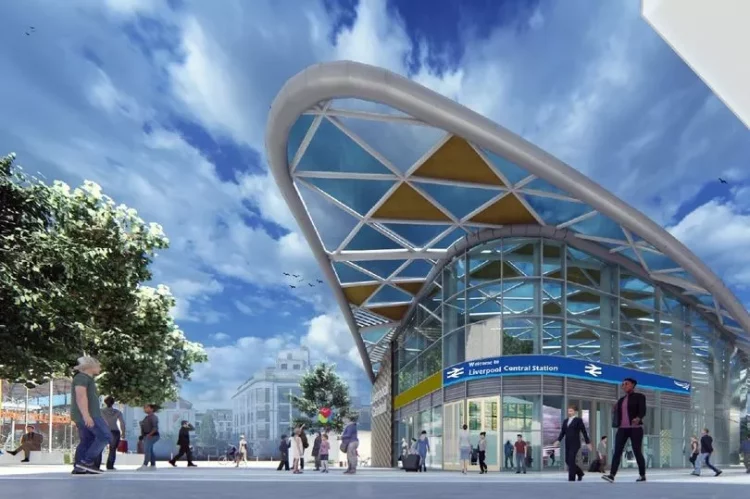
The Central Liverpool vision is best understood not as a standalone property development, but as a holistic, transport-oriented district masterplan. Bounded roughly by Renshaw Street, Bold Street, and Ranelagh Street, the 86-acre red-line boundary acts as the critical hinge between Liverpool's waterfront and retail core (L1) to the west, and the rapidly expanding Knowledge Quarter (L3/L7) to the east .
Historically, this central expanse has suffered from fragmented ownership, aging 1960s retail architecture, and poor pedestrian permeability, acting as a physical barrier rather than a conduit. The current Liverpool Central Station, largely hidden beneath street-level retail, exemplifies this dysfunction. Despite handling over 15 million passengers annually, making it one of the busiest underground stations outside of London, its cramped single-island platform and limited concourse restrict both passenger flow and overall network capacity .
The masterplan effectively treats the station's obsolescence as the catalyst for total neighbourhood renewal. By stripping back piecemeal mid-century additions and leveraging the land above and immediately adjacent to the rail infrastructure, the combined authority intends to unlock a scale of development previously thought impossible in the city's dense historic core.
The strongest currently available public description of the Central Liverpool vision, synthesised from official LCRCA statements, mayoral announcements, and underlying strategic frameworks (such as the Upper Central Spatial Regeneration Framework), is detailed below.
| Masterplan Component | Best-Supported Current Position |
|---|---|
| Development Role | A high-density transport, commercial, and residential gateway linking the historic retail core to the Knowledge Quarter (Source: Liverpool Echo). |
| Gross Scale & Value | 86 acres of comprehensive city-centre redevelopment with an estimated Gross Development Value (GDV) of £5bn (Source: Liverpool City Region Combined Authority, Liverpool Business News). |
| Transport Infrastructure | Total overhaul of the 150-year-old Liverpool Central Station; proposed subterranean rail link to Lime Street; integration with Northern Powerhouse Rail (Source: Liverpool Echo). |
| Commercial Space | Up to 2.5 million sq ft of new development opportunities, heavily weighted towards Grade A office, lab-enabled space, and tech hubs (Source: dpsimulation.org.uk, Liverpool City Council, AtkinsRéalis). |
| Employment Target | Potential to create up to 7,000 new jobs, particularly in tech, digital, life sciences, and hospitality (Source: dpsimulation.org.uk, AtkinsRéalis). |
| Housing Delivery | High-density, mixed-use residential delivery encompassing Build-to-Rent (BTR), open-market sales, and student accommodation, though specific unit counts remain indicative (Source: Liverpool City Region Combined Authority). |
| Public Realm | Walkable, pedestrianised spaces, active travel corridors, and new urban green spaces elevated above the station footprint (Source: Liverpool City Region Combined Authority, dpsimulation.org.uk). |
| Delivery Vehicle | Emerging Mayoral Development Corporation (MDC) to oversee land assembly, rapid planning, and institutional partnerships (Source: Place North West). |
The commercial ambition of the scheme is driven largely by the "Upper Central" Spatial Regeneration Framework (SRF), a 56-acre subset of the wider masterplan zone. Approved in draft form by Liverpool City Council in early 2020, the Upper Central SRF explicitly targeted 2.5m sq ft of new development to accommodate the spillover from the Knowledge Quarter (Source: Liverpool City Council, AtkinsRéalis). The Knowledge Quarter itself is already home to £1bn of active investment at Paddington Village, including the Royal College of Physicians' northern headquarters (The Spine) and advanced oncology centres .
As these anchor institutions attract specialized supply chains, biotech start-ups, and digital health firms, the Knowledge Quarter is rapidly reaching spatial capacity. The Central Liverpool vision provides the necessary expansion zone. By transforming Renshaw Street and the areas surrounding the Adelphi Hotel into an international-standard business district, the city can retain high-growth companies that might otherwise migrate to Manchester or London due to a lack of suitable Grade A space.
Metro Mayor Steve Rotheram has repeatedly compared the scale, approach, and potential impact of the Central Liverpool project to the regeneration of King's Cross and St Pancras in London (Source: Liverpool Echo, Liverpool City Region Combined Authority). This comparison is highly instructive for investors: it underscores that the project is not merely about running more trains, but about leveraging a multi-billion-pound transport node to completely re-price and re-brand the surrounding real estate ecosystem.
Official scheme details and delivery timeline
Delivering a £5bn infrastructure and real estate mega-project in the middle of a historic, operational city centre is an exercise in extreme logistical and financial phasing. As of 2026, the project is officially in the strategic vision, feasibility, and business case development stage (Source: Liverpool City Region Combined Authority).
The funding architecture is based on a 50/50 public-private split. The LCRCA is seeking £2.5bn in direct transport and infrastructure funding from the UK Treasury, with the remaining £2.5bn expected to be generated through institutional investment, private developer capital, land receipts, and local authority borrowing against future business rates (Source: Liverpool City Region Combined Authority).
The project's viability received a massive endorsement in March 2026 when the UK government allocated £95m to the Liverpool City Region to "bulldoze through roadblocks" holding up major city-centre regeneration schemes (Source: Place North West). This capital is critical. It provides the LCRCA and the city council with the immediate liquidity required to fund advanced architectural design, subterranean engineering surveys, strategic land acquisitions, and the complex legal structuring of the delivery vehicle.
Furthermore, the Combined Authority is heavily supported by a consortium of global engineering and real estate consultancies, including AtkinsRéalis, Steer, and Cushman & Wakefield, who are tasked with developing the masterplan, creating the business case, and identifying the most appropriate funding models to attract private capital .
To provide a structured view of the likely trajectory, I have modelled an indicative delivery sequence based on official Combined Authority roadmaps, Northern Powerhouse Rail schedules, and the typical lifecycle of equivalent UK mega-projects.
| Phase | Estimated Timeframe | Key Milestones and Strategic Actions |
|---|---|---|
| Phase 1: Feasibility & Mobilisation | 2024 - 2026 | LCRCA tenders £1m masterplan contract; project selected for Green Book reform pilot; £95m early-stage government funding secured; consortium of AtkinsRéalis/Cushman & Wakefield appointed. |
| Phase 2: Governance & Statutory Powers | Late 2026 - 2028 | Submission of outline business case for the Mayoral Development Corporation (Autumn 2026); formal legislative establishment of the MDC; submission of overarching outline planning consents for the 86 acres. |
| Phase 3: Land Assembly & Procurement | 2027 - 2030 | Execution of Compulsory Purchase Orders (CPOs) where necessary; relocation of existing fragmented retail tenants; appointment of Tier 1 civil engineering contractors; finalisation of the £2.5bn Treasury settlement. |
| Phase 4: The "Big Dig" & Infrastructure | 2030 - 2035 | Commencement of subterranean tunneling between Central and Lime Street; excavation for station expansion; rerouting of utilities; delivery of the new concourse and transit integration works. |
| Phase 5: Vertical Real Estate Delivery | 2032 - 2040+ | Phased delivery of 2.5m sq ft of commercial space, high-density residential plots, hotels, and the elevated public realm. Plot disposals to private developer partners. |
Investors must explicitly acknowledge the back-loaded nature of the vertical real estate. The Northern Powerhouse Rail timeline clearly projects that construction on the new Liverpool-to-Manchester line and associated major station upgrades will not begin until the 2030s . While smaller, peripheral plots within the 86-acre MDC boundary may be brought forward for residential or commercial development before the end of the decade, the core structural transformation of the station footprint is a medium-to-long-term horizon. Capital deployed in this district over the next five years is an investment in anticipated future value, rather than immediate yield realization.
Planning, infrastructure and transport context
The regulatory and engineering foundations of the Central Liverpool vision are unprecedented for the city region. They revolve around three distinct pillars: the creation of a Mayoral Development Corporation, the implementation of Green Book reform, and the integration of Northern Powerhouse Rail via the "Big Dig."
1. The Mayoral Development Corporation (MDC)
To deliver 86 acres of holistic regeneration, standard local authority planning processes are insufficient. They are often too slow, vulnerable to localized political disputes, and ill-equipped to handle the compulsory purchase of dozens of fragmented high-street freeholds. To solve this, Mayor Steve Rotheram is utilizing powers granted under the Localism Act 2011 to establish a Mayoral Development Corporation .
An outline business case for the MDC is scheduled for submission to the government in Autumn 2026 (Source: Place North West). Once legally established, the MDC becomes the statutory planning authority for the defined boundary, stripping away lower-tier bureaucracy. It wields enhanced powers for accelerated planning consent, innovative gap funding, and aggressive land assembly via Compulsory Purchase Orders (CPOs) .
The LCRCA has already witnessed the success of this model in neighboring Greater Manchester, where the Stockport MDC successfully catalyzed the delivery of over 1,200 brownfield homes and a new transport interchange by providing institutional investors with a single, reliable point of contact . By adopting the MDC model for Central Liverpool, the combined authority is signaling to sovereign wealth funds and institutional capital that the regulatory environment will be streamlined, commercially focused, and protected from localized planning delays.
2. Green Book Appraisal Reform
Historically, Liverpool and other Northern cities have struggled to secure Treasury funding for multi-billion-pound transport schemes. The government's standard "Green Book" appraisal rules relied heavily on strict Benefit-Cost Ratios (BCRs) (Source: Liverpool Business News). Because land values and average wages are lower in the North than in London, the absolute economic uplift calculated in GBP terms always favored investing in the South East, creating a self-perpetuating cycle of underinvestment in regional cities.
In October 2025, Chancellor Rachel Reeves announced a fundamental overhaul of this system, shifting toward a "place-based" assessment that factors in broader social value, job creation, and housing unlocked by infrastructure (Source: Liverpool Business News). Crucially, the Central Liverpool Station scheme was selected as one of only four national pilots to test this new system (Source: Liverpool Business News). This designation is highly material for investors. It means the project's £2.5bn funding request is no longer being evaluated solely on ticket sales or raw transport metrics, but on its ability to unlock 2.5m sq ft of commercial space and thousands of homes. The project's alignment with the new Treasury methodology significantly de-risks the likelihood of the funding being rejected.
3. The "Big Dig" and Northern Powerhouse Rail (NPR)
The engineering crux of the masterplan is the proposed subterranean rail tunnel linking Liverpool Central to Lime Street (Source: Liverpool City Region Combined Authority). Liverpool Central currently suffers from a lack of integration with the national rail network, while Lime Street acts as a terminus bottleneck, forced to handle both slow local stopping services and long-distance intercity trains.
By boring a tunnel between the two hubs, the transport strategy aims to route local and regional commuter services through an expanded, high-capacity Liverpool Central. This dramatically increases network efficiency and frees up vital platform capacity at Lime Street.
This localized reconfiguration is the prerequisite for Liverpool's integration into the national Northern Powerhouse Rail (NPR) network. In January 2026, the government confirmed plans for a new high-capacity line linking Liverpool to Manchester via Warrington and Manchester Airport . Currently, a rail journey from Liverpool to Manchester Airport takes approximately 85 minutes and requires navigating 21 stops . The new NPR line is projected to slash this journey time to just 25 minutes .
Achieving a 25-minute connection to an international airport fundamentally alters Liverpool's economic geography. It transitions the city from an end-of-the-line destination into a globally connected, hyper-accessible node within a broader Pennine economic corridor.
Local economy implications
The economic impact of the 86-acre Central Liverpool regeneration must be evaluated across two distinct horizons: the immediate stimulus of capital expenditure during the construction phase, and the long-term structural realignment of the city's Gross Value Added (GVA).
Construction and Capital Expenditure
The injection of £5bn in capital over a 15-to-20-year lifecycle represents a massive economic stimulus. While exact labor modelling depends on final detailed planning, a project of this scale will undoubtedly support several thousand construction job-years. Given the prominence of subterranean tunneling, rail systems engineering, and high-rise commercial construction, the labor demand will be heavily skewed toward specialized, high-wage civil engineering and architectural roles.
The LCRCA’s £2bn wider investment fund, alongside the new £95m central government allocation, ensures that early-stage procurement, site remediation, and architectural design contracts will generate immediate, localized supply chain benefits throughout the late 2020s (Source: Place North West).
Long-Term Structural Economic Shift
The true economic value of the Central Liverpool vision lies in its capacity to reshape the city's employment demographics. The masterplan explicitly targets the creation of up to 7,000 new jobs within the 86-acre zone, facilitated by the delivery of up to 2.5m sq ft of new commercial floorspace (Source: dpsimulation.org.uk, AtkinsRéalis).
This space is not intended to be generic corporate overflow. It is strategically positioned to capture the exponential growth of Liverpool's knowledge economy. Over the past decade, the adjacent Knowledge Quarter (KQ Liverpool) has secured over £1bn in investment, driving innovations in life sciences, materials chemistry, and artificial intelligence . Anchor institutions like the £35m Spine building (Royal College of Physicians), the £35m Rutherford Cancer Centre, and the £25m LJMU health extension are rapidly turning the district into a globally competitive biotech and digital health cluster .
However, as start-ups spin out of the universities and international firms look to establish a footprint near these academic anchors, the Knowledge Quarter requires highly accessible, Grade A commercial expansion space. The Central Liverpool zone provides exactly this. By acting as the commercial "front door" to the Knowledge Quarter, complete with a 25-minute rail link to Manchester Airport, the district removes the primary barriers to inward Foreign Direct Investment (FDI).
Consequently, investors should anticipate a gradual shift in the city centre's economic gravity. While the L1 waterfront and traditional retail core will remain vital for the visitor economy and leisure, the eastern flank of the city centre, running along the Renshaw Street corridor toward Paddington Village, will mature into the city's primary high-wage employment engine.
Housing market implications
Liverpool's residential property market is currently defined by robust affordability, strong rental yields, and a localized divergence between older legacy stock and new-build waterfront apartments. Local property evidence from completed sales in February 2026 highlights this dynamic: the median price in the L1 district (the traditional retail core and Ropewalks) stood at £120,000 on a low volume of 4 sales, while the L3 district (encompassing the commercial business district, waterfront, and university fringes) achieved a median of £167,000 on 11 sales [cite: user_prompt].
The introduction of the £5bn Central Liverpool regeneration will not immediately rewrite these baselines, but it will fundamentally restructure how the city centre housing market is tiered over the next decade.
Near-Term Anticipatory Impact (2026 - 2030)
In the years leading up to the commencement of major infrastructure works, the housing market impact will be heavily sentiment-driven. The combination of £95m in central government backing, Green Book pilot status, and the imminent formation of the Mayoral Development Corporation provides a powerful signal of intent to the market (Source: Liverpool Business News, Place North West).
Institutional investors and speculative developers will likely accelerate land acquisition and site assembly on the immediate fringes of the 86-acre boundary. Areas such as the Fabric District, the Pumpfields regeneration zone to the north, and the Ropewalks to the south will experience a "halo effect." Property owners in these adjacent districts should anticipate steady, evidence-led land value appreciation as developers seek to position residential schemes within walking distance of the future high-speed transport hub. However, for individual residential stock in L1 and L3, investors should expect stable, incremental capital growth rather than immediate, exponential spikes, as the physical delivery of the Central Liverpool amenities remains years away.
Long-Term Delivery Impact (Post-2030)
As the subterranean engineering concludes and vertical real estate delivery begins in the 2030s, the market dynamics will split.
On a macro, city-wide level, the Central Liverpool vision aims to introduce thousands of new high-density homes into the urban core. When combined with other mega-projects in the LCR pipeline, such as Peel's £5bn Liverpool Waters scheme (which includes 2,350 homes at Central Docks) and the 17,500 homes targeted by the wider North Docks MDC, the city is facing a massive influx of future supply . This volume is necessary to meet the LCRCA's ambitious target of delivering 64,000 new homes across the region . For the investor, this scale of supply acts as a vital moderating force. It ensures that the broader city housing market remains relatively accessible and prevents the sort of runaway, unsustainable price inflation seen in severely supply-constrained Southern cities.
Conversely, on a micro-level, the specific residential units built within the 86-acre Central Liverpool footprint will command a distinct "placemaking premium." Apartments that offer immediate pedestrian access to a 25-minute Manchester Airport rail link, new elevated urban parks, and 2.5m sq ft of Grade A employment space will sit at the very top of the Liverpool pricing hierarchy. This new stock will likely establish a pricing ceiling significantly higher than the current L3 median of £167,000, appealing specifically to high-earning professionals migrating to the city for roles in the adjacent Knowledge Quarter.
Rental market implications
The rental market implications of the Central Liverpool vision are intrinsically linked to the demographic profile of the 7,000 jobs the masterplan aims to create. Employment in life sciences, digital technology, AI, and advanced manufacturing typically attracts a younger, highly educated, and internationally mobile workforce.
This specific demographic exhibits strong, highly defined rental preferences. They prioritize transit-oriented living, high-speed digital connectivity, and immediate access to premium lifestyle amenities (co-working spaces, independent F&B, wellness facilities) over sheer square footage or suburban car-dependency. The Central Liverpool masterplan, with its emphasis on walkable public realm, reduced reliance on the private car, and hyper-connectivity via Northern Powerhouse Rail, is perfectly calibrated to meet these demands.
Consequently, the 86-acre zone is highly likely to become the epicenter of Liverpool's Build-to-Rent (BTR) and institutional Private Rented Sector (PRS) markets. Major institutional landlords and pension funds will view the district as a prime target for forward-funding large-scale, professionally managed residential blocks.
For private buy-to-let investors holding existing stock in L1 and L3, the outlook is nuanced. The overall tenant pool will expand as companies relocate to the new commercial spaces, providing a robust baseline of demand. However, tenant expectations will rise. As thousands of new, high-specification, energy-efficient (high EPC rating) apartments enter the market within the Central Liverpool boundary, older legacy stock in the surrounding streets may suffer from comparative obsolescence. To maintain premium yields and avoid void periods, landlords of older properties will likely need to invest heavily in retrofitting, aesthetic modernization, and energy efficiency upgrades to compete with the new institutional product.
Furthermore, the introduction of the 25-minute rail link to Manchester Airport will introduce a completely new tenant archetype to the Liverpool market: the international commuter. Aviation-linked professionals, global biotech consultants, and frequent international business travellers who historically defaulted to residing in South Manchester or Cheshire will now find central Liverpool a highly viable, and culturally vibrant, alternative. This will generate specific demand for high-end, serviced apartments and flexible, short-term corporate lets within the immediate vicinity of the station.
Supply, demographics and demand drivers
Understanding the underlying demographic pressures is essential for cautious investor due diligence. Liverpool's population was officially recorded at 508,961 in 2024, reflecting a sustained period of urban repopulation following the dramatic industrial declines of the late 20th century .
A defining characteristic of the city centre demographic is its youth. Liverpool is home to a massive higher education sector, with over 70,000 students across institutions like the University of Liverpool, Liverpool John Moores University (LJMU), and Liverpool Hope University . Historically, the city has faced challenges with graduate retention. While students flock to the city for its cultural vibrancy and relatively low cost of living, a lack of sufficient high-wage corporate roles has historically forced many highly skilled graduates to migrate to London, Leeds, or Manchester upon graduation.
The Central Liverpool vision acts as the structural remedy to this exact problem. By delivering 2.5m sq ft of commercial space directly adjacent to the academic institutions of the Knowledge Quarter, the city is building the physical infrastructure necessary to retain these graduates (Source: Liverpool City Council). The transition of these 70,000 students into tax-paying, economically active young professionals is the primary long-term demand driver for both the housing and retail sectors in the city core.
Furthermore, the masterplan reflects a necessary evolution in urban land use. The traditional L1 retail core, dominated by 20th-century indoor shopping centres like St Johns, is increasingly vulnerable to the structural shift toward e-commerce. The Central Liverpool vision reimagines these 86 acres not as a retail monoculture, but as a resilient, mixed-use environment. By blending high-density residential, Grade A office space, and experiential leisure, the district ensures continuous 24-hour footfall, protecting the area against retail downturns and creating a sustainable, vibrant urban ecosystem.
Investor watchpoints and risks
While the strategic logic of the Central Liverpool vision is sound and the recent £95m funding allocation is highly encouraging, a £5bn mega-project is inherently fraught with execution risks. Prudent investors must build the following scenarios into their risk modelling:
1. Reliance on Central Government and Treasury Funding
The LCRCA has explicitly stated that realizing the £5bn vision requires £2.5bn in transport and infrastructure funding from the UK government (Source: Liverpool Echo, Liverpool City Region Combined Authority). While the Green Book pilot status drastically improves the project's appraisal metrics, national infrastructure budgets remain highly sensitive to macroeconomic shocks, changes in political administration, and comprehensive spending reviews. If the Treasury delays, downgrades, or cancels the Northern Powerhouse Rail link to Liverpool, the fundamental business case for the subterranean "Big Dig" collapses. Without the station expansion, the capacity to deliver the above-ground 2.5m sq ft of commercial space is severely truncated.
2. Engineering Complexity and Abnormal Costs
Redeveloping a live, 150-year-old underground rail hub and boring a new subterranean tunnel through a historic, densely populated city centre is an engineering challenge of the highest magnitude. The likelihood of encountering unmapped utilities, archaeological remains, or complex geological faults is high. Such discoveries inevitably lead to abnormal costs and severe timeline slippage. Investors should view target completion dates in the 2030s as optimistic best-case scenarios, rather than guaranteed delivery milestones.
3. Mayoral Development Corporation (MDC) Execution
The strategy relies heavily on the successful establishment and operation of the MDC. While the business case is advancing toward an Autumn 2026 submission, formal legislative approval takes time. Furthermore, the MDC's power to utilize Compulsory Purchase Orders (CPOs) to assemble fragmented land across the 86 acres is almost certain to face legal challenges, public inquiries, and protracted negotiations from existing freeholders. Delays in land assembly translate directly into delays in plot disposals and vertical construction (Source: Place North West).
4. Supply Saturation and Phasing Risks
The Central Liverpool vision is not advancing in a vacuum. It coincides with the delivery of Peel's £5bn Liverpool Waters scheme to the north, the Pumpfields residential expansion, and the ongoing £1bn Paddington Village phases . Collectively, these projects will introduce tens of thousands of homes and millions of square feet of commercial space to the market over the next two decades. Developers and the MDC must carefully phase their plot releases to match actual demographic and economic absorption rates. A rush to build out multiple high-density residential towers simultaneously could lead to localized oversupply, depressing rental yields and suppressing capital growth for early investors.
5. Transitional Construction Disruption
For investors holding existing assets within the L1 and L3 boundaries, the 2030s will be defined by intensive, heavy civil engineering. The "Big Dig" will necessitate long-term road closures, rerouting of pedestrian traffic, noise, and dust. While the end-state is a world-class urban environment, the transitional decade may temporarily suppress the rental appeal and capital liquidity of properties located immediately adjacent to the primary construction zones.
Scenario outlook and delivery path
The table below is an analytical scenario model intended to guide investor expectations, rather than an official combined authority forecast. It utilizes the published capacities of the Upper Central SRF and broader mayoral targets: 2.5m sq ft of commercial development, 7,000 new jobs, an assumed high-density residential delivery of 3,000+ units across the 86 acres, and the integration of the NPR 25-minute airport link.
The scenarios evaluate the impact on the immediate L1/L3 micro-market relative to wider Liverpool averages. Occupancy is modelled at 1.8 to 2.2 persons per dwelling. I assume that major subterranean infrastructure completes in the early-to-mid 2030s, followed by the bulk of vertical real estate delivery.
| Scenario | Market Conditions & Funding | Anticipated Timeline for Core Infrastructure | Likely Micro-Market Sales Premium (vs City Avg) | Likely Micro-Market Rent Premium (vs City Avg) | Stabilised On-Site Jobs by 2040 |
|---|---|---|---|---|---|
| Pessimistic | Treasury funding delayed; NPR scaled back; MDC faces prolonged CPO legal battles. | Post-2040 | 2-5% (driven by minor surface upgrades only) | 3-6% | 2,000 - 3,500 |
| Central | £2.5bn government funding secured; NPR proceeds as planned; MDC successfully assembles land with minor delays. | 2035 - 2038 | 8-12% (placemaking and transit premium) | 10-15% | 5,000 - 6,000 |
| Optimistic | Accelerated Green Book funding; seamless engineering on the "Big Dig"; rapid institutional uptake of commercial plots. | 2032 - 2035 | 15-20% (establishment of a premier regional hub) | 18-25% | 7,000+ (Full target achieved) |