
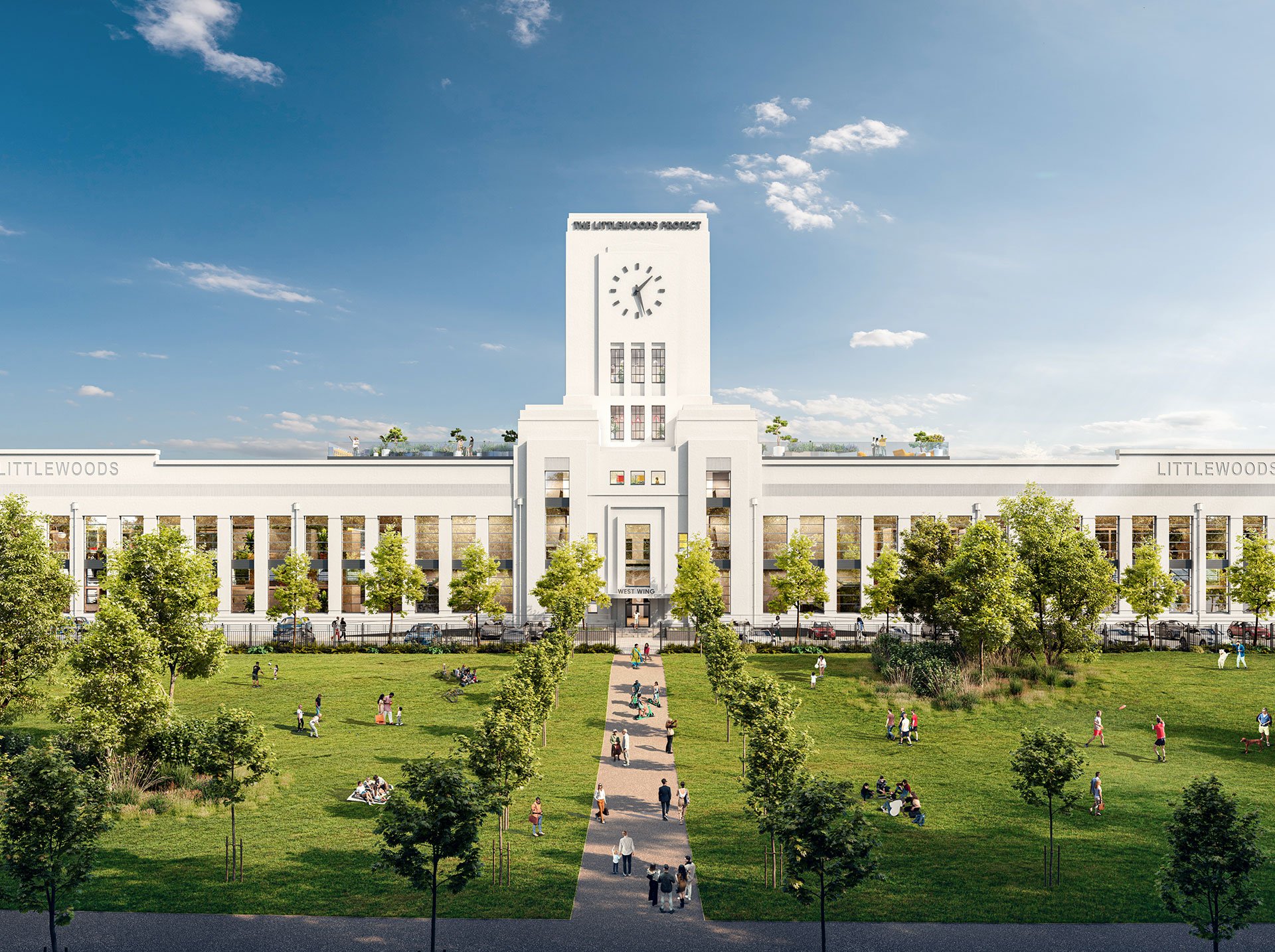
The Littlewoods Project is a proposed £70 million heritage-led regeneration scheme designed to transform the iconic 1930s former Littlewoods football pools headquarters on Edge Lane, Liverpool, into a world-class film and television campus. Positioned as the focal point of a wider strategy to cement the Liverpool City Region as a premier production hub, the development aims to provide 260,000 sq ft of high-specification creative space, including two newly constructed 20,000 sq ft sound stages, alongside substantial workspace, cultural amenities, and educational facilities.
The central analytical judgement regarding The Littlewoods Project is that the scheme is currently navigating a critical transition phase between site preparation and vertical delivery. The fundamental strategic and planning foundations are exceptionally robust: Liverpool City Council's Planning Committee formally approved the transformational plans in October 2024, essential enabling and remediation works have concluded, and the scheme benefits from a highly supportive public sector, evidenced by an existing £17 million funding commitment from the Liverpool City Region Combined Authority (LCRCA).
However, the primary execution challenge has transitioned from planning, design, and land assembly toward financial viability. In mid-2025, the development vehicle, Capital&Centric, publicly confirmed that macro-economic headwinds and construction cost inflation meant the cost of delivering the project exceeded the value of the completed development. Consequently, the project is currently reliant on securing gap funding from central government. Following targeted delegations to Downing Street, Liverpool City Council leadership reported "real ministerial interest" in May 2026, placing the development in a substantially stronger position than in previous years, though vertical construction schedules remain contingent on the formalisation of this financial package.
For the local property market, specifically within the L7 postcode district encompassing Edge Hill, Fairfield, and parts of Kensington, the long-term implications are profound. L7 currently presents a remarkably low barrier to entry, with local property evidence indicating a median completed sales price of £137,000 as of early 2026. The successful operational delivery of the Littlewoods campus is projected to support approximately 4,000 full-time equivalent (FTE) jobs in the creative sector and add significant annual gross value to the local economy. This influx of creative, technical, and educational professionals would inherently alter the demographic and economic profile of the Edge Lane corridor. It introduces new demand drivers for high-quality private rental stock, build-to-rent (BTR) apartments, and transient accommodation suitable for visiting production crews, shifting the area away from a traditional reliance on standard student houses in multiple occupation (HMOs).
Investors must approach the L7 market with an evidence-led, phased strategy. The transition of Edge Lane into a premium creative hub will be gradual and relies heavily on the physical delivery of the sound stages and the commencement of full studio operations. Capital deployment should be calibrated to track infrastructure milestones, treating immediate property price implications as anticipatory rather than guaranteed.
2. Project overview
The Littlewoods Project represents a profound piece of civic and architectural restoration for Liverpool. Constructed in 1938, the striking Art Deco structure with its prominent central clock tower was originally commissioned by Sir John Moores as the headquarters of the Littlewoods football pools empire. At its operational peak, the building hosted thousands of employees, predominantly women from the local area, processing up to 16 million pools coupons weekly, establishing the site as a primary economic engine for East Liverpool and a cornerstone of the city's twentieth-century commercial identity.
Following the structural decline of the football pools business in the wake of the National Lottery's introduction, the building was vacated in 1994. The structure suffered decades of dereliction and severe urban decay, culminating in a devastating fire in 2018 that destroyed parts of the structure, including the western wing's roof and barrel-vaulted sections.
Following its acquisition by social impact developer Capital&Centric, the site has been meticulously planned for comprehensive adaptive reuse. The strategic rationale for developing a film and television campus is firmly rooted in Liverpool's existing success as a premier international filming destination. The city is consistently the most filmed UK location outside of London, providing the architectural backdrop for major global productions including *The Batman*, *Captain America*, and *Peaky Blinders*.
Despite this locational success, the regional economy's growth in the media sector has historically been constrained by a critical lack of purpose-built, large-scale indoor sound stages. This infrastructure deficit limits productions to transient exterior location shooting rather than anchoring the full lifecycle of post-production and sustained studio work within the region. The Littlewoods Project is explicitly designed to plug this infrastructure gap. By combining heritage restoration with modern, big-budget production facilities, the project is forecast to capture international productions that would otherwise default to the South East of England or established international studio spaces.
The development is heavily sponsored by the local public sector. The Metro Mayor has positioned Littlewoods as the indispensable anchor of a regional strategy to transform the Liverpool City Region into the "Hollywood of the North". Consequently, the project is best analysed not as a standalone speculative commercial real estate asset, but as a publicly backed piece of catalytic regional infrastructure intended to anchor a high-value, future-facing industrial cluster in Merseyside.
3. Official scheme details and delivery timeline
The approved masterplan, spearheaded by architectural practice shedkm with landscaping by Planit, spans 260,000 sq ft across the existing heritage assets and adjacent brownfield land. The physical proposition is divided into distinct functional zones designed to create a cohesive ecosystem for media production, education, and public interaction.
The most defensible reading of the current physical scheme composition is detailed below, based on official planning and developer submissions.
| Component | Official Project Description |
|---|---|
| New-Build Sound Stages | Two newly constructed, 20,400 sq ft sound stages built on adjacent land to the main structure. These 17m-high structures are designed specifically to accommodate big-budget, large-scale indoor filming. |
| The East and West Wings | Restoration of the existing 1930s wings to provide extensive commercial workspace, studio support facilities, production offices, and dedicated educational spaces. |
| The Hangar | Transformation of the barrel-vaulted 1960s former canteen space into a multi-purpose screening and performance zone. This area is designed to include five small-format cinema screens, a permanent foodhall, and an outdoor performance space. |
| Public Realm & Open Space | A heavily landscaped central courtyard, a roof garden offering panoramic city views, and a "walk of fame" paying homage to screen stars. Crucially, the site will be opened to the public out of hours. |
| Heritage Restoration | Comprehensive façade restoration, window replacements, and the planned reinstatement of a working clock on the iconic central tower, following initial structural demolition and stabilisation works. |
The commercial viability of the campus relies heavily on securing specialised operators and anchor tenants capable of drawing consistent footfall and industry credibility. In terms of cultural operations, it was reported in 2024 that Broadwick Group, the prominent cultural operator behind Printworks London and Depot Mayfield in Manchester, entered advanced talks to pre-let and operate the broader film and media hub. Backed by international investment from Rockstar Games, Broadwick's potential involvement brings significant operational weight to the foodhall, cinema, and event spaces.
Integrating an educational partner is a core pillar of the scheme, ensuring a localised talent pipeline for the incoming productions. While an initial agreement with Liverpool John Moores University (LJMU) as a primary educational anchor was withdrawn in 2022, subsequent public positioning by political leadership in late 2025 indicates strong backing for the London Screen Academy model to establish a vocational training school for 16- to 18-year-olds situated directly within the working production centre.
The project's timeline has been phased to allow complex remediation and stabilisation work to occur while definitive funding structures are negotiated with central government. The current delivery sequence is documented below.
| Phase / Milestone | Status & Anticipated Date |
|---|---|
| Early Enabling Works & Stabilisation | Complete (Commenced December 2023) |
| Full Planning Permission Granted | Complete (October 2024) |
| Clock Tower Demolition/Stabilisation | Complete (2024 / Early 2025) |
| Viability Gap Funding Negotiations | Active (Reported strong progress May 2026) |
| Main Contractor Appointment | Pending (Awaiting government funding formalisation) |
| Vertical Construction (Sound Stages) | Dependent on funding; estimated 12-month build timeline once commenced |
| Target Operational Completion | Earmarked for 2027 (Highly contingent on imminent funding closure) |
4. Planning, infrastructure and transport context
The overarching planning application framework was formally recommended for approval subject to a Section 106 agreement and subsequently granted by Liverpool City Council in October 2024. The development consortium, featuring planning consultancy Avison Young, successfully navigated the complexities of integrating modern acoustic requirements with highly sensitive heritage assets.
The planning strategy utilised by Capital&Centric places a significant emphasis on "adaptive re-use." This approach is widely recognised within the construction sector as the most effective method for mitigating the environmental impact of large-scale development. By retaining the structural core of the 1930s building, the project is estimated to save over 5,000 tonnes of embodied carbon compared to an equivalent pure new-build scheme.
Edge Lane serves as the primary arterial gateway connecting the M62 motorway directly to Liverpool City Centre. The Littlewoods Building occupies a highly visible, commanding position along this route, passed by an estimated 17 million vehicles annually. Historically, the site operated as a closed, private industrial campus, physically separated from the surrounding residential neighbourhoods.
A transformative shift in the current planning context is the intentional integration of the site into the surrounding community infrastructure. Official masterplan documents detail the creation of a new, direct public link between the studio site and the adjacent Wavertree Park. Wavertree Park, which houses the historic Grade II* listed Botanic Gardens, represents a major green asset for the L7 district. Improving pedestrian permeability between the creative campus and this park will effectively merge a high-value commercial zone with established public green space, substantially enhancing the aesthetic appeal and everyday amenity value of the immediate Edge Lane neighbourhood.
The site is exceptionally well-placed for large-scale logistics, a non-negotiable requirement for the film industry which relies on the rapid movement of heavy sets, lighting rigs, and production equipment. Its direct proximity to the M62 facilitates frictionless access to the national motorway network, mitigating the need for heavy goods vehicles to navigate congested city-centre streets. While immediate local rail access is somewhat limited compared to central hubs, Edge Hill railway station is situated to the south, providing regional connections. Given the scale of the proposed workforce, significant pressure will inevitably be placed on local bus corridors and active travel routes. The integration of high-quality cycle storage and alignment with the LCRCA's broader active-travel investments will be necessary to manage daily commuter flows without overwhelming Edge Lane's vehicular capacity.
5. Local economy implications
The economic calculus underpinning The Littlewoods Project is extensive and transformative for the immediate postcode district. Official projections from the developer and the Combined Authority estimate that the completed campus will generate £200 million per year in Gross Value Added (GVA) for the local economy.
The job creation matrix operates across two distinct phases. Initially, the construction phase will provide sustained employment for regional trades, specialised heritage restoration workers, and civil engineers during a multi-year build period. Subsequently, the operational phase is projected to create up to 4,000 full-time equivalent (FTE) jobs across the creative, technical, and hospitality sectors.
Crucially, the media sector operates heavily on spatial clustering effects. The presence of world-class sound stages naturally attracts a deep, high-value supply chain of secondary businesses. These include post-production houses, visual effects (VFX) studios, lighting and rigging hire companies, set construction firms, specialised legal and accounting services, and talent agencies.
A localised proof-of-concept for this economic dynamic already exists adjacent to the site. In 2021, the city opened 'The Depot', two temporary 20,000 sq ft filming stages constructed on vacant land next to Littlewoods. Built as an agile measure to capture immediate post-pandemic production demand, The Depot alone was forecast to create a £24 million economic boost and support 360 new jobs. The Littlewoods Project scales this dynamic exponentially, providing the permanent, premium facilities required to transition Liverpool from a temporary 'location shoot' city to a comprehensive production and post-production headquarters.
For context, investors analysing spatial regeneration can look to the economic transformation of Salford Quays following the development of MediaCityUK, or the revitalisation of Cardiff Bay driven by BBC Roath Lock and Wolf Studios Wales. In both instances, the anchoring of large-scale studio infrastructure resulted in rapid, multi-decade economic compounding for the surrounding postcode districts, driving up commercial and residential land values.
6. Housing market implications
The L7 postcode, encompassing Edge Hill, Fairfield, and parts of Kensington, presents a unique baseline for property investors. Current local property evidence from completed sales indicates a median price of £137,000 as of early 2026. This figure sits considerably below the national average and remains highly accessible even relative to broader Liverpool city averages.
The delivery of a £70 million creative campus supporting thousands of highly skilled jobs will inevitably alter the localised housing market, fundamentally shifting the primary demand drivers. Historically, residential parts of L7 have been dominated by lower-to-middle-income households and dense student populations inhabiting traditional Victorian terraces formatted as Houses in Multiple Occupation (HMOs).
The introduction of media professionals, studio executives, technical staff, and creative sector educators will introduce a new demographic of young professionals with higher disposable incomes seeking accommodation close to their workplace. In the near-to-medium term, this typically exerts upward pressure on property values in the immediate micro-market (properties within a 15-minute walk or short cycle of the campus). The planned physical connection to Wavertree Park further enhances the liveability of the immediate streets, transitioning the area from a purely utilitarian arterial route into a distinct, destination neighbourhood.
However, this transition requires analytical caution. The immediate visual environment surrounding Edge Lane currently remains heavily commercial and industrial in places. Structural price appreciation relies entirely on the physical completion and successful occupation of the studios.
Furthermore, the broader Liverpool housing supply pipeline is actively responding to local needs, which will moderate unchecked price inflation. For instance, housing association Torus, in partnership with contractor Vistry, recently developed a £23 million scheme on Edge Lane providing 145 high-specification homes for Shared Ownership and Rent to Buy. The presence of substantial affordable and subsidised housing provisions nearby acts as a crucial moderator on aggressive house price inflation, ensuring the area maintains a mixed demographic rather than becoming exclusively premium.
Investors looking at single-family residential or light refurbishments in L7 should focus on quality and proximity to the new public realm links, anticipating a gradual uplift in neighbourhood desirability rather than speculative, short-term valuation spikes.
7. Rental market implications
The operational nature of the film and television industry creates highly specific rental market dynamics that differ markedly from standard corporate employment hubs. Unlike traditional sectors where employees relocate permanently and sign long-term leases, the media sector relies heavily on transient, project-based workforces.
When a major international production occupies a sound stage, it brings hundreds of crew members, directors, producers, actors, technical operators, and set designers, who typically require accommodation for the duration of a shoot, which generally ranges from three to nine months. This demographic rarely engages with traditional 12-month Assured Shorthold Tenancies (ASTs).
Consequently, the area surrounding The Littlewoods Project is highly likely to experience a structural surge in demand for alternative rental products:
- High-end, fully furnished corporate short-lets.
- Serviced apartments and apart-hotels.
- Flexible Build-to-Rent (BTR) products offering agile 3-to-6 month lease terms with inclusive amenities.
Parallel to the transient production crews, the campus will house permanent staff managing the facility, employees of the post-production and creative businesses leasing the commercial office space in the East and West wings, and staff operating the foodhall and cinema zones.
Additionally, the integration of a vocational training school based on the London Screen Academy model will drive localised demand for high-quality student and young-professional housing. As the local employment base diversifies away from traditional retail and industrial sectors toward high-value creative services, landlords upgrading older, lower-quality HMOs into modern, en-suite professional co-living spaces or self-contained flats are likely to encounter strong tenant absorption and reduced void periods.
8. Supply, demographics and demand drivers
Understanding the demographic trajectory of L7 requires an analysis of how the Littlewoods Project fits into the broader eastward expansion of Liverpool's economic gravity.
Over the past two decades, Liverpool's economic resurgence has been heavily concentrated on the waterfront, the Baltic Triangle, and the Knowledge Quarter. The Littlewoods Project effectively pulls that regeneration momentum eastward along the Edge Lane corridor. By anchoring a major creative sector outside the immediate city centre, the project redistributes demand. Young creatives who might previously have restricted their housing searches to the established, higher-priced Baltic Triangle or the Georgian Quarter may increasingly view L7 as a viable, affordable alternative with direct proximity to the new creative hub.
While the demand side of the equation appears robust, the localised supply side in L7 is constrained by existing urban density. Much of the surrounding housing stock consists of dense, older terraced streets. There is limited availability of large-scale brownfield land for immediate, massive residential development directly adjacent to the site, outside of targeted public-sector interventions.
This relative inelasticity of supply in the immediate micro-market indicates that any sustained increase in localised demand driven by the studio's operation is likely to result in steady, organic improvements to the existing housing stock. Existing properties are expected to be acquired, refurbished, and repurposed by local investors to meet the elevated expectations of the incoming creative class.
9. Investor watchpoints and risks
While the narrative surrounding The Littlewoods Project is undeniably positive and the political will is evident, the scheme is not without significant execution risks. Prudent investors must monitor the following live variables closely before committing capital based on anticipated regeneration effects.
The Viability Gap and Central Government Funding
This remains the single largest risk factor. The development is not a fully privately funded commercial venture; it is heavily reliant on public sector intervention. In mid-2025, Capital&Centric co-founder Tim Heatley stated explicitly that “the cost of delivering the project in the current climate exceeds the value of the completed development,” highlighting a clear viability challenge driven by construction inflation.
While enabling works are complete and £17 million of regional funding is committed, the vertical construction of the sound stages and the expensive retrofitting of the heritage wings require substantial gap funding from central government. May 2026 reports of a "very successful meeting" at Downing Street and "real ministerial interest" are highly encouraging indicators. However, until a legally binding funding package is announced and a main contractor is appointed for vertical works, the target timeline for completion in 2027 remains highly vulnerable to slippage.
Operator and Anchor Tenant Commitments
The success of the physical real estate relies entirely on the operational expertise of its tenants. The advanced talks with Broadwick Group to manage the cultural and event spaces represent a massive positive, given their robust track record. However, investors must monitor for formal lease signings to ensure the leisure components are fully activated. Similarly, the educational anchor has experienced turbulence, with LJMU stepping back from the project in 2022. The subsequent strategic alignment with the London Screen Academy model is conceptually strong, but formalisation of this partnership is required to guarantee the long-term student and educational footfall that underpins secondary rental demand.
Heritage Retrofit Risks
Retrofitting a 1930s Art Deco building that suffered severe fire damage and decades of weather exposure is inherently complex. The developer has correctly initiated adaptive re-use and stabilisation. However, heritage projects of this scale are notoriously prone to unforeseen structural issues and inflationary cost overruns, which could further strain the viability gap if supply chain costs escalate during the main construction phase.