
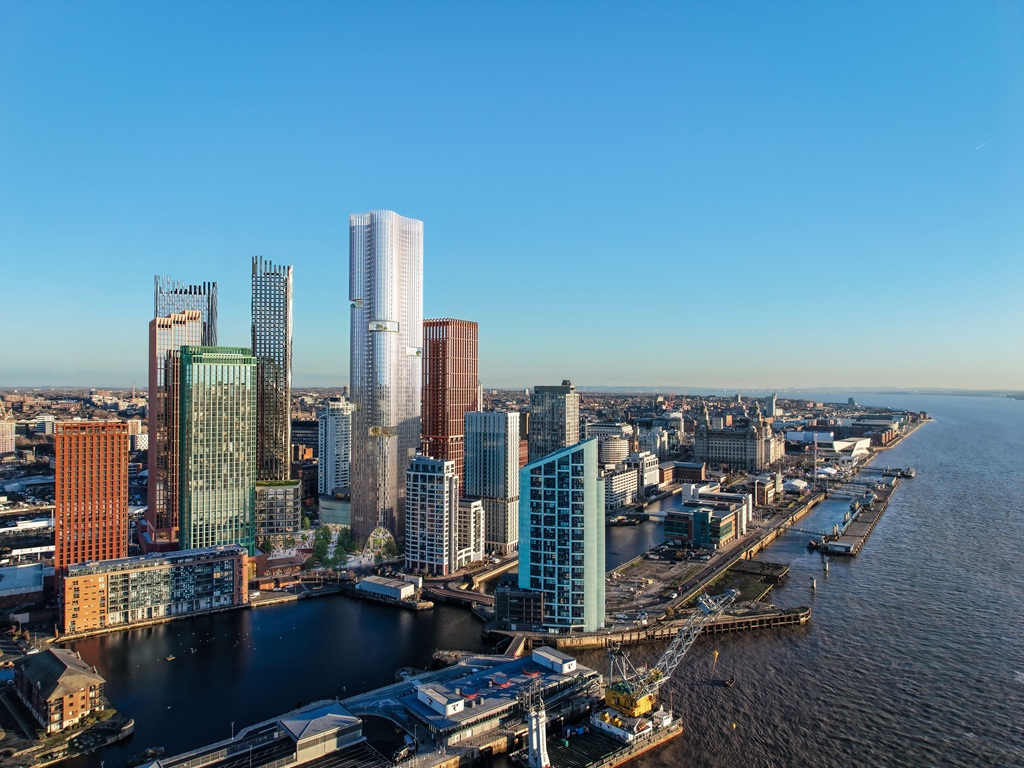
The Kings Waterfront Masterplan, formerly known as the King Edward Industrial Estate, is a major mixed-use regeneration proposal for Liverpool’s northern waterfront. Current public material describes an eight-acre district, a £1.2 billion masterplan, around 2,750 homes, commercial space, leisure uses and a 70-storey centrepiece tower. The project is being brought forward by Beetham Group and Davos Property Developments, with KEIE linked to Tom Morris of Home Bargains.
The most important change since the original report is that the wider Kings masterplan moved into public consultation in May 2026. That sits alongside the earlier February 2026 consent for No. 1 Kings, a 28-storey tower comprising 255 apartments. The later buildings, including the 70-storey tower, still depend on the hybrid/masterplan planning route and future delivery decisions.
For property readers, the project should be treated as a long-duration regeneration proposal rather than a near-term market forecast. Its confirmed relevance is the scale of planned housing supply, the shift from light-industrial land to a mixed-use waterfront district, and the planning risk attached to tall buildings in a sensitive waterfront setting. Any rent, resale or absorption effect remains qualitative until completed units, achieved rents, service charges and transaction evidence are available.
Project overview

The Kings Waterfront project occupies an eight-acre (3.2-hectare) site formerly known as the King Edward Industrial Estate, positioned strategically on Gibraltar Row, bounding Waterloo Road, Great Howard Street, and the River Mersey. Historically a low-density light industrial zone, the site's transformation represents a deliberate policy shift by municipal leaders to maximise the economic density of Liverpool's waterfront.
The site's transition was definitively unlocked in April 2024 when Liverpool City Council agreed to a £1.5 million deal to lift a restrictive historical covenant on the land, legally enabling the construction of high-rise structures. Following this legal clearance, the site was acquired from Peel Waters by KEIE Limited. This acquisition brought together two distinct strands of property expertise: Hugh Frost’s Beetham Group, which has historically redefined the skylines of Manchester, Birmingham, and Liverpool (most notably with the adjacent 40-storey West Tower), and Tom Morris’s KEIE, providing the robust private capital necessary to navigate the costly early phases of masterplanning and site clearance.
The development consortium has explicitly divided the masterplan into three functional zones to ensure mixed-use vitality and avoid the pitfalls of monolithic residential dormitories:
- The Living Zone (North): Focused on high-density residential towers, this area provides a natural, walkable extension to the existing communities of Waterloo Dock and the Pall Mall residential quarter.
- The Leisure Zone (Centre): Designed as the civic and entertainment heart of the development, this zone is programmed to house extensive retail, food and beverage operators, and the proposed 25,000 sq ft cultural and events arena.
- The Work Zone (South): Strategically located closest to the existing commercial business district and the Royal Liver Building, this zone is dedicated to delivering Grade A office space, effectively bridging the gap between the city centre and the Princes Dock office quarter.
The architectural intent across the masterplan is heavily influenced by Liverpool’s deep maritime and industrial heritage, seeking to blend historical vernacular with hyper-modern scale. The flagship 70-storey tower, designed by the acclaimed SimpsonHaugh Architects, explicitly draws its façade inspiration from Peter Ellis’s 1864 Oriel Chambers, a Grade I listed building in Liverpool widely regarded as the world’s first metal-framed, glass curtain-walled structure. The remainder of the masterplan, including the approved No. 1 Kings tower, is guided by masterplan architects Brock Carmichael, with extensive public realm and landscape design led by Planit, and planning, heritage, and economic consultancy provided by Pegasus Group.
By deliberately moving away from the "King Edward Triangle" moniker to the simplified, assertive branding of "Kings", the developers are positioning the site not merely as a regenerated industrial estate, but as an internationally recognisable destination district in its own right, intended to be visible from land, sea, and air as visitors approach the city.
Official scheme details and delivery timeline
The public-facing metrics for the Kings masterplan have been clearly articulated through the 2026 public consultation portals, developer press releases, and formal planning committee reports submitted to Liverpool City Council. While some commercial floorspace allocations have expanded during the iteration process, the figures below represent the most defensible headline capacities currently available in the public domain.
| Category | Best-supported current position |
|---|---|
| Development scale | 8 acres (3.2 hectares), encompassing 10 proposed buildings across three functional zones. |
| Total investment | Estimated at £1.0 billion to £1.2 billion. |
| Residential capacity | Approximately 2,750 homes across six primary residential buildings. |
| Flagship tower | 70 storeys (221.5m), comprising a 212-room 5-star hotel (floors 1-23) and 563 luxury branded residences (floors 24-70). Designed by SimpsonHaugh. At 924,000 sq ft, it will be the second largest building by volume in Liverpool. |
| Pathfinder building | "No. 1 Kings": 28 storeys, 255 apartments (127 one-bed, 123 two-bed, 5 three-bed), approved February 2026. Designed by Brock Carmichael with a terracotta facade. |
| Commercial space | Up to 200,000 sq ft of premium Grade A office accommodation. |
| Retail & Leisure | Up to 250,000 sq ft of retail, food and beverage, and leisure space, designed to animate the ground floors and waterfront frontages. |
| Cultural infrastructure | A planned 25,000 sq ft destination events arena and dedicated arts venue. |
| Public realm | Over 400,000 sq ft of integrated public space, including ambitious proposals to build over sections of The Strand to connect the city centre to the waterfront. |
| Parking | Up to 1.8m sq ft of covered parking structures. |
The sequencing of this masterplan is critical for investor due diligence. The developers are adopting a deliberate "pathfinder" approach. Rather than waiting for the entire 10-building masterplan to navigate the complex hybrid planning system, they carved out a single gateway plot at the junction of Waterloo Road and Galton Street to secure early detailed consent. This building, No. 1 Kings, serves to prove market viability, establish the district's premium architectural identity, and set a high benchmark for resident amenities (providing nearly 50 sq ft of shared space per apartment, including rooftop lounges).
Below is an indicative analytical delivery timeline based on published planning targets, committee approvals, and developer statements. It should be noted that while early phases are well-defined, the later delivery of the 70-storey tower remains dependent on future planning approvals and institutional funding cycles.
| Phase | Milestone | Estimated Timeframe |
|---|---|---|
| Site Assembly | Liverpool City Council lifts restrictive covenant; KEIE acquires the freehold site. | April 2024 |
| Initial Planning | Planning application for the 28-storey pathfinder tower (No. 1 Kings) is formally submitted. | July 2025 |
| Site Preparation | Demolition application (25PM/2541) submitted for light-industrial structures on the northern boundary. | September 2025 |
| Pathfinder Approval | No. 1 Kings is granted full planning consent by the city's planning committee. | February 2026 |
| Public Engagement | A comprehensive masterplan consultation is launched to shape the final proposals. | May 2026 |
| Masterplan Application | Target submission for the overarching hybrid planning application for the remaining 9 buildings. | Late 2026 |
| Vertical Construction | Target start on site for No. 1 Kings (subject to clearing Building Safety Act Gateway 2 regulations). | Target Q2 2027 |
| Flagship Delivery | Anticipated mobilisation on the 70-storey tower and subsequent wider masterplan phases. | Target 2030+ |
Planning, infrastructure and transport context
The planning context for Kings Waterfront is highly supportive but structurally complex, existing at the intersection of local municipal frameworks and regional combined-authority ambitions.
Locally, the site falls within the boundaries of Liverpool City Council’s Tall Buildings strategy, which specifically designates this northern waterfront fringe as an appropriate location for the city's highest density and vertical growth. By consolidating height in this specific cluster, the council aims to protect the heritage sightlines of the Georgian Quarter and the historic commercial core, while satisfying the intense demand for high-density urban land.
Regionally, the site is deeply integrated into the political and economic framework of the emerging North Docks Mayoral Development Corporation (MDC). Driven by Liverpool City Region Mayor Steve Rotheram and the Combined Authority, this statutory body aims to accelerate the regeneration of 174 hectares of brownfield land stretching from the commercial district to the new Everton stadium. The MDC seeks to deliver 17,500 new homes and 5 million sq ft of commercial space over 15 years. The inclusion of Kings Waterfront as a priority zone within this MDC ensures the project is aligned with regional infrastructure funding, transport upgrades, and strategic political backing.
In terms of live planning, the strategy is strictly phased:
- Standalone detailed consent: The developers successfully secured detailed consent for the 28-storey pathfinder tower (ref 25F/1887) in February 2026. Notably, this approval was granted despite objections from some heritage bodies and a lack of on-site affordable housing. The planning committee determined that the regenerative benefits, bringing a derelict brownfield site back into intense economic use, outweighed the policy conflicts. Furthermore, a financial contribution of approximately £650,000 for local off-site improvements was waived by the council to ensure the financial viability of this catalytic first phase.
- Hybrid masterplan consent: The overarching application, expected in late 2026, will seek detailed consent for core infrastructure, site layout, and specific early-phase commercial buildings, alongside outline consent for the remaining residential plots, including the 70-storey tower.
Transport integration and pedestrian permeability are focal points of the masterplan. Historically, the multi-lane arterial route of The Strand has acted as a concrete collar, severing the waterfront from the city centre. The Kings proposal includes ambitious long-term concepts to build over or cap sections of the adjacent road network to mitigate this traffic severance and improve active travel flows. However, the sheer scale of parking provision proposed, reported in cabinet documents at 1.8m sq ft of covered parking, suggests that while the development promotes active travel and public realm, the developers acknowledge the car-dependent nature of the regional commuter base and the logistical realities of servicing a 25,000 sq ft arena and a 5-star hotel.
Local economy implications
The economic implications of a £1.2 billion capital injection into a concentrated, eight-acre urban footprint are significant, spanning construction activity, future commercial floorspace, visitor-economy uses and long-term local-service demand.
Construction and Capital Investment: Based on standard industry multipliers for high-density residential and commercial builds, a £1.2 billion capital expenditure will sustain several thousand construction job-years over the next decade. The developers have explicitly cited the creation of at least 900 direct construction jobs during the initial mobilisation phases alone. Furthermore, Liverpool City Council explicitly noted in its October 2025 cabinet report that the development will "substantially increase council tax and rates revenue for the city," providing a vital long-term annuity stream for municipal services.
Long-term Employment and Commercial Density: Liverpool has historically suffered from an acute deficit of Grade A office space, which has constrained corporate relocations, limited the expansion of the professional services sector, and acted as a drag on regional gross value added (GVA). The inclusion of up to 200,000 sq ft of Grade A office space within the Kings Work Zone directly addresses this structural deficit. Using standard density metrics of approximately 100 sq ft per employee, this floorspace could comfortably accommodate 1,500 to 2,000 high-value office workers. When combined with the operational staffing requirements of the 400+ hotel rooms, the 25,000 sq ft arena, and the extensive retail units, the stabilised on-site employment capacity is analytically estimated at between 2,500 and 3,500 permanent jobs.
Tourism and Hospitality Ecosystem: The integration of a five-star hotel is linked to the city’s visitor economy and the developers’ stated cruise-market rationale. Hugh Frost noted that 135 cruise ships are scheduled to visit Liverpool during the 2026 season, with capacity expected to increase if cruise infrastructure expands. A hotel and events venue could strengthen the waterfront hospitality offer, but the eventual effect will depend on operator demand, planning approval, delivery timing and visitor-market conditions.
Housing market implications
The most defensible housing-market point is supply. The masterplan proposes about 2,750 homes across six primary residential buildings, which would be a substantial addition to the northern waterfront pipeline if delivered in full. That does not by itself prove a specific price outcome, because timing, tenure, specification, service charges and wider Liverpool supply will all affect absorption.
As a baseline, ONS local housing data recorded Liverpool’s average house price at £177,000 in early 2026, with flats and maisonettes materially below detached and semi-detached housing values. Kings is likely to sit in a different product category from much of the city’s existing flat stock because of its waterfront location, proposed amenity package and branded-residence element, but completed-sale evidence will be needed before any reliable premium can be measured.
The safer way to read the scheme is through two questions. First, how much of the masterplan moves from consent to construction, and over what period? Second, how does that new stock interact with other schemes, especially the adjacent Central Docks programme? Until those delivery paths are clearer, the report should not present price movement as a forecast.
Rental market implications
Rental impact remains qualitative at this stage. There are no completed Kings apartments, no achieved rents from the scheme, and no verified operating costs for future blocks. ONS data provides a citywide reference point, with Liverpool average private rent at £893 in March 2026, but that figure should not be treated as a direct comparator for a future waterfront tower.
The rental evidence to monitor later is practical rather than promotional: achieved rents for one- and two-bedroom units, lease-up speed, service-charge levels, restrictions on short-term letting, management costs, and whether build-to-rent or branded-residence operators are confirmed. Higher specification and waterfront amenity may support stronger asking rents than ordinary city stock, but higher acquisition and running costs can offset that advantage.
Short-term, corporate and visitor-led demand should also be treated cautiously. The five-star hotel, events venue, cruise terminal and Everton stadium may broaden the visitor economy around the waterfront, but local licensing, planning control and national regulation can materially affect whether individual homes can be used for short-term accommodation.
Supply, demographics and demand drivers
The approved dwelling schedule for the pathfinder building, No. 1 Kings, gives the clearest early signal of product mix. Of the 255 apartments approved in February 2026, 127 are one-bedroom, 123 are two-bedroom, and 5 are three-bedroom. That mix points more toward singles, couples, corporate renters and downsizers than family housing.
If the wider masterplan is delivered, the additional resident population would be material for an eight-acre waterfront site. That creates opportunities for ground-floor leisure, retail and services, but it also increases the importance of healthcare capacity, active-travel routes, public transport frequency, school access for any family households, and day-to-day estate management.
The project should therefore be read alongside the wider North Docks and Central Docks pipeline, not as a standalone island. Delivery coordination will matter: public realm, transport, utilities and civic services need to keep pace with residential occupation if the district is to feel connected rather than isolated.
Market watchpoints and risks
1. Phasing and funding risk: No. 1 Kings has consent, but the wider 10-building masterplan still needs the hybrid planning process and later delivery commitments. The 70-storey tower is a complex and capital-intensive element, so timing may move with funding conditions, operator demand and construction-cost pressure.
2. Building safety and construction complexity: Residential towers over 18 metres are subject to the Building Safety Regulator Gateway 2 process. A 70-storey building on a waterfront site also introduces wind, fire-safety, logistics and foundation complexity. These factors can affect programme and cost even when planning support exists.
3. Planning and heritage sensitivity: The pathfinder tower has been approved, but the wider tall-building cluster will still face detailed scrutiny around height, massing, views, microclimate, heritage setting, lighting and public realm. Outline or hybrid consent would reduce some uncertainty, but it would not remove every reserved-matters or technical risk.
4. Competing city-centre supply: Kings is being promoted alongside other northern waterfront and city-centre pipelines, including Liverpool Waters Central Docks. Readers should monitor how many similar one- and two-bedroom apartments reach the market at the same time, rather than assuming demand will absorb every phase evenly.
Scenario outlook and delivery path
The table below is a delivery-sensitivity framework, not a price or rent forecast. It is designed to show what readers should monitor as the scheme moves from consultation and early consent toward construction.
| Scenario | What would need to happen | Reader implication |
|---|---|---|
| Slower delivery | Funding, planning conditions, Gateway 2 review or construction costs delay later towers. | The page should be monitored for phase-by-phase progress rather than assuming the full masterplan arrives on one timetable. |
| Steady phased delivery | No. 1 Kings progresses, the hybrid application is determined, and later plots come forward in sequence. | The scheme becomes a meaningful addition to Liverpool’s waterfront supply, with market impact best judged from completed unit evidence. |
| Faster delivery | Operator partnerships, funding and technical approvals align across several plots. | Local infrastructure, estate management and absorption evidence become the key checks as more homes arrive in a shorter period. |
The physical delivery logic remains sequential: land assembly, site clearance, pathfinder construction, masterplan infrastructure, and then later vertical phases. Each stage should add evidence to the report rather than replacing the existing timeline history.