

The Kings Waterfront District has emerged as the most ambitious, transformative, and capital-intensive residential-led regeneration project in Liverpool’s modern history. Promoted by a joint venture between Beetham Group and Davos Property (the development vehicle of TJ Morris), this £1.2bn masterplan targets an eight-acre brownfield site currently occupied by the King Edward Industrial Estate. The strategic positioning of the scheme is highly robust: it effectively bridges the long-standing physical and economic gap between Liverpool’s central commercial business district and the sprawling, historically underutilised northern docklands. By doing so, it acts as a high-density southern anchor to the city's emerging North Docks Mayoral Development Corporation (MDC) zone.
My central analytical judgement is that the Kings development has decisively moved from a speculative vision to an active delivery pipeline with genuine momentum. In February 2026, the developer secured planning consent for a 28-storey "pathfinder" tower named No. 1 Kings, establishing the commercial and architectural benchmark for the site. Following this, in May 2026, a comprehensive public consultation opened for the wider masterplan. This broader vision is publicly described as a 10-building mixed-use district designed to deliver up to 2,750 homes, approximately 400 hotel rooms, up to 200,000 sq ft of Grade A office space, and 250,000 sq ft of retail, leisure, and events facilities. The centrepiece of the development is an unprecedented 70-storey, 221.5m skyscraper designed by SimpsonHaugh, which would comfortably surpass the nearby West Tower to become Liverpool's tallest building.
Despite the evident planning progress, the primary execution risk for a scheme of this magnitude lies in its extended delivery horizon and its absolute reliance on securing institutional partnerships. The developer has stated an optimistic full build-out target of 2035, with construction on the first tower slated to begin in the first half of 2027 following immediate demolition works. The joint venture is actively seeking Build-to-Rent (BTR) forward-funding partners, a branded residences partner, and a global hotel operator. This institutional reliance indicates that while the initial enabling phases have momentum, the later, larger phases, most notably the 70-storey landmark, will be highly sensitive to macroeconomic conditions, construction cost inflation, and the flow of international capital into UK regional cities over the next decade.
For the regional housing market, the introduction of 2,750 homes into the L3 postcode will manifest as a dual, seemingly contradictory effect. Within the immediate waterfront micro-market, the delivery of ultra-premium amenities, branded luxury residences, and a five-star hotel should establish a new pricing ceiling, commanding a significant premium over older, existing stock. At the city scale, however, this represents a massive supply injection. Against a local baseline where the L3 district median price currently sits at £167,000, the broader systemic effect of this supply should be to moderate general price and rent pressure across the wider city centre, absorbing high-end demand that would otherwise inflate the values of existing, secondary stock.
2. Project overview
The Kings development is explicitly positioned by its backers as the largest single regeneration project in Liverpool since the delivery of the catalytic Liverpool ONE retail district in 2008. The masterplan seeks to comprehensively reimagine an eight-acre industrial site situated on the edge of the city centre, replacing low-density industrial shedding with a high-density, mixed-use urban neighbourhood.
The project team assembled for this endeavour comprises highly credentialed firms with extensive experience in delivering complex urban environments: Brock Carmichael acts as the masterplan architect, Pegasus Group leads on planning, economics, and environmental impact assessments, Planit is tasked with the public realm and landscape design, and SimpsonHaugh serves as the lead architect for the signature 70-storey tower.
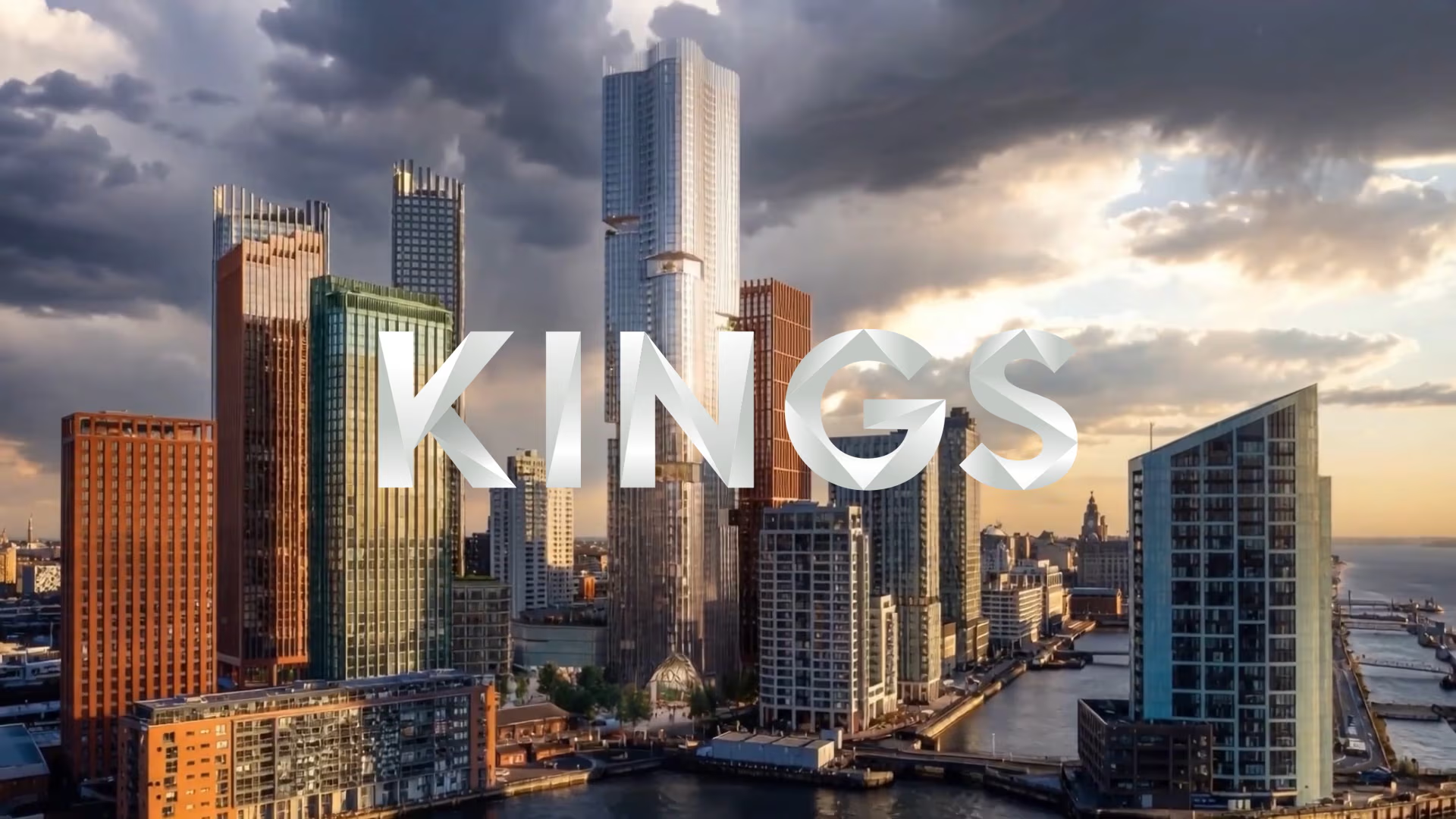
Official CGI animation thumbnail indicating the proposed scale of the Kings Waterfront District skyline.
The spatial strategy of the development is structurally divided into three functional zones, carefully designed to seamlessly integrate with and enhance the surrounding civic infrastructure:
- The Northern Zone: This area is primarily residential in focus. It is designed to link visually and physically with the existing residential communities of Waterloo Dock and the emerging developments around Pall Mall. This zone acts as the transitional threshold between the dense city core and the sprawling northern docklands.
- The Central Zone: Focused intensely on leisure, hospitality, and culture, this sector is positioned as the civic heart of the development. It will feature a new 25,000 sq ft arts and events arena, supported by an array of cafes, bars, and restaurants clustered around a major new central plaza and an enclosed winter garden.
- The Southern Zone: Anchored by commercial and employment uses, this area will feature up to 200,000 sq ft of Grade A office space. Its location is highly strategic, acting as a physical and economic bridge connecting the established Princes Dock office quarter with Liverpool's traditional commercial business district.
The headline public offer is substantial. Based on the official consultation materials and planning disclosures released in Spring 2026, the parameters of the scheme are the most defensible public headline capacities at present:
| Category | Masterplan Specification |
|---|---|
| Site Scale | 8 acres (formerly King Edward Industrial Estate) |
| Total Buildings | 10 high-rise structures |
| Total Residential Output | Approximately 2,750 apartments |
| Tallest Building | 70 storeys (221.5m / 727ft) - Mixed-use hotel and residential |
| Hospitality Provision | ~400 hotel rooms across two hotels (including a 212-room 5-star hotel) |
| Commercial Workspace | 150,000 to 200,000 sq ft of Grade A office space |
| Retail & Leisure Space | 160,000 to 250,000 sq ft, plus a 25,000 sq ft events arena |
| Public Realm Features | Central plaza, winter garden, extensive pedestrian linkages |
The architectural vernacular of the district explicitly draws upon Liverpool's rich maritime and industrial heritage, rather than imposing a generic international style. For example, the flagship 70-storey tower's façade expression is publicly stated by architect Ian Simpson to reference Peter Ellis’s ground-breaking 1864 Oriel Chambers, widely acknowledged as one of the world’s first metal-framed, glazed curtain-walled buildings. This heritage-led design approach is not merely an aesthetic choice; it is a strategic necessity to navigate Liverpool's rigorous planning environment, ensuring the contemporary glass-and-steel forms remain contextually rooted in the city's unique civic identity and address historic sightline concerns from the Wirral shore.
3. Official scheme details and delivery timeline
The delivery strategy for the Kings district is highly phased, designed to build market confidence, establish the brand identity, and generate early revenue before embarking on the most complex engineering challenges.
Phase 1: "No. 1 Kings" (The Pathfinder Tower)
The initial element of the scheme to successfully secure full planning approval is a 28-storey terracotta-clad residential tower located at the junction of Waterloo Road and the now stopped-up Galton Street, occupying the site of the former Bacchus Taverna. Planning application reference 25F/1887 was approved by the Liverpool City Council planning committee on 17 February 2026.
This £65m building serves as a "pathfinder," setting the benchmark for the density, quality, and operational model of the wider development. It comprises 255 apartments, with a unit mix heavily weighted toward smaller, high-yield formats: 127 one-bedroom, 123 two-bedroom, and a marginal 5 three-bedroom homes. The developer has placed an unprecedented emphasis on the residential experience, targeting nearly 50 sq ft of shared amenity space per apartment, a figure the planning consultants claim is almost double the current top provision in the city.
The amenity schedule is extensive, including a first-floor residents' lounge, a commercial-grade gym, and dedicated co-working workspace. The top floor is devoted to two indoor lounges and a large outdoor social space offering 360-degree panoramic views of the River Mersey, the city skyline, and the Welsh mountains. Crucially, car parking is provided at a highly restrictive 15% provision, indicating a strong reliance on active travel, public transport, and a demographic shift away from private vehicle ownership in the urban core.
Phase 2+: The 70-Storey Centrepiece and Wider Masterplan
The absolute focal point of the subsequent development phases is the 70-storey SimpsonHaugh-designed tower. If delivered to its proposed scale, this 924,000 sq ft structure would become the second-largest building by internal floor space in Liverpool (behind only the historic Tobacco Warehouse).
The current structural configuration allocates the lower 23 floors to a 212-room five-star hotel, with 563 luxury branded residences occupying the upper levels. Facilities for guests and residents will include high-end bars, destination restaurants, gymnasiums, expansive banqueting and meeting facilities, and a spectacular rooftop terrace. The integration of a five-star hotel is a calculated move to capture premium corporate travel, high-net-worth tourism, and to provide world-class, on-site facility management for the branded residences above.
The physical delivery sequence is highly dependent on institutional procurement and smooth progression through the planning system, but the developer’s publicly stated goals outline the following indicative path:
| Milestone | Target Date / Current Status |
|---|---|
| No. 1 Kings Planning Consent | Achieved (February 2026) |
| Masterplan Public Consultation | Achieved (May 2026) |
| Demolition Works Commence | Spring/Summer 2026 |
| Hybrid Planning Application Submission | Late Summer / Autumn 2026 |
| No. 1 Kings Construction Starts | First Half 2027 |
| No. 1 Kings Completion | Mid-2029 |
| Subsequent Phases (incl. 70-storey tower) | Post-2028 / 2029 |
| Optimistic Full Build-Out | 2035 |
Analytical Note: Dates post-2026 are developer estimates and remain highly subject to planning approvals, the successful onboarding of institutional funding partners, and prevailing macroeconomic conditions in the construction sector.
4. Planning, infrastructure and transport context
The Planning Strategy
The developers are pursuing a highly sophisticated and layered planning route. Having secured full, detailed consent for No. 1 Kings to guarantee a near-term start on site, they are moving forward with a hybrid planning application for the remainder of the eight-acre site. This application is expected to be submitted to Liverpool City Council in late 2026.
A hybrid application is a strategic mechanism: it will seek detailed consent for the site layout, the subterranean infrastructure, and the core public realm, alongside outline consent for the massing, height, and scale of the remaining nine building plots. This approach mathematically de-risks the overarching density and infrastructure framework while retaining crucial flexibility. It allows the developers to adjust the final internal layouts, exact use classes, and tenures of individual buildings to meet the specific, evolving demands of future institutional funding partners over the next decade.
It is important to acknowledge that the approval of the initial No. 1 Kings tower was not without debate. While planning officers ultimately recommended approval, statutory consultees raised significant issues regarding daylight provision, lighting impacts, and the adequacy of green space. Notably, the first tower was approved without a mandate for on-site affordable housing, though a commuted sum of £454,000 for off-site open space provision was negotiated. Investors should anticipate that subsequent phases, particularly the 70-storey tower, will face intense, prolonged scrutiny regarding wind microclimate, heritage setting impacts, and far more substantial Section 106 infrastructure contributions.
The Mayoral Development Corporation (MDC)
The Kings project cannot be accurately analysed in isolation; its true value proposition lies in its position within the boundary of an unprecedented Mayoral Development Corporation for Liverpool's North Docks. Supported heavily by the Liverpool City Region Combined Authority and national agencies like Homes England, this emerging MDC seeks to consolidate and transform 174 hectares of brownfield land.
The MDC’s stated ambition is to deliver up to 17,700 new homes and 5 million sq ft of commercial space over the next two decades. The Kings district acts as the vital, physical linkage point between this vast northern regeneration zone (which includes the £55m government-backed Central Docks scheme and Everton's new waterfront stadium) and Liverpool's established commercial core. By anchoring the southern tip of the MDC, Kings benefits from massive, state-backed infrastructure upgrades occurring immediately to its north, ensuring it is at the centre of the city's primary growth corridor rather than an isolated outpost.
Transport and Civic Infrastructure
The transport strategy for the Kings district hinges on a paradigm shift toward low car dependence and exceptionally high pedestrian connectivity. The scheme's location on the waterfront provides immediate, flat, pedestrian access to the Pier Head, the commercial business district, and the Princes Dock.
Furthermore, the developers have explicitly linked the economic viability of the five-star hotel and premium retail to Liverpool's rapidly expanding cruise tourism infrastructure. With 135 international cruise ships scheduled to visit in the 2026 season alone, and a new cruise terminal planned to accommodate two massive vessels simultaneously, the footfall matrix for the waterfront is shifting dramatically. The masterplan's public realm, specifically the enclosed winter garden and the central plaza, is deliberately designed to capture this transient, high-spending tourist demographic while concurrently serving the everyday needs of the permanent residential population.
5. Local economy implications
The economic footprint of a £1.2bn urban development is profoundly systemic, impacting both the immediate construction sector and the long-term Gross Value Added (GVA) of the regional economy.
The Construction Phase
The sequential construction of 10 high-rise towers, complex subterranean infrastructure, and highly engineered public realm over a projected 9-to-10-year period will generate a sustained employment boom. While official, granular economic impact assessments for the forthcoming hybrid application have not yet been published, robust benchmark data for schemes of this magnitude suggests it is highly likely to support thousands of construction job-years.
The demolition applications (ref: 25PM/2541) already submitted for structures on Roberts Street, Greenock Street, and Waterloo Road indicate that site preparation works are imminent. This early-stage activity will begin injecting substantial capital into the local supply chain, supporting demolition contractors, waste management logistics, and initial groundworks engineering well before vertical construction becomes visible.
The Operational Phase
The stabilised operational economy of the Kings district will be driven primarily by its commercial and hospitality components, rather than its residential footprint. The provision of up to 200,000 sq ft of Grade A office space introduces vital, modern stock to a city centre that has historically suffered from an acute undersupply of prime, ESG-compliant workspace capable of attracting global corporate occupiers. Based on standard employment density metrics (typically 10-12 sq m per employee for modern, agile workspaces), this office component alone could support roughly 1,500 to 1,800 direct, high-value jobs.
When integrating the 400 hotel rooms (which require intensive staffing ratios, particularly in the five-star luxury category), the 160,000 to 250,000 sq ft of retail and food/beverage operations, and the 25,000 sq ft events arena, the completed district is positioned to support an estimated 2,500 to 3,500 permanent on-site jobs. This dense concentration of employment diversifies the waterfront economy away from purely residential uses, creating a self-sustaining micro-economy that generates constant daytime footfall to support local retail and hospitality, insulating the district from the "dormitory suburb" effect that plagues some mono-use residential developments.
6. Housing market implications
To accurately forecast the impact of the Kings development on property values, the proposed premium stock must be rigorously contextualised against local evidence and baseline data. Official transaction data for the L3 postcode district from February 2026 shows a relatively accessible market, with a median price of £167,000 based on a modest sales volume of 11 transactions.
The introduction of 2,750 high-specification, amenity-rich apartments, culminating in luxury branded residences in a 70-storey skyscraper, will fundamentally alter the pricing architecture and market perception of the L3 district.
The Micro-Market Premium
Properties located within the Kings development itself, particularly those situated on upper floors with uninterrupted river views or situated within the flagship hotel-integrated tower, are highly likely to command a significant "waterfront premium" over the current L3 median. The inclusion of 50 sq ft of amenity space per apartment, 24/7 concierge services, co-working spaces, and integration with a global five-star hotel brand aligns these specific properties with prime global real estate standards rather than the standard regional build-to-sell market. Investors should anticipate that per-square-foot valuations achieved inside this scheme will be among the highest ever recorded in Liverpool, effectively setting a new ceiling for luxury city-centre living.
Macro-Market Stabilisation
However, when analysing the broader Liverpool market beyond the boundaries of the eight-acre site, the effect is inverted. Delivering 2,750 homes represents a massive, systemic expansion of local housing supply. By successfully absorbing thousands of high-earning tenants, corporate relocations, and affluent owner-occupiers, the Kings development will likely alleviate demand pressure on existing, secondary stock across the city centre.
Investors holding older, low-amenity apartments in adjacent postcodes (such as standard stock in L1 or L2) may find it increasingly difficult to command premium prices or secure top-tier tenants once this vast volume of modern, highly-amenitised stock comes online. The analytical conclusion is that Kings will stretch the top end of the market upward to unprecedented levels, while simultaneously anchoring the middle of the market through the sheer volume of supply it introduces, preventing runaway inflation in the broader regional market.
7. Rental market implications
The rental market dynamics of the Kings district will be heavily dictated by the developer's procurement and funding strategy. Official statements confirm the joint venture is actively seeking Build-to-Rent (BTR) forward-funding partners to underwrite large portions of the residential delivery. This strongly suggests that a significant proportion, if not the majority, of the standard residential towers will be retained under single institutional ownership and operated explicitly for the private rental market, rather than sold piecemeal to individual buy-to-let investors.
The institutional BTR model relies fundamentally on community creation, high tenant retention rates, and premium service delivery to maintain yields. The planned amenities in the pathfinder No. 1 Kings tower, commercial-grade gyms, integrated workspaces, outdoor terraces, and communal lounges, are textbook BTR features designed specifically to justify premium monthly rents over standard buy-to-let stock.
If successfully delivered at scale, this concentration of institutional BTR stock will irreversibly elevate tenant expectations in Liverpool. Private, individual buy-to-let landlords operating in the L3 and adjacent districts will face intense competition. To remain competitive and avoid extended void periods, private landlords will likely need to commit to significant capital expenditure (capex) to upgrade their properties, or alternatively, moderate their rental expectations when competing against the professionally managed, lifestyle-oriented product offered at Kings.
8. Supply, demographics and demand drivers
The sheer scale of residential supply introduced by the Kings masterplan will trigger a measurable demographic shift in the waterfront area, establishing a new civic centre of gravity.
Assuming a standard urban average occupancy of 1.6 to 1.8 persons per apartment (which is typical for high-density, one- and two-bedroom weighted city centre developments), the 2,750 homes could eventually house between 4,400 and 4,950 new residents. This is functionally equivalent to injecting the population of a small market town into an eight-acre site.
The demographic profile of this incoming population is highly predictable based on the specific unit mix of the pathfinder tower (which is nearly 98% one- and two-bedroom units). The district will overwhelmingly attract:
- Young Professionals: Drawn to the proximity of the commercial district and the "live-work-play" environment.
- International Students and Post-Graduates: Seeking premium, secure, and highly amenitised accommodation close to the city's academic hubs.
- High-Net-Worth Individuals (HNWIs) and Downsizers: Specifically targeted by the branded luxury residences in the 70-storey tower, offering turnkey luxury and panoramic views.
- Corporate Tenants: Executives and contractors associated with the expanded cruise terminal, the events arena, and the influx of businesses into the new Grade A office space.
The demand drivers underpinning this demographic influx are highly robust. The integration of employment, retail, and residential elements means residents will not have to leave the district for their daily needs, creating a highly desirable '15-minute city' ecosystem. Furthermore, the broader North Docks regeneration, specifically the gravitational pull of Everton's new stadium and the planned Central Docks park, ensures that the northern waterfront is rapidly transitioning from a peripheral, neglected industrial zone into Liverpool's primary, most prestigious growth corridor.
9. Investor watchpoints and risks
While the narrative surrounding the Kings masterplan is overwhelmingly positive and backed by serious capital, prudent investor due diligence requires a sober assessment of structural, cyclical, and delivery risks.
Phase and Market Cycle Risk
The most acute risk to the project is its extended timeline. The developer aims to complete the site by 2035. Property markets are inherently cyclical, and a nine-year delivery window virtually guarantees that the project will have to navigate at least one major economic downturn, period of tightened credit, or severe fluctuation in construction costs. If the institutional BTR or hotel investment markets soften globally, vertical construction on the later, larger towers could stall. This could result in early phases being surrounded by undeveloped plots for extended periods, delaying the realisation of the full "neighbourhood premium" that investors in Phase 1 are relying upon.
Planning and Heritage Scrutiny
While the 28-storey No. 1 Kings has successfully navigated the planning system, the 70-storey tower relies entirely on the forthcoming hybrid application. A building of 221.5m is utterly unprecedented in Liverpool. The city has historically had a highly complex, often adversarial relationship with tall buildings, particularly concerning sightlines, heritage impacts on the Pier Head (which recently lost its UNESCO World Heritage status, altering the planning context but not eliminating heritage concerns), and wind microclimates. Investors should treat the 70-storey scale as a developer's "ambition" that may face significant downward height pressure from statutory bodies and heritage groups before final, unchallengeable consent is granted.
Viability and Construction Cost Inflation
High-rise construction is inherently complex and heavily capital-intensive. The recent period of high material inflation and elevated interest rates has severely strained viability models across the UK construction sector. The fact that the developer successfully negotiated a waiver of affordable housing contributions on the first tower indicates that profit margins may currently be exceptionally tight. If build costs escalate further, developers may be forced to engage in severe value-engineering, which could negatively impact the final quality of the public realm, internal finishes, or the delivery of non-revenue-generating civic amenities.
Infrastructure Sequencing and Capacity
A population influx of 4,500+ residents, combined with thousands of daily office workers, cruise tourists, and event-goers, will place immense, unprecedented strain on the local transport network. The success of the "15% car parking" strategy depends entirely on the concurrent, punctual delivery of high-quality active travel routes and reliable public transport integration by municipal authorities. If these civic infrastructure upgrades lag behind residential occupation, the resulting traffic congestion and logistical failures could severely damage the district's premium, seamless appeal, leading to tenant dissatisfaction and downward pressure on rents.
Analytical Scenario Model
The following table provides an evidence-led scenario model for the completion of the 2,750 homes by 2035, demonstrating how varying macroeconomic conditions and delivery hurdles might alter the project's ultimate impact on the local property market. *(Note: This is an analytical framework designed to test assumptions, not an explicit forecast of guaranteed outcomes).*
| Scenario | Anticipated Build-Out Rate (by 2035) | Likely Tenant Demographic Profile | Housing Supply Impact (Citywide) | Local Waterfront Price/Rent Premium |
|---|---|---|---|---|
| Cautious | 1,000 - 1,500 units (later phases delayed by market cycle) | Domestic professionals, post-graduates | Negligible; absorbed quickly by baseline demand | Moderate premium over L3 baseline |
| Central | 1,800 - 2,200 units (steady institutional BTR funding secured) | Blended professional, corporate, BTR | Noticeable moderation of pricing on secondary city-centre stock | Strong, established premium setting new local benchmarks |
| Optimistic | 2,750 units (Full delivery incl. 70-storey tower) | High proportion of HNWIs, international corporate, premium tourism | Significant easing of mid-market pressure due to mass luxury supply | Exceptional premium (setting absolute new city ceilings) |